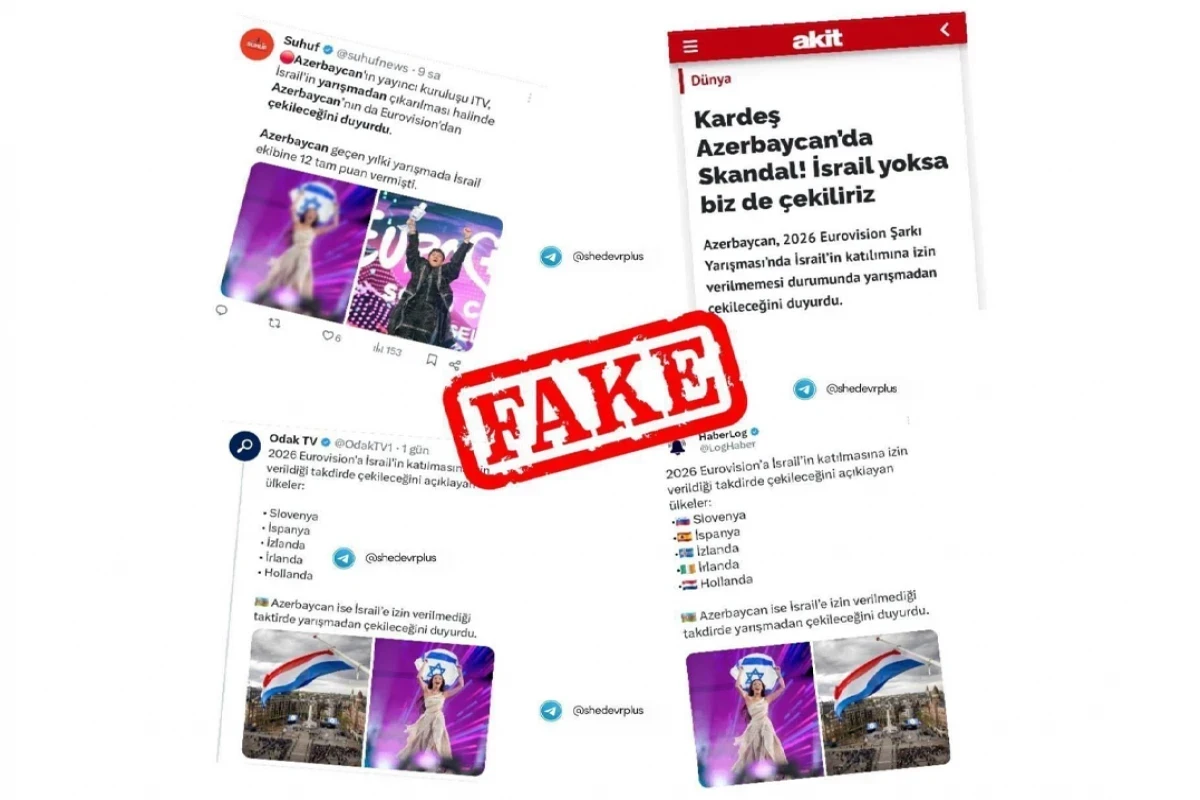


In recent months, the number of false and distorted reports about Azerbaijan in the Turkish media has been increasing. It is now very difficult to believe that this is accidental or the personal initiative of any particular media outlet. Whereas in the past we considered it to be the provocation of a specific media organization or certain forces, today we believe that this activity is being carried out in a deliberate and targeted manner.
Because despite constant refutations and statements from the Azerbaijani side, the circulation of fake news continues.
Official statements of Azerbaijan

Since the beginning of this year, at various times, false news about Azerbaijan has started appearing in the Turkish media. At the beginning of this month, however, the “fake news campaign” intensified further. In some Turkish media outlets and social media accounts, fabricated news was circulated under the headline, “If Israel is not at Eurovision 2026, then neither are we,” allegedly on behalf of the Azerbaijani state. Initially, this information was published on little-known Turkish websites with low readership. The APA news agency reacted to the report, stating that the information was fake.
However, our colleagues in Türkiye did not stop there. This false news spread to more widely read websites, and later even entered television discussions. The Media Agency of Azerbaijan issued a statement, declaring that the report was fake.

Our Turkish colleagues, however, continued. This time, at the press conference of the Junior Eurovision Song Contest, in response to a question from Azerbaijani media, the Organizing Committee once again stated that there had been no such discussion and no such decision. This is fake news!
Despite this clarification, Türkiye's Hürriyet and Sabah newspapers once again repeated the same falsehood. In an interview with APA, the Deputy Director of the Azerbaijan Media Agency, Natig Mammadli, stated that such information contradicts our bilateral relations and the concept of a joint media platform: “The Azerbaijani side has repeatedly stated that this news is fake.”
It is well known both in Türkiye, in Azerbaijan, and perhaps even globally that the Sabah and Hürriyet newspapers, as well as the TV channels discussing this fake news, are currently close to the Turkish government.
UN images and disinformation

What is surprising is that once again, regarding an issue that never actually took place — an event witnessed by the entire world at the UN — the matter was distorted in the Turkish media. In certain Turkish media outlets and social media segments, fake photos and reports were circulated, claiming that Azerbaijan’s official delegation was among those listening to Israeli Prime Minister Netanyahu during his speech, which was boycotted by several countries at the UN General Assembly.
In reality, the UN debates are broadcast live, and anyone can watch them on the UN’s official website. The entire world’s media participated in the UN session, not only Turkish media. Azerbaijan was represented there with a large media team. Leading Azerbaijani news agencies and television channels covered the President’s visit from New York.
How is it possible that at such an open event, in front of everyone’s eyes, such fake news could be fabricated and spread? Everyone could see that Azerbaijan’s delegation was not present in the hall during Netanyahu’s speech. What advantage can the Turkish media gain by photoshopping these images and spreading false reports?
Why are Turkish officials silent?
In Türkiye, a new body has been established under the Presidential Administration to combat disinformation. In addition, the Directorate General of Press and Information (Basın-Yayın ve Enformasyon Genel Müdürlüğü) is already operating. The existence of these institutions shows that the Turkish government treats the issue of fake news with sensitivity. But how is it that, while these bodies immediately issue statements inside Türkiye about any ordinary fake news or fabricated photo, they remain silent when it comes to false information about Azerbaijan? Moreover, they even ignore the statements released by Azerbaijan’s official institutions and reliable media on these matters.
Incidentally, APA has sent an inquiry to these Turkish institutions regarding the recent wave of fake news and the reasons for their lack of response. So far, no reply has been received.
Is there still a need for a joint media platform?

Azerbaijan and Türkiye established a joint media platform for information exchange, closer cooperation between the media outlets of both countries, and joint efforts to combat fake news. The main purpose of this platform is to enable the two countries’ media to share information without relying on third-country outlets, thereby preventing the spread of false reports and information sabotage. But if fake news continues to be spread directly by the Turkish media itself, and if the statements released by Azerbaijani media are disregarded, then there is no longer any point in talking about the significance of such a joint media platform.
From Iranian and Russian media to Turkish media
The question arises: why is the Turkish media seeking to lose its credibility in Azerbaijan? Every media outlet covering the UN event recorded that Azerbaijan’s delegation was not in the hall when Netanyahu spoke. As well as fake news about Eurovision.

In this case, the false reports spread by the Turkish media about Azerbaijan erode public trust in them. They risk acquiring the same status as unreliable sources like the Russian and Iranian media. Today, what is written in Russian and Iranian outlets holds no significance for us; they are hardly ever cited. Thus, the Turkish media is also losing its credibility, and the Azerbaijani public no longer has confidence in it. The question is: why does the Turkish media need this?
Respecting red lines
What the Azerbaijani media knows and what it uncovers during its investigations often creates a real sensation. Today, the Azerbaijani media itself serves as an independent source of reference for foreign outlets.
This media is capable of writing and investigating issues such as Israel–Türkiye maritime transport and interests in the Mediterranean, their economic cooperation interests, and, in some cases, their informal dialogues on regional matters. This is not difficult at all. Just as we have managed to bring forward investigations that were discussed in the Kremlin, the Élysée, and Tehran regarding Russia, Iran, and France, we can also make our voice heard in Ankara.
However, Azerbaijan has always managed to respect red lines in both state and media policy. The recommendation is that Türkiye should also approach this matter with sensitivity. Otherwise, with groundless and fabricated news, Turkish media may completely lose its standing in Azerbaijan.



 Follow us on Telegram
 t.me/apanewsaz
 Follow us on Instagram
 Follow us on TikTok
 Follow us on Facebook
 Follow us on X