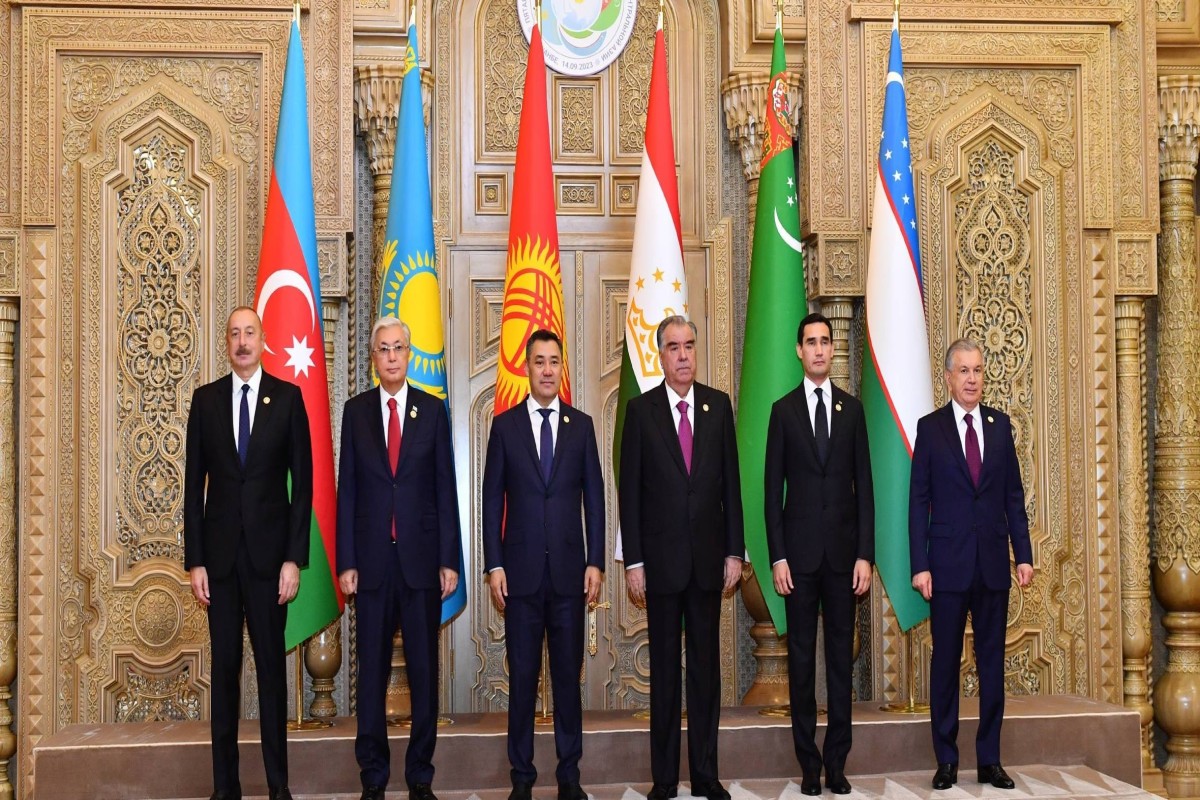


The visit program of President of the Republic of Azerbaijan Ilham Aliyev to Turkmenistan also includes participation in the 8th Consultative Meeting of the Heads of State of Central Asia and the Republic of Azerbaijan.
The Consultative Meeting of the Heads of State of Central Asia and the Republic of Azerbaijan plays an important role in the development of Azerbaijan's political dialogue and regional cooperation with Central Asian countries.
The Consultative Meeting of the Heads of State of Central Asia was held for the first time in Astana, Kazakhstan, in 2018. So far, seven official and one informal meetings have been held.
President Ilham Aliyev participated in and delivered speeches at the 5th and 6th Consultative Meetings, held in 2023 and 2024, respectively, as a guest of honor.
At the 7th Consultative Meeting, held in Tashkent, Uzbekistan, on November 16, 2025, a decision was adopted on the full-fledged participation of the Republic of Azerbaijan in the Consultative Meeting of the Heads of State of Central Asia.
This decision once again demonstrated Azerbaijan's strategic importance for the region and its close relations with Central Asian countries.
As a result of Azerbaijan's active involvement in the process, the cooperation format previously known as C5 has effectively been upgraded to C6, giving regional dialogue and strategic partnership new substance and scope.
At the consultative meetings, the heads of state discuss issues such as the development of political relations, expansion of cooperation in the Caspian Sea basin, strengthening of transport and logistics connections, increasing trade turnover and implementing energy projects, digital transformation, green energy, combating climate change, agriculture, efficient management of water resources and humanitarian cooperation.
Bilateral meetings are also held between the heads of state. During these meetings, agreements are reached on new treaties, memorandums and joint projects.
On July 31, 2026, during his state visit to Kyrgyzstan, President Ilham Aliyev participated in the informal Consultative Meeting of the Heads of State of Central Asia and the Republic of Azerbaijan, held in Cholpon-Ata.
At the conclusion of the meeting, the heads of state signed the Cholpon-Ata Declaration on the outcomes of the meeting.
Significance of Azerbaijan's full-fledged participation in the Consultative Meeting of the Heads of State of Central Asia
Ensuring Azerbaijan's full-fledged participation in this platform is of great importance in terms of the transition of our country's relations with Central Asian states to a new stage at the institutional level. Although Azerbaijan is not geographically part of Central Asia, it is closely connected to the region through the Caspian Sea. Historical and cultural ties, energy resources, trade and transport routes create favorable conditions for the further expansion of relations between Baku and the capitals of Central Asian countries.
One of the most significant aspects of Azerbaijan's full-fledged participation is the expansion of political dialogue. Regular contacts at the level of heads of state make an important contribution to making existing cooperation between Azerbaijan and Central Asian countries more systematic. Such a format also creates additional opportunities for coordinating both bilateral relations and multilateral initiatives.
Another important area is transport and logistics. Due to its location on the western shore of the Caspian Sea and its important position in transport connections between Europe and Asia, Azerbaijan is a significant partner for Central Asian countries in expanding their access to European markets. The Baku International Sea Trade Port, railway infrastructure and East-West transport connections make Azerbaijan an important link in transit and logistics cooperation between Central Asia and Europe. Azerbaijan's full-fledged participation in the Consultative Meeting will bring the discussion and coordination of regional projects in this area into a broader institutional framework and enable joint discussions on coordinating infrastructure, simplifying logistics procedures and improving the efficiency of freight transportation along the Trans-Caspian International Transport Route, known as the Middle Corridor.
Cooperation in the energy sector is also of particular importance. As both an energy producer and a country involved in the development of energy transportation infrastructure, Azerbaijan can expand its energy cooperation with Central Asian states. The transportation of Caspian Sea energy resources to European markets, as well as cooperation on electricity and green energy projects, will create new areas of economic relations between Azerbaijan and Central Asian countries in the future.
At the same time, Azerbaijan's participation in the Consultative Meeting is also important for the development of humanitarian and cultural ties. The peoples of Azerbaijan and Central Asia share a common historical and cultural heritage, linguistic similarities and longstanding ties. Expanding cooperation in education, science, culture, tourism and youth policy will serve to further strengthen relations between the peoples.
Furthermore, this participation is noteworthy in terms of expanding the geographical scope of regional cooperation. The representation of countries located on both shores of the Caspian Sea within the same cooperation platform creates new opportunities for the more systematic development of relations between Central Asia and the South Caucasus. This process will ensure the further strengthening of interregional cooperation in transport, trade, energy and other areas.


 Follow us on Telegram
 t.me/apanewsaz
 Follow us on Instagram
 Follow us on TikTok
 Follow us on Facebook
 Follow us on X