

The history and Christian heritage of Caucasian Albania have recently returned to the spotlight. Discussions regarding ancient Albanian-Christian monuments in Karabakh, visits by diplomatic representatives to the Gandzasar and Khudavang monasteries, and statements by Azerbaijani officials concerning the historical significance of this heritage have brought the topic to the fore. At the same time, objections raised by the Armenian side regarding Azerbaijan’s linking of the Christian heritage in Karabakh to Caucasian Albania have become a key aspect of the discourse. Meanwhile, recent archaeological research conducted in various regions of the country has once again highlighted the importance of studying the material and cultural heritage of Caucasian Albania.
Hikmet Hajiyev: Traces of Albanian-Christian heritage exist in Karabakh
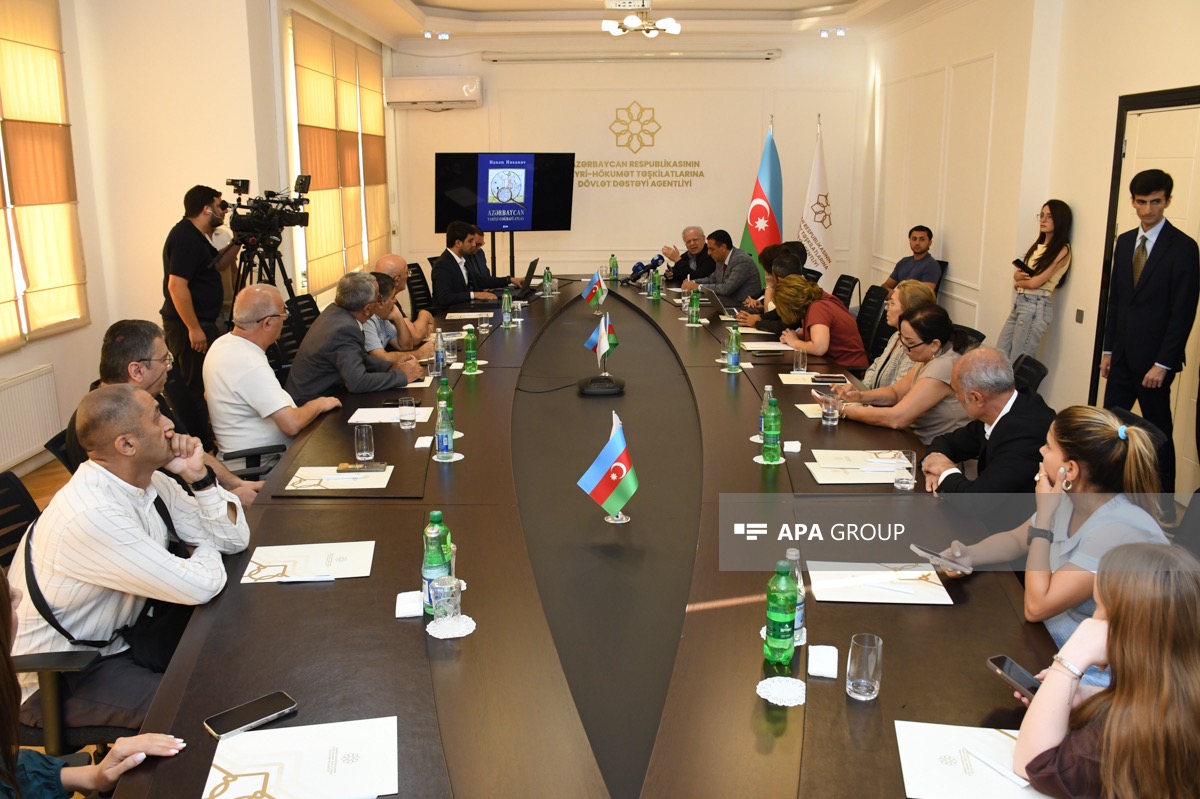
Two days ago, Hikmet Hajiyev spoke at the Arab Media Forum about the rich Christian heritage of Caucasian Albania in Karabakh and other regions. He noted that enduring and particularly significant traces of this heritage can be found in Karabakh and other parts of Azerbaijan. Amidst ongoing discussions, a seminar was held today at the Agency for State Support to Non-Governmental Organizations, focusing on excerpts regarding Caucasian Albania from the work "Azerbaijan: Historical-Geographical Atlas" by historian and Doctor of Historical Sciences Hasan Hasanov.
Representatives from various NGOs, as well as members of the media, participated in the seminar.
Hasan Hasanov: The founding dates of the states of Atropatene and Albania are stated incorrectly
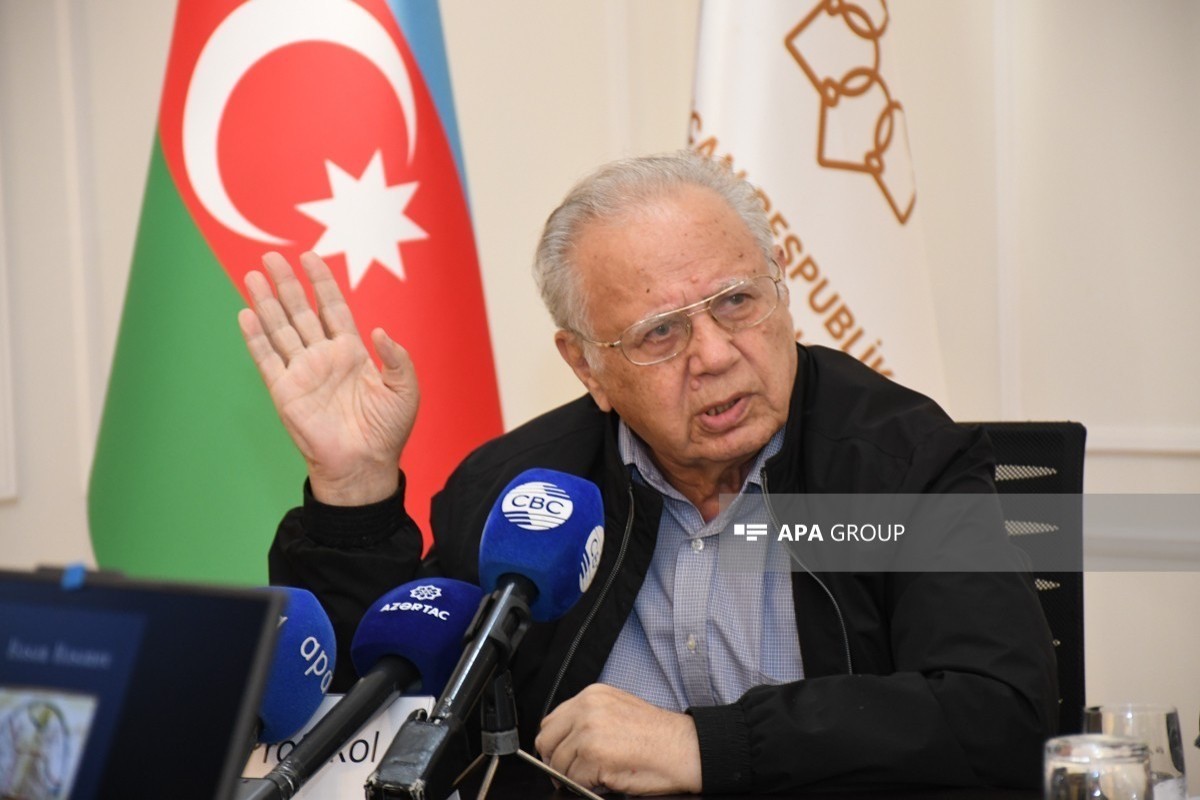
“As long as the founding dates of Atropatene and Albania are not correctly recorded in textbooks, the attacks against us will not cease,” Hasan Hasanov began his presentation by saying.
He emphasized that the founding dates of the states of Atropatene and Albania are presented incorrectly in Azerbaijani history textbooks: “This is one of the fundamental problems regarding our history. The Institute of History of the Azerbaijan National Academy of Sciences shows no desire to resolve this issue either. They remain wedded to the Soviet concept. Consequently, we are being ‘attacked’ today based on historical sources that we ourselves have published.”
Questions naturally arise in everyone's mind: When, then, were the states of Atropatene and Albania actually founded?
Albania was established in 66 BC, not in the 4th century BC
Hasan Hasanov noted that the word "tsar" (king), referring to the Albanians, was used in 66 BC—during the time of Pompey: "Albania was established in 66 BC, not in the 4th century BC. Prior to that, Albania had been part of Atropatene for 546 years. This serves as a basis for countering Armenian claims. Atropatene, meanwhile, was established in 612 BC. If we record this accurately, a major problem would be resolved." The geographical atlas displayed on the large screen states: “During the 546-year period spanning the establishment of the land of Atropatene/Adorbayqan (612 BC) and the founding of the Albanian Kingdom (66 BC), the territories inhabited by the Albanians and Sakas were part of the country known as ‘Atropatene/Adorbayqan.’ In the 1st century BC, the territory of the former Ashkuz Kingdom—whose primary inhabitants were Albanians and Sakas/Sakesians and which had remained part of Atropatene—was separated from Atropatene and declared the independent Albanian Kingdom. The first state on the lands of the future Kingdom of Albania was established by the Cimmerians in the 8th century BC and was named ‘Qimiray/Qamir,’ based on their ethnonym. In the 7th century BC, they succeeded in defending their country against invasions by the King of Urartu. In 673 BC, power passed to the Scythians, who began calling the country ‘Ashkuz.’ The root of this word is the ethnonym ‘quz’ (‘oghuz’). Assyrian cuneiform texts contain records regarding these two countries.”
A geographical atlas notes that the first mention of the Kingdom of Albania dates back to 66 BC. Specifically, Plutarch and Cassius Dio provide information about the King of Albania in connection with events from that period: "The 'King of the Albanians' is mentioned for the first time in the account concerning Pompey (in 66 BC) (Plutarch, *Pompey*, 34). Similarly, when describing events involving Pompey in 66 BC, Cassius Dio makes the following reference: 'Oroezes, King of the Albanians.' The very existence of a king implies the existence of a kingdom. Thus, it is evident from ancient sources that the formation of a centralized, independent Kingdom of Albania dates to 66 BC."
Another of the scholar's historical arguments is that none of the ruling dynasties of Albania had any connection to the Armenians: "According to Movses Khorenatsi and Movses Kaghankatvatsi, the first ruling dynasty of Albania was the lineage of Sisak, and its first king was Aran. Researchers acknowledge that the Sisak lineage was of Scythian origin."
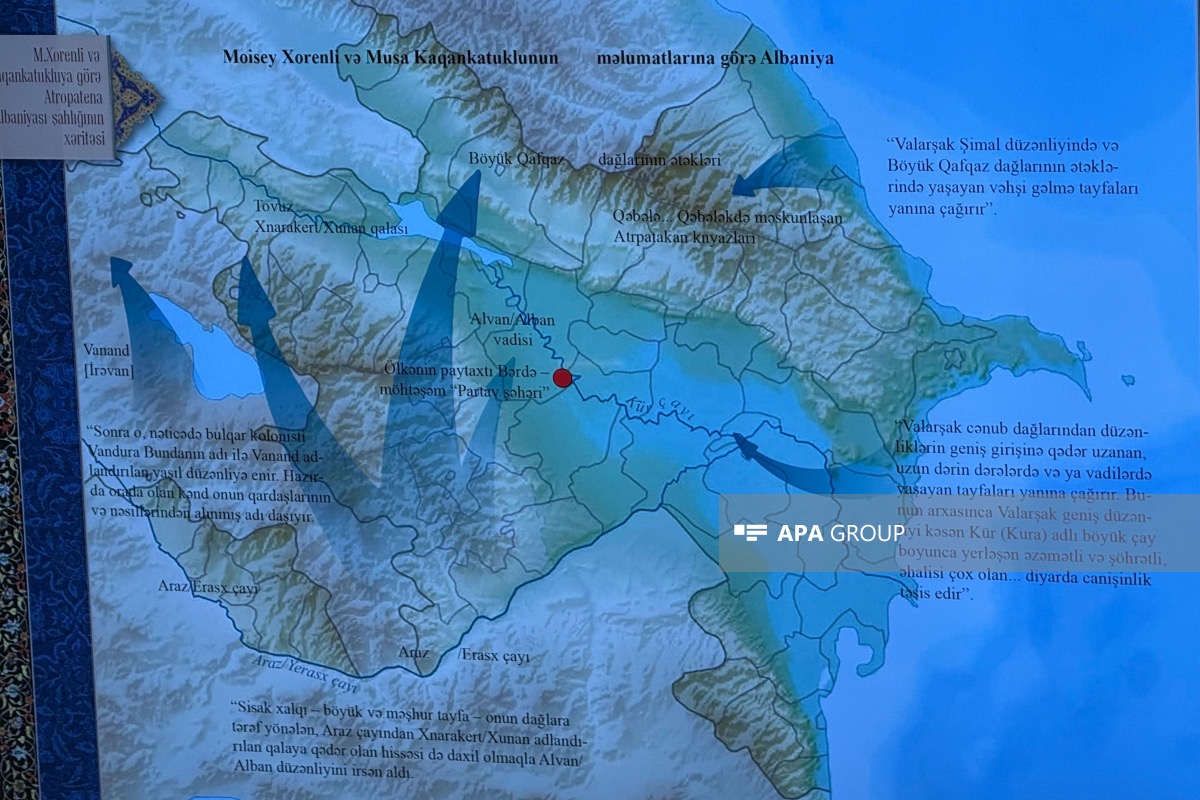
How is Albania depicted on the map? The scholar then displayed a map of Albania from the geographical atlas on the screen: “This map is highly significant. Reflecting the historical geography of Caucasian Albania based on the accounts of Movses Khorenatsi and Movses Kaghankatvatsi, the map depicts the state’s territory as a vast expanse stretching from the foothills of the Greater Caucasus Mountains to the Aras River. Marked on the map are the Kura and Aras rivers, the city of Barda (Partav), Gabala, and the fortress of Khnarakert (Khunan), as well as the names of regions and tribes such as Vanand and Sisak. The accompanying annotations provide information on the various tribes inhabiting the territory of Albania and their geographical locations. This material offers a visual presentation of ancient Albania’s historical geography, settlements, and tribal distribution.”

Did the Armenian factor play a role in the formation of the Albanian kingdom?
According to Hasan Hasanov, neither the Parthian nor the Armenian factor played a role in Albania’s declaration of independence. The emergence of the Albanian kingdom was the result of the Albanians' own will and a specific conflict between the ruling Albanian tribe and the ruling dynasty of Atropatene:
“In some sources, the Armenian ruler Artaxias's seizure of Caspiana is cited as evidence that Armenia's eastern borders extended to the Caspian Sea. However, according to the text in question, the ancient historian Strabo is referring not to the Caspiana located in Albania, but to the Caspiana within the territory of Media. The source also emphasizes that Tigranes's relations with the rulers of Atropatene were characterized more by specific political alliances and dependency than by direct conquest. Based on this perspective, the emergence of Caucasian Albania as a state was not the result of political decisions made by Armenia or Parthia, but rather the outcome of local political processes within the region.”
***
As discussions regarding the history and Christian heritage of Caucasian Albania continue, one of the key tasks facing Azerbaijan is to study and present this heritage based on scholarly sources and archaeological evidence. Discussions regarding Gandzasar, Khudavang, and other ancient Christian monuments in Karabakh demonstrate that the region's historical heritage is a relevant topic not only of the past but also of the present. The Azerbaijani side emphasizes the importance of demonstrating—on historical and scientific grounds—the connection between these monuments and the heritage of Caucasian Albania. It is evident that research into centuries-old sources, maps, and stone inscriptions will remain a key focus of discussions concerning Karabakh's historical past.


 Follow us on Telegram
 t.me/apanewsaz
 Follow us on Instagram
 Follow us on TikTok
 Follow us on Facebook
 Follow us on X