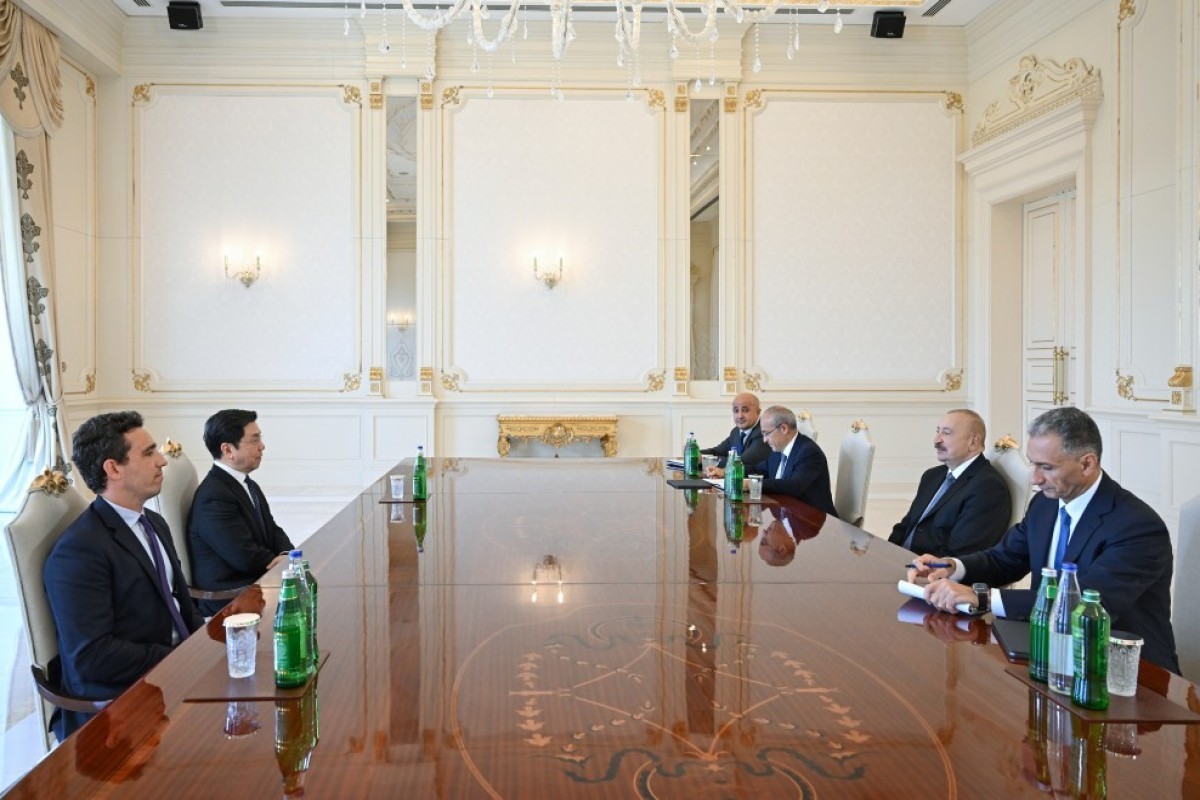


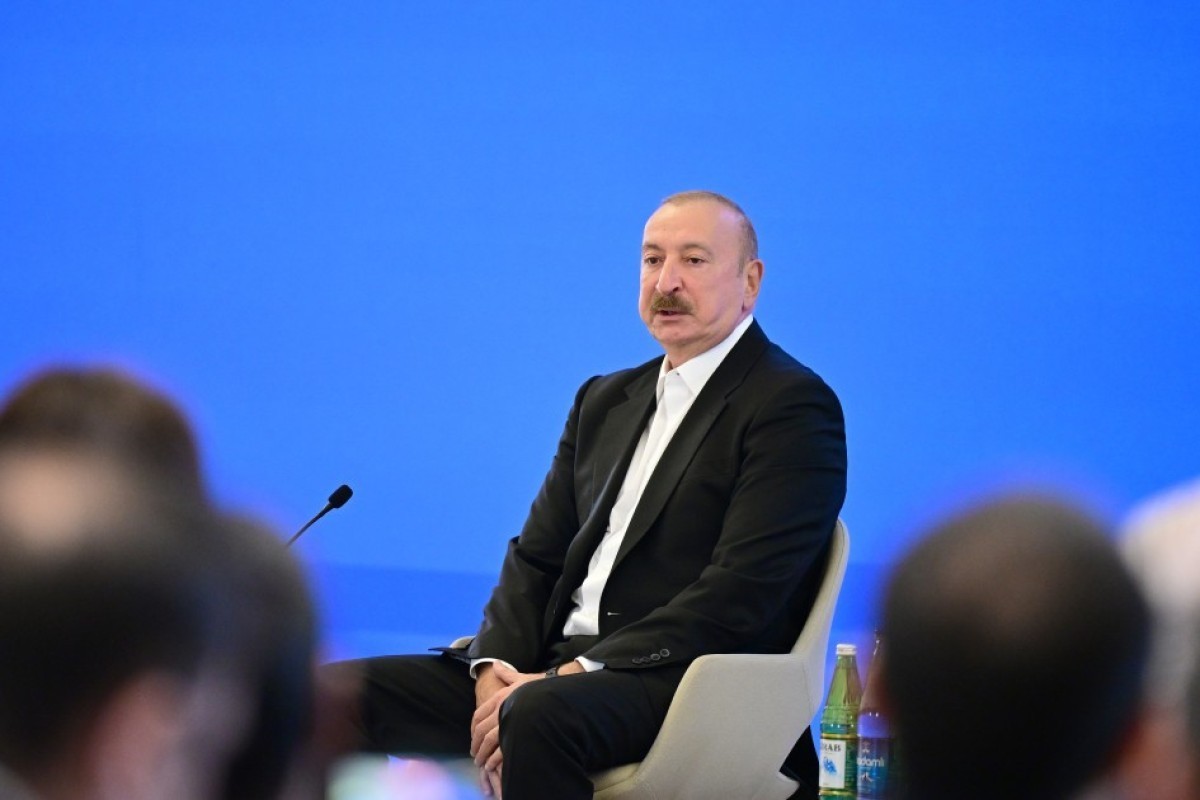


The South Caucasus has changed fundamentally in recent years, with new centers of power emerging, President Ilham Aliyev said while answering a Russian journalist's question about Russia's role in the South Caucasus at the 4th Shusha Global Media Forum, APA reports.
"As for Russia's role in the South Caucasus, it is somewhat difficult for me to speak about it because I believe this concept should first be formulated within Russia itself. If it has not yet been fully formulated, it is important to do so. The South Caucasus has changed fundamentally in recent years. I believe the main turning point in these changes was the Second Karabakh War. That war completely altered many geopolitical approaches that had long been considered unchanged. Later, the full restoration of Azerbaijan's sovereignty, Armenia's steps toward European integration, and other related developments demonstrated that the region had entered an entirely new stage.
I believe this situation makes it necessary for both analysts and politicians to reconsider their approaches to the South Caucasus. This cannot be done without maintaining constant engagement with the region and closely following the developments taking place here, because the old methodologies regarding the South Caucasus have become completely outdated. Today, the region is entirely different from what it was five years ago. New centers of power have emerged. New political courses developing in different directions have appeared. Perhaps these trends are now more visible than before, but those who have closely followed the region observed them from the very beginning.
Therefore, for any external actor, building relations with the South Caucasus is quite a complex task because the region is not a single political, economic, or transport space. We are still at the initial stage of this process. I have conveyed the same views to my European partners. When we saw the West's openly one-sided approach toward Armenia, it raised questions for us. After all, we know the region's geography, economic potential, and other realities very well. We also assess our own capabilities accurately. Presenting Armenia as the region's main transport hub raised serious questions. A country with no experience as a transit state was suddenly declared the region's principal transport center, even though it was unclear what transit was actually being discussed. This was an obvious imbalance created for political purposes. Everyone should abandon such approaches.
The South Caucasus should not be viewed as an arena for geopolitical rivalry. At least Azerbaijan did not allow that. We did not allow external forces to draw us into geopolitical games. No one succeeded in using Azerbaijan as a tool against other states. I now believe our neighbors should adopt the same approach and demonstrate it not only in words but also through practical actions.
All parties that seek peace and cooperation in the region should establish separate and balanced formats of cooperation with each country in the South Caucasus. Once the normalization process between Azerbaijan and Armenia is completed, direct transport links — through the Zangezur corridor or other routes — are opened, and the region becomes politically ready for trilateral cooperation, the situation will be entirely different. At present, however, we are not at that stage. Therefore, it is important to objectively assess each country's economic, political, military, demographic, and other potential. This will make it possible to set the right priorities and avoid regretting wrong choices later. Most importantly, anyone wishing to cooperate with the region should first view the South Caucasus as a space of peace, cooperation, and, as much as possible, free from geopolitical rivalry. Of course, there is no region in the world that is completely free from geopolitical influence," the head of state said.
President Ilham Aliyev also touched upon the regional cooperation initiative involving Russia, Iran, Türkiye, Armenia, Azerbaijan, and Georgia.
"As for that cooperation format, it was first proposed by us. We believed that issues concerning the destiny of the region should primarily be resolved by the countries of the region themselves. To be honest, no one had returned to this topic for quite a long time. We put forward this initiative in the post-conflict period. At that time, the goal was to achieve a comprehensive settlement and the full restoration of Azerbaijan's sovereignty. Part of Karabakh was still under occupation then. As events developed and relations with countries outside the region changed, our view of this cooperation format also evolved.
Today, we believe it should be a full-fledged six-party, or at least five-party, cooperation format. Moreover, this cooperation should have a clearly defined agenda. This format should not function as a new Minsk Group or deal only with Azerbaijan-Armenia issues. It should discuss the problems of the entire region. Russia, Iran, Türkiye, Armenia, and Azerbaijan should participate as equal partners. This is the concept we now consider the main approach. If this approach is also shared by the other capitals, I believe there will be a need to hold at least a five-party meeting at the level of foreign ministers," the head of state noted.


 Follow us on Telegram
 t.me/apanewsaz
 Follow us on Instagram
 Follow us on TikTok
 Follow us on Facebook
 Follow us on X