

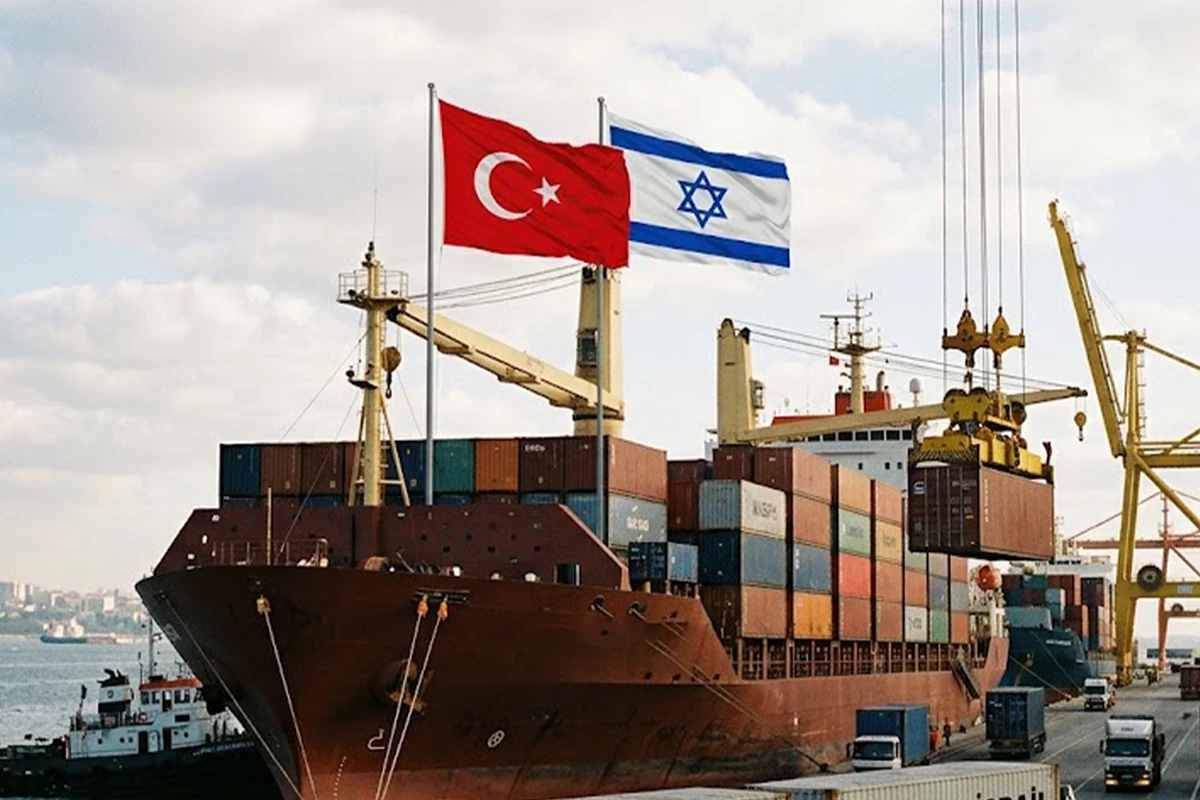


The flag changes, the route does not: The maritime line stretching from Türkiye to Israel
Azerbaijan–Türkiye relations are built on strategic alliance and the principle of “one nation, two states.” However, in recent years, “black PR” campaigns against Azerbaijan have periodically been carried out in the Turkish media and on social networks. One of the “traditional topics” of these campaigns, which are launched every two or three months, is the issue of Israel.
The latest such wave emerged after one of Azerbaijan’s diplomats remained in the hall during Israeli Prime Minister Benjamin Netanyahu’s speech at the UN General Assembly. In the Turkish media and on social networks, the incident quickly turned into a “black PR” campaign against Azerbaijan. Some reports even emphasized that the Azerbaijani representative was allegedly among only a small number of delegates who remained in the hall, although representatives of many other countries, alongside Azerbaijan, were also present during Netanyahu’s speech. What makes the issue even more sensitive is that the campaign was not limited to social media users but spread to Turkish media outlets. Worst of all, there has been no visible, clear and effective political stance from Ankara aimed at stopping this campaign.
It is worth recalling that some time ago, Türkiye also witnessed a similar anti-Azerbaijan wave against the backdrop of the Israel–Palestine issue. A group of radical individuals presenting themselves as supporters of Palestine attacked SOCAR’s office in Istanbul, accused Azerbaijan of selling oil to Israel and damaged the company’s office. Yet the issue that Turkish public opinion should actually pay attention to is different: Türkiye itself has fairly deep economic and trade relations with Israel that have been established over many years. Moreover, despite official restrictions, there are serious questions as to whether these economic ties continue today through various channels and mechanisms. Interestingly, those supporters of Palestine in Türkiye who make harsh accusations against Azerbaijan somehow either fail to see these points or choose to ignore them. As a result, when it comes to relations with Israel, one of the main targets of criticism becomes Azerbaijan rather than Türkiye’s own economic ties.

APA TV’s exclusive investigation, however, has revealed that more interesting and serious facts lie behind the visible side of the issue. Official Ankara says that trade with Israel has been halted and maritime transport between the two countries has been reduced to zero. But the movement patterns of ships departing from Turkish ports paint a completely different picture.
The investigation found that cargo ships departing from Turkish ports continue to reach Israeli ports today. So how does this happen? If trade has officially been halted, through what mechanism are goods from Türkiye reaching Israel? What role do ships sailing under foreign flags play in this scheme?
APA TV investigated these questions through ship-tracking systems and specific routes. The picture that emerged raises serious questions about whether Türkiye–Israel trade has actually stopped.
Restrictions imposed on Türkiye–Israel trade
Following growing political debate and criticism in Türkiye over trade relations with Israel, Ankara began gradually imposing restrictions on direct trade with the country starting in 2024. The first step was taken on April 9, 2024, when Türkiye announced that it had suspended exports to Israel of 1,019 products across 54 product groups.
Just a few weeks later, in May, the restrictions were tightened further. Türkiye announced that exports, imports and transit trade with Israel had been completely halted across all product groups. The official statement emphasized that no trade operations with Israel were being carried out in customs areas or free zones either.
In a statement dated March 30, 2026, Türkiye’s Ministry of Trade once again reaffirmed this position. According to the ministry, no customs declarations for exports to or imports from Israel have been registered since May 2, 2024, and Türkiye’s trade with Israel is at “zero” level.
The restrictions were later extended to maritime transport as well. On August 29, 2025, Turkish Foreign Minister Hakan Fidan said that ships sailing under the Turkish flag were not permitted to call at Israeli ports, while Israeli ships were not allowed to enter Turkish ports. According to information reported by Reuters at the time, ship agents at Turkish ports were also required to provide documents confirming that vessels had no connection with Israel and were not transporting military cargo to Israel.
Thus, according to the official position, direct trade between Türkiye and Israel has been halted, and strict restrictions have also been imposed on maritime transport. Turkish-flagged vessels should not call at Israeli ports, while Israeli ships should not enter Turkish ports.
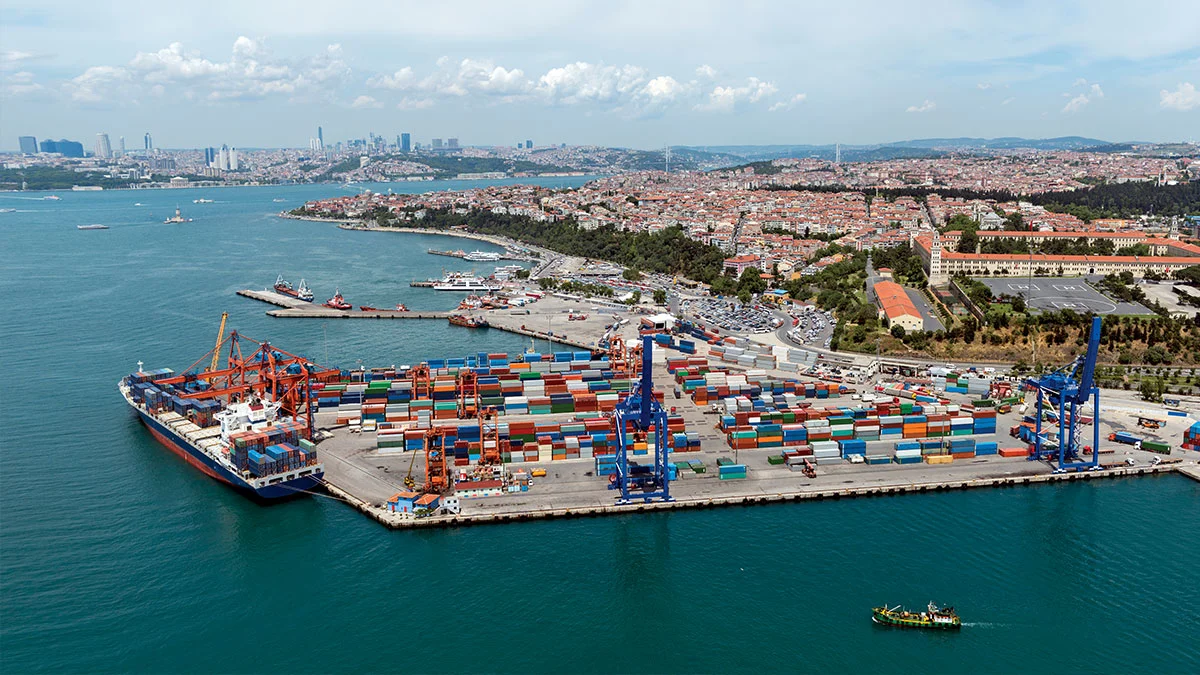
The vast majority of Türkiye-linked vessels sail under foreign flags
As can be seen, the restriction covers vessels flying the “Turkish and Israeli flags.” The issue is that, in order to identify a vessel linked to Türkiye, it is not enough to look at which country’s flag it is flying. This is because a large part of Türkiye’s shipping sector operates under the flags of foreign countries.
According to a report by the Turkish Shipowners’ Association covering 2024–2025, by the beginning of 2025 the total deadweight tonnage of the Türkiye-linked fleet had reached 51.943 million tons. The number of vessels with a gross tonnage of more than 1,000 stood at 2,092.
But the key point is which flags the fleet sails under.
By deadweight tonnage, of the Türkiye-linked fleet:
27.63% sails under the Marshall Islands flag, 16.90% under Panama, 15.97% under Malta, 13.03% under Liberia, and only 12.30% under the Turkish flag.
In other words, these four foreign flags alone — the Marshall Islands, Panama, Malta and Liberia — account for 73.53% of the total deadweight tonnage of the Türkiye-linked fleet.
Another international source makes the picture even clearer. The United Nations Conference on Trade and Development — UNCTAD — states in its Review of Maritime Transport 2025, citing Clarksons Research data, that of 2,159 Türkiye-linked vessels at the beginning of 2025, 1,743 were registered under foreign flags and only 404 under the Turkish flag.
The difference is even greater in terms of tonnage: foreign-flagged vessels account for approximately 88% of the total capacity of the Türkiye-linked fleet.
These figures reveal a point of crucial importance for our investigation: tracking Türkiye-linked shipping activity solely on the basis of vessels sailing under the Turkish flag means leaving out a large part of the real picture.
For this reason, APA TV did not conduct the investigation solely on the basis of a vessel’s flag.
To determine which company stands behind a vessel sailing under a foreign flag, information such as its beneficial owner, registered owner, ISM manager, technical manager, commercial operator and charterer must be examined separately. At the same time, what cargo the vessel is carrying and the route it actually follows are also of key importance.
One of the main keys in this investigation is the IMO number, the permanent identifier assigned to each vessel. A ship can change its flag, name and even operator, but its IMO number makes it possible to track it throughout its entire operational history. It is precisely through this number that information on who owns the vessel, who manages it and which routes it follows can be cross-checked across different databases.
20 companies placed under monitoring
A monitoring list consisting of 20 companies was compiled to investigate the movements of foreign-flagged vessels linked to Turkish shipping companies.
The companies were selected based on data from the Turkish Shipowners’ Association concerning tonnage figures.
The following companies were included in the monitoring list:
-
Genel Denizcilik Nakliyati AS
-
YASA Shipping Industry
-
Beks Denizcilik ve Ticaret
-
Densay Shipping & Trading DMCC
-
Ciner Ship Management
-
Klan Gemi Yönetimi
-
Karadeniz Holding
-
Active Denizcilik
-
Arkas Holding
-
Kıran Holding
-
Besiktas Shipping Group
-
İnce Shipping Group
-
Marinsa Denizcilik
-
Güngen Denizcilik
-
İskenderun Gemi İşletmeciliği
-
TÜPRAŞ
-
Manta Denizcilik
-
Ulusoy Deniz Yolları
-
İmza Marine
-
Aruna Shipping
The question now is: during the period when restrictions on Türkiye–Israel trade were in force, where did foreign-flagged vessels linked to these companies depart from and where did they go?
Türkiye-linked foreign-flagged vessels sailing to Israeli ports
Now let us answer the main question: did Türkiye-linked foreign-flagged vessels call at Israeli ports while the restrictions were in force?
We examined Automatic Identification System (AIS) data and open sources and tracked the movements of vessels that entered Israeli ports in September 2026.
The result is noteworthy.
During monitoring covering September 17–30, 2026, a total of 11 port calls at Israel’s Ashdod and Haifa ports were recorded by six different vessels linked to Türkiye and sailing under the flags of Panama and Liberia.
The vessels for which port calls were recorded are:
MEDKON LTF
MEDKON CANAKKALE
MEDKON MERSIN
ADMIRAL MARS
ADMIRAL STAR
ANITA A
Of the 11 recorded port calls, eight were at Ashdod and three at Haifa.
But an even more interesting picture emerges when the vessels’ routes are examined.
For example, according to the monitoring data, MEDKON LTF departed from Istanbul’s Ambarlı Port on September 27. On September 30, the vessel was sailing toward Ashdod.
MEDKON MERSIN, meanwhile, was observed heading toward Haifa and Ashdod between September 28 and 30.
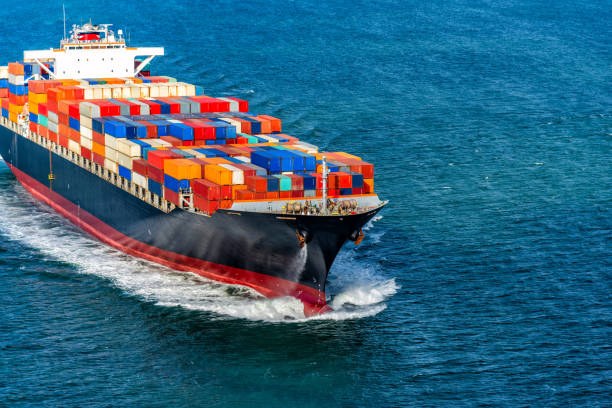
In other words, at a time when Turkish-flagged vessels were officially restricted from calling at Israeli ports, AIS records continued to show port calls in Israel by vessels linked to Türkiye but sailing under foreign flags.
The MEDKON Group vessels identified in the monitoring sail under the Panama flag and are linked in open shipping databases to Türkiye-related operators and management structures.
ADMIRAL MARS and ADMIRAL STAR, meanwhile, sail under the Liberian flag and are linked to Türkiye-related commercial management structures.
One important point should be emphasized here: AIS data make it possible to determine where a vessel departed from, the route it followed and the port it entered. However, these data do not in themselves show exactly what cargo was being carried, who owned that cargo or who the final buyer was. Therefore, the recorded port calls should not be regarded as proof that a specific cargo was sold to Israel, but rather as evidence that maritime traffic continued between Turkish ports and Türkiye-linked shipping structures on the one hand, and Israeli ports on the other.
Moreover, this is not limited to the six vessels recorded by APA TV in September 2026.
Open sources indicate that similar movements were also observed in 2025.
There are reports that vessels such as MEDKON Canakkale, Trans Carrier, Sahin 2, Bozkurt, Lady Ayan, Lady Sema, Lady Ayse, Navin Osprey and Navin Harrier were observed at Israel’s Ashdod and Haifa ports while sailing under the flags of Panama, Liberia, Vanuatu and other foreign jurisdictions.
But even larger figures were reported for 2025.
According to information published by the BirGün website on October 7, 2025, a total of 456 direct vessel voyages from Turkish ports toward Israel were recorded between January and September of that year.
According to figures presented by the source, 302 of those voyages were to Haifa and 154 to Ashdod.
Where did the vessels heading toward Israel depart from?
From Iskenderun — 130 voyages.
From Mersin — 103 voyages.
From Nemrut Port in the Aliaga area of Izmir — 80 voyages.
From ports in the Gulf of Kocaeli — 45 voyages.
The structure of the shipments is also noteworthy. Of the 456 voyages, 176 were listed as container vessel voyages, 118 as general cargo, 79 as Ro-Ro, 35 as dry cargo and 30 as tanker voyages.
Looking at the flags, the same picture described earlier emerges again: the report said that 110 voyages were carried out by Panama-flagged vessels and 98 by Liberian-flagged vessels.
Another noteworthy claim is that, according to the source, eight vessels sailing under the Turkish flag were also recorded as calling at the ports of Haifa and Ashdod during that period.
Thus, two different pictures emerge.
On the one hand, there is Türkiye’s official position: trade with Israel is at “zero,” and Turkish-flagged vessels are not permitted to call at Israeli ports.
On the other hand, there are open-source vessel-tracking data and statistics published by various sources showing movements to Israel’s Haifa and Ashdod ports by foreign-flagged vessels departing from Turkish ports or operated by Türkiye-linked structures.
These facts do not in themselves prove that the cargoes aboard those vessels were sold to Israeli companies. But they raise a very specific question:
If Türkiye–Israel trade is truly at “zero,” what are these vessels travelling from Turkish ports to Israeli ports carrying, what is the official destination of their cargoes, and who are the commercial parties involved in these shipments?
And the most important question is: if maritime traffic from Turkish ports to Israel continues on this scale, how can Azerbaijan be accused of economic ties with Israel while all of this is ignored? If the principle is opposition to economic relations with Israel, should the same principle not first be applied to what is happening within Türkiye itself?


 Follow us on Telegram
 t.me/apanewsaz
 Follow us on Instagram
 Follow us on TikTok
 Follow us on Facebook
 Follow us on X