


"Countries suffering from conflict are among the most affected by the consequences of climate change"
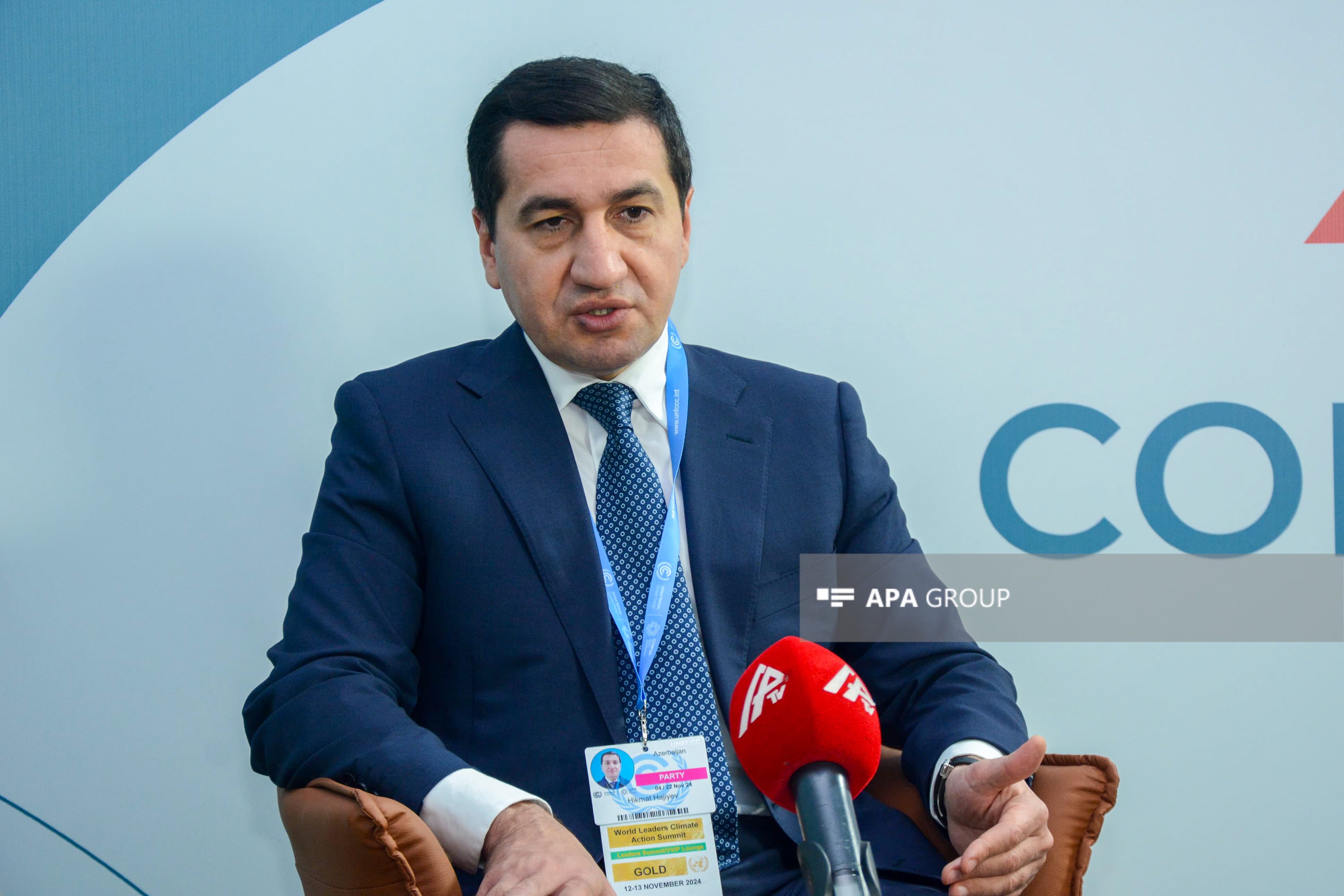
Interview of Hikmat Hajiyev, Assistant to the President of the Republic of Azerbaijan - Head of the Department of Foreign Policy Affairs of the Presidential Administration of the Republic of Azerbaijan, to APA
"Countries suffering from conflict should have a special approach in the process of digital climate transformation"
- Yesterday, a group of countries suffering from the conflict issued an appeal that they suffer more from climate change. Although Azerbaijan is not a member of this initiative, it has been affected by conflict. We would like to know your opinion on this statement.
- Before addressing your question, I would like to take the opportunity to sincerely congratulate the leadership and all the staff of the APA News Agency on the 20th anniversary of its founding. The APA News Agency holds a special place and plays a significant role in Azerbaijan's information space. The agency’s influence goes beyond Azerbaijan’s borders, covering a vast information space, and it plays a unique role in shaping the flow of information not only in the region but also beyond. We also observe that leading global media outlets are increasingly referencing APA. In this sense, APA plays a vital role in shaping the information flow of our country and a broader region. This achievement is the result of hard work and intensive effort. I wish success to the entire team in their future endeavors. Today, in connection with the COP29 being held in Azerbaijan, Azerbaijani media, including APA News Agency, is actively participating in covering this event alongside other media structures, working hand in hand with global media. As you know, there is intense competition in the information space. At this event, too, there is a healthy competitive environment based on the principles of leadership in obtaining, preparing, and disseminating information. In this competitive environment, Azerbaijan’s information resources are in a leading position. Therefore, I would like to congratulate you once again for this achievement.
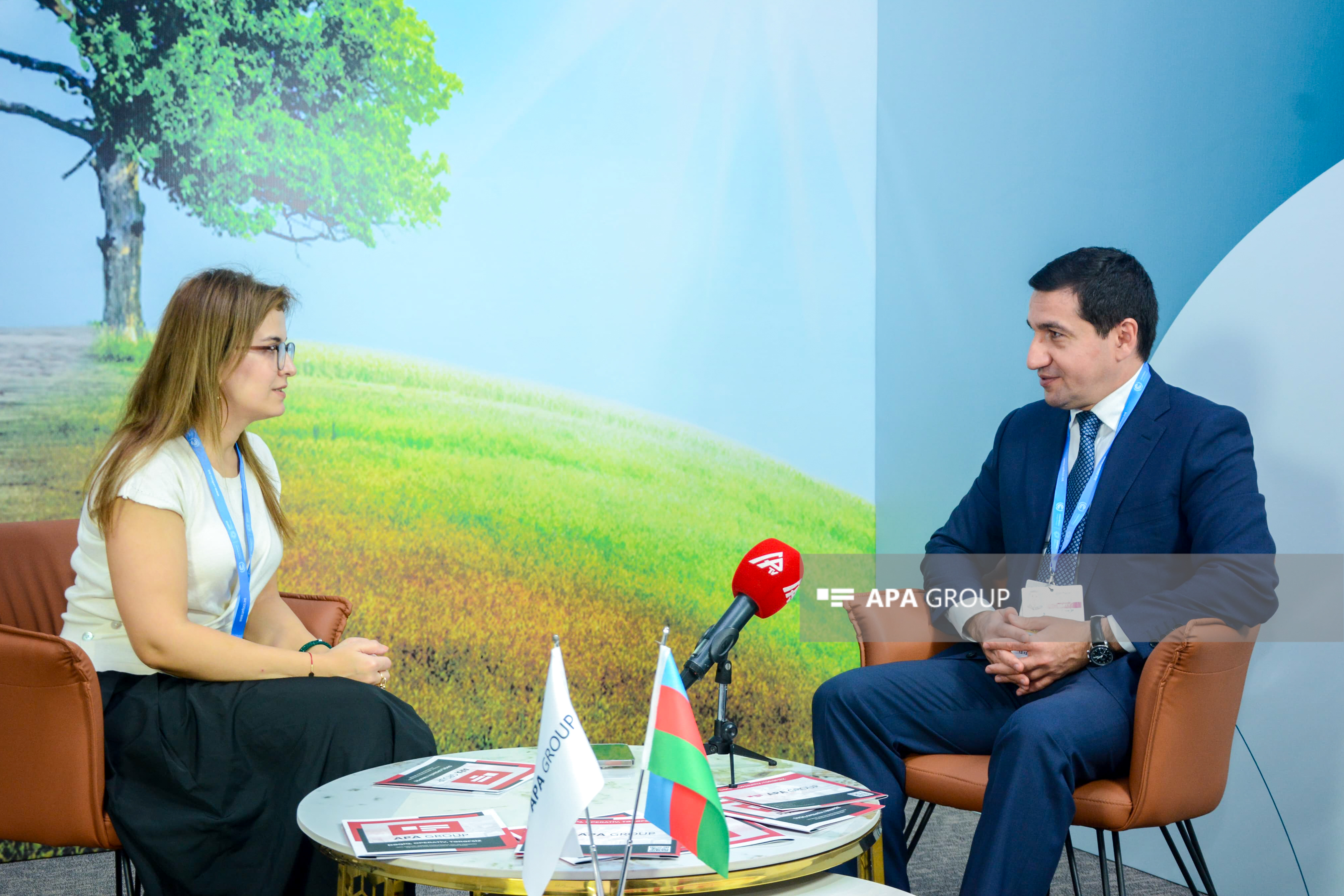
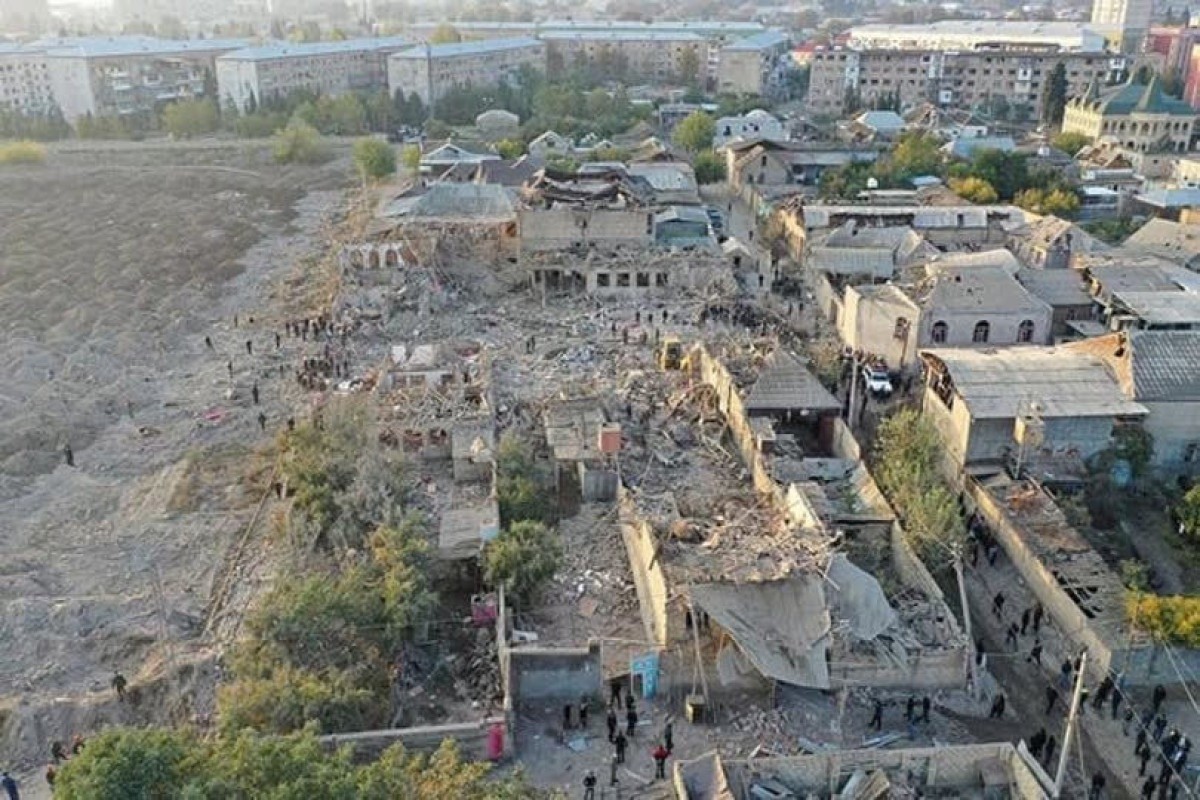
Regarding your specific question, yes, the Republic of Azerbaijan has not joined the mentioned initiative. This is because Azerbaijan has already resolved the conflict. There is no conflict in Azerbaijan, but the consequences of the conflict remain. In this regard, we fully understand these countries and their concerns. This is because countries suffering from conflict are among the most affected by the consequences of climate change. They also need certain aid and support. To put it another way, as a country that endured 30 years of occupation, Azerbaijan clearly saw the consequences of Armenia's military occupation and aggression. We can also say that if Armenia's military aggression and occupation of Azerbaijan, this 30-year-long occupation, had not existed, Azerbaijan would have achieved even greater success in implementing its green agenda and Green Concept. However, despite this, as you can see, after the liberation of Karabakh and Eastern Zangazur, in accordance with the relevant decisions of the President, that territory was immediately declared a zero-waste zone. This is the policy of our state. The Republic of Azerbaijan has achieved significant progress in the field of green transformation in a short period of time. Another aspect of this is that occupation, aggression, and military operations inflicted serious damage on the ecological environment and ecosystem of those territories. We saw that Armenia destroyed the flora and fauna of our territories under occupation over the years. All of this has been documented. We believe that COP29 is important for raising and discussing such issues. Therefore, returning to the question you raised, I would like to reiterate that we fully understand and empathize with the concerns of these countries. We believe that countries suffering from conflict should have a special approach in the process of digital climate transformation.
"Azerbaijan’s approach is marked by consistency and systematicity"
- So, how has Azerbaijan's foreign policy developed after resolving the conflict?
- For Azerbaijan, the conflict is now a thing of the past. Azerbaijan has fully ensured its territorial integrity and sovereignty. In general, Azerbaijan’s resolution of Armenia's occupation and aggression, as well as its implementation of the UN Security Council resolutions, is one of the most exemplary models for conflict resolution in the world. As President Ilham Aliyev has also stated, Azerbaijan has fully secured its territorial integrity through both political and military means. restrictions and certain shackles. The goal was to create certain obstacles and additional restrictions to the implementation of Azerbaijan's foreign policy goals. With the end of the conflict and the restoration of the country’s territorial integrity, Azerbaijan now carries out its foreign policy across a larger geographical space, based on its distinct geopolitical identity and character. The fact that COP29 is being held in Azerbaijan is a clear example of this. As you can see, it is Azerbaijan that is hosting COP29, a world-scale event that deals with one of the most important and urgent issues on the global agenda. And Azerbaijan is doing this very successfully. From an organizational perspective, as well as in terms of the substance and content of the discussions, Azerbaijan is managing this event excellently. Additionally, as part of the follow-up to COP29, Azerbaijan will host the 2026 UN World Urban Forum in Baku. This is one of the largest events at the UN level. In fact, the UN has a saying: “Climate issues arise in cities and climates also perish in cities,” as Urban areas are among the greatest polluters of the environment. Azerbaijan’s approach is marked by consistency and systematicity. In the post-conflict period, Azerbaijan is setting a unique model by rebuilding 9 cities and hundreds of villages from scratch. The contours of the foreign policy of Azerbaijan, which is becoming more globalized and covers an even wider geography, were defined by Mr. President. I can mention another example of this. During these days, Mr. President held more than 50 different meetings. If we look at the geographical scope of these meetings, we see that Latin America, Africa, Asia, and European countries were all represented, covering virtually every continent. There were even a number of countries with which, although we have diplomatic relations, our commercial, economic and cultural relations have not developed so widely. This has now defined a new direction for Azerbaijan. Going forward, Azerbaijan will implement a broader foreign policy from the point of view of contributing to issues on the global agenda and solving problems.
"We are not interested in whether Armenia will participate or not"
- Armenia did not respond positively to Azerbaijan’s invitation to participate in COP29. How does this impact efforts to create lasting peace in the region?
- As a member of the UN Framework Convention on Climate Change and host of COP29, the Republic of Azerbaijan has invited all UN and Convention member states to the event. The number of parties to the Convention is 198, including non-state parties such as the European Union and two independent non-state entities, all of which we also invited. This is part of our commitment, and as part of this, Azerbaijan also extended an invitation to Armenia. Frankly, it is not so interesting for us whether Armenia will participate or not. This is Armenia’s decision. If Armenia does not wish to engage in the global climate change concept, it likely has certain issues related to its green agenda. But in any case, this remains an internal matter for Armenia and is its decision. But the whole world is in Azerbaijan these days. Let's look at the number of event participants—already over 75,000 people have registered. Just looking at the COP venue is enough. If we exclude Armenia and non-state parties, all the other parties are represented here. I would like to emphasize that this makes no difference to us, whether Armenia participates or not, Azerbaijan has fulfilled its responsibility and invited Armenia. Armenia likely has issues with green transformation or other concerns. However, we also believed that this event could contribute to the trust-building process between Armenia and Azerbaijan and in the region. If Armenia truly supported the peace agenda, trust-building, and regional cooperation in the region, its participation here could have been beneficial. Furthermore, Armenia’s participation would have been useful in discussing issues such as the impacts of climate change in the Caucasus region. Recently, the UN Environment Programme presented a very interesting report. In that report, we can see the parameters of climate change in the Caucasus region, including the decline in the water level of the Caspian Sea, the reduction in glacier levels in the Caucasus Mountains, the decrease in precipitation, and the consequences of various impacts. But if Armenia does not wish to, or has made such a decision, it is, in any case, Armenia's responsibility. To be clear, this holds no significance for us. Azerbaijan has made significant efforts to advance the global climate agenda with the world’s countries and will successfully conclude this conference. After the conference, Azerbaijan's work is not finished. As the Presidency country, Azerbaijan will lead this process for a year.
“We hope that the discussions held within the G20 framework will contribute to discussions on the financial goals at COP29”
- Will the climate investment targets be achieved at COP29, and will these funds be raised?
- There is one issue that needs to be fully clarified. Azerbaijan, as a member of the Convention, the host country, and the chair state of COP29, has created a very conducive environment and atmosphere for the conduct of result-oriented discussions. However, the adoption of decisions within the Convention depends on all its parties. I regret to note that sometimes international media presents the issue as if it were solely Azerbaijan's decision or entirely dependent on Azerbaijan, that only Azerbaijan must take action. This is not the case. Azerbaijan is the chair country, the host country. Azerbaijan has created a very real, conducive, and fertile environment for result-oriented discussions. It is essential to acknowledge openly and sincerely that new financial commitments fall heavily on the shoulders of developed countries. The essence of the Paris Agreement revolves around the concept of common but differentiated responsibilities, where developed countries bear a unique responsibility for the increase in carbon emissions that began with the Industrial Revolution. Therefore, at COP29 hosted by Azerbaijan, the expectation from the developed countries of the world is precisely the establishment of new financial targets. The upcoming G20 meeting is on the horizon. We hope that the discussions held within the G20 framework will ultimately contribute to the financial targets deliberated at COP29.
Photo - Rufat Mustafayev©️ APA GROUP


 Follow us on Telegram
 t.me/apanewsaz
 Follow us on Instagram
 Follow us on TikTok
 Follow us on Facebook
 Follow us on X