














APA presents Mohammad Rahmanifar’s article “Historical Continuity in Contemporary Azerbaijani History: From Sattar Khan to Pishavari” as part of the “Explore South Azerbaijan” project.
You can read the previous article of the project here.
Three major uprisings mark the beginning of modern turbulent history in South Azerbaijan: the Constitutional Revolution (1905–1911), the Sheikh Mohammad Khiabani uprising (1920), and the Azerbaijan National Government (1945–1946). Today, some regard Sattar Khan and the constitutional fighters as heroes, while others label them traitors. A similar divide exists regarding Khiabani and Pishevari, with those who view Pishevari as a hero often calling Sattar Khan and the constitutional fighters traitors.
As a researcher, I do not agree with one-sided approaches to historical topics and figures. Historical personalities should be studied and judged within the context of their time and place, and from the perspective of historical continuity. In my opinion, although these three major movements each have their own distinct characteristics, they form integral parts of the last 150 years of South Azerbaijani Turks’ history. However, it should not be forgotten that, no matter how different these parts may appear, they emerged within a framework of historical continuity and influenced one another.

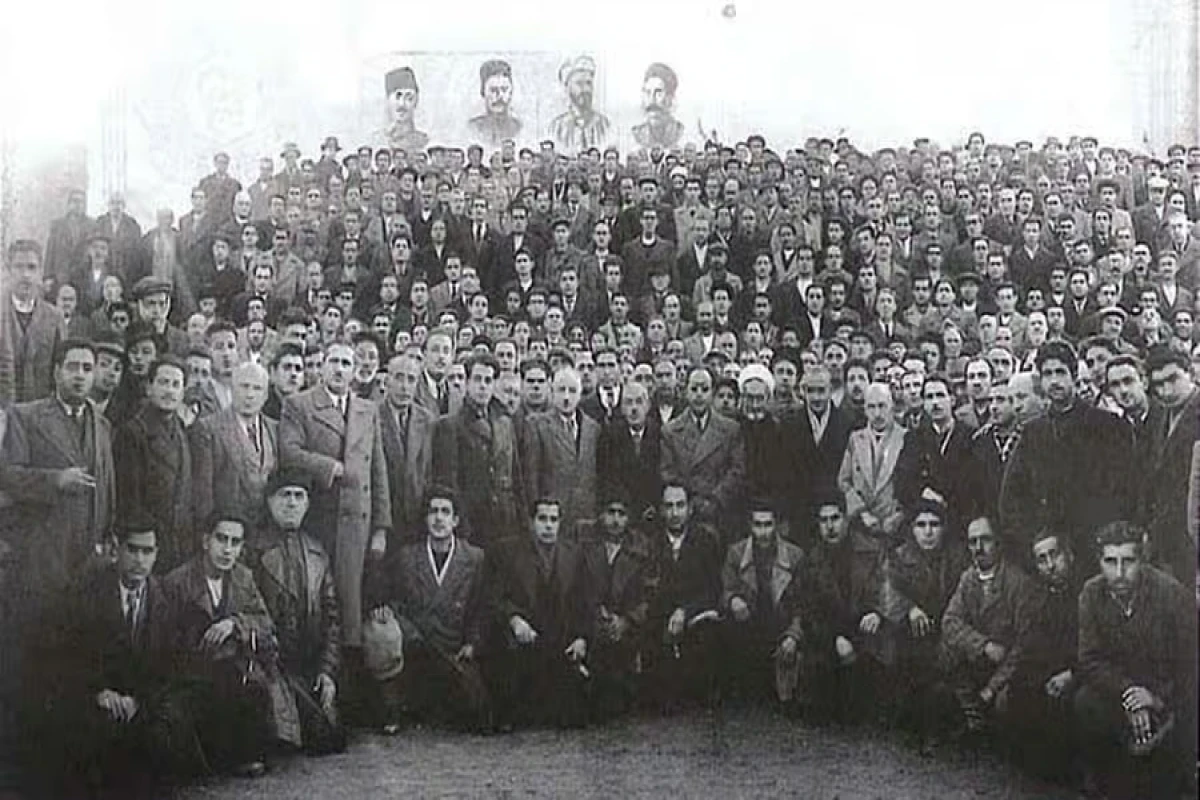
(Alongside Sayyed Jafar Pishevari, other leaders and members of the Azerbaijani Democratic Party pictured beneath portraits of Sattar Khan, Bagher Khan, Sheikh Mohammad Khiyabani, and Heydar Khan Amoghlu)
The Flag of Sattar Khan waving in Tabriz
The Minister of War of the Azerbaijan National Government (1945–1946), General Jafar Kavyan, made a very interesting and thought-provoking statement. He said that we have already learned from our past and will no longer repeat the mistakes of 40 years ago. We will now fight not for Iran, but for Azerbaijan. If we go back 40 years from the date when Jafar Kavyan made this statement (1946), we reach the time of the Constitutional Movement (1905–1911). This means that the words spoken today by Sattar Khan’s opponents were said approximately 80 years ago by Jafar Kavyan. However, unlike the current opposition, neither Jafar Kavyan nor other leaders of the Azerbaijani Democratic Party ever opposed Sattar Khan and the constitutionalist fighters.

(Minister of War of the Azerbaijan National Government, General Jafar Kavyan)
During the period of the Azerbaijan National Government, Sattar Khan, the constitutionalist fighters, and Sheikh Mohammad Khiyabani were always remembered with respect. In fact, at that time, a statue of Sattar Khan was erected in Tabriz, and a flag bearing his image was flown. On the other hand, many of the surviving constitutionalist fighters joined the Azerbaijani Democratic Party and the Azerbaijan National Government.

(At the opening ceremony of Sattar Khan’s statue in Tabriz, Jafar Pishevari, other leaders and members of the Azerbaijani Democratic Party are participating)
Those who place Sattar Khan and Pishevari on two opposite sides
In November 1945, the Great People’s Congress, which decided to establish the Azerbaijan National Government, began its work with a speech by Sattar Khan’s brother, Haji Azim Khan and a month later, when the Azerbaijan's Milli Majlis opened since the speaker of the parliament and members of the Presidium had not yet been elected, Haji Azim Khan opened and managed the assembly. Sattar Khan’s daughter also supported the Azerbaijan National Government and earned the government’s respect.

(Sattar Khan’s daughter and Sayyed Jafar Pishevari)
I agree that history speaks of the past and is not a place for predictions. Nevertheless, as a researcher, based on historical evidence, I would like to offer my own perspective. I believe that if Sattar Khan had not been shot in the leg in Tehran’s Atabey Garden and had not lost his life as a result of that wound, he would undoubtedly have been one of the leaders of the Azerbaijan National Government in 1945.
Those who placed Sattar Khan and Pishevari on opposing sides, or who view them in completely different ways, should remember that without the lessons gained from Sattar Khan’s movement for the Azerbaijani Turks, the people might not have decided to establish the National Government in 1945. Indeed, on the very day—and even the hour—of the opening of the Great People’s Congress, the Azerbaijani Democratic Party sought the restoration of the “Provincial and District Councils” mentioned in the Constitutional Charter of the Constitutional Revolution but never implemented. Pishevari himself had proposed this idea in his speech, but during the course of the congress, the lessons drawn from history changed his position.
Although the sentence we quoted from Jafar Kavyan was not yet stated during the congress, the mentality of the majority of Azerbaijanis at that time was the same. They believed that the central government could not be trusted and that Azerbaijan must establish its own government. In the end of the congress, they also came to this decision. However, let us not forget that the factor that led them to make this decision was the lessons they had learned from the past. To be frank, if the Azerbaijani Turks had not participated in the Constitutional Revolution and had not gained the experiences they had with Sattar Khan, how would they have come to the conclusion in 1945 that the central government could no longer be trusted and that the Azerbaijan National Government must be established?
Kavyan was a child during the Constitutional Revolution, but played an influential role in the Khiyabani movement
Today, it is possible to view the Constitutional Revolution and even Sattar Khan from a different perspective and even oppose them. However, let us not forget that the Azerbaijani Turks who joined this movement between 1905 and 1911 did not have the experience that existed in 1945. In other words, this path had to be taken so that its results would serve as valuable experience for future generations. From this point of view, the history of every nation, consisting of fragmented details and characteristics, forms a unity. That is, when examining and studying historical events, they should not be approached separately but as a complex whole together with preceding and subsequent events.

(Sattarkhan)
I truly cannot understand those who pit Sattar Khan, Sheikh Mohammad Khiyabani, and Pishevari against each other, presenting one as a national hero and the other as a traitor. Sheikh Mohammad Khiyabani himself was also one of the leaders and fighters of the Constitutional Movement. In his speeches, he repeatedly praised Sattar Khan and regarded the movement he initiated as a continuation of Sattar Khan’s path. Many of those who joined him, including well-known fighters such as Zeynalabdin Giyami and Nurullah Khan Yekanli, had previously joined the Sattar Khan movement. These individuals later joined the Azerbaijani Democratic Party and became founders of the Azerbaijan National Government.

(Sheikh Mohammad Khiyabani)
General Jafar Kavyan, whom we quoted earlier, was the son of one of Sattar Khan’s fellow fighters. Kavyan was a child during the Constitutional Revolution, but played an influential role in the Khiyabani movement and, as we mentioned, served as the Minister of War in the Azerbaijan National Government.
We discussed above the attitude of the leaders of the Azerbaijani Democratic Party towards Sattar Khan and Sheikh Mohammad Khiyabani. These leaders considered themselves successors of Sattar Khan and Sheikh Mohammad Khiyabani. They knew very well that being successors of Sattar Khan and Sheikh Mohammad Khiyabani did not mean simply repeating what they had done. They knew very well that, while being successors to earlier leaders, it was necessary to analyse events, recognise mistakes, and act in accordance with the new situation. For this reason, they saw not contradiction, but continuity between those three great movements.

(Sayyid Jafar Pishevari)
The Role of Mahammad Amin Rasulzadeh in the formation of the Azerbaijani Democratic Party
Although the Constitutional Movement (1905–1911), Sheikh Mohammad Khiyabani’s Rebellion (1920), and the Azerbaijan National Government (1945–1946) had different circumstances, we argued and presented facts that there was no contradiction between them; on the contrary, there was historical continuity. We discussed Sheikh Mohammad Khiyabani’s view of Sattar Khan and Pishevari’s views on both Sattar Khan and Sheikh Mohammad Khiyabani. We talked about the people who participated in all three movements. According to historical documents, the number of active participants in all three movements was by no means small. However, at the end of the article, I would like to draw attention to one more point: the name of the Azerbaijani Democratic Party. This was the same name used by Sheikh Mohammad Khiyabani.

(Mahammad Amin Rasulzade, later recognised as one of the founders of the Azerbaijani Democratic Party)
The Democratic Party was established in 1908 by well-known Azerbaijani figures such as Mahammad Amin Rasulzadeh, Sayyed Hasan Taghizadeh, Sayyed Mohammadreza Musavat, and Sheikh Mohammad Khiyabani. In 1920, when Sheikh Mohammad Khiyabani started a movement against the central government in Tabriz, he used that same name. However, since that day, the party that emerged in Tehran began to operate not as an Iranian party but as a South Azerbaijani party. Pishevari’s reuse of that name in the 1940s was by no means accidental. Because, as we said, these leaders believed that they were not opposites but successors to one another. Thus, the party’s name supports the idea we presented in this brief article, namely the concept of historical continuity.


 Follow us on Telegram
 t.me/apanewsaz
 Follow us on Instagram
 Follow us on TikTok
 Follow us on Facebook
 Follow us on X


