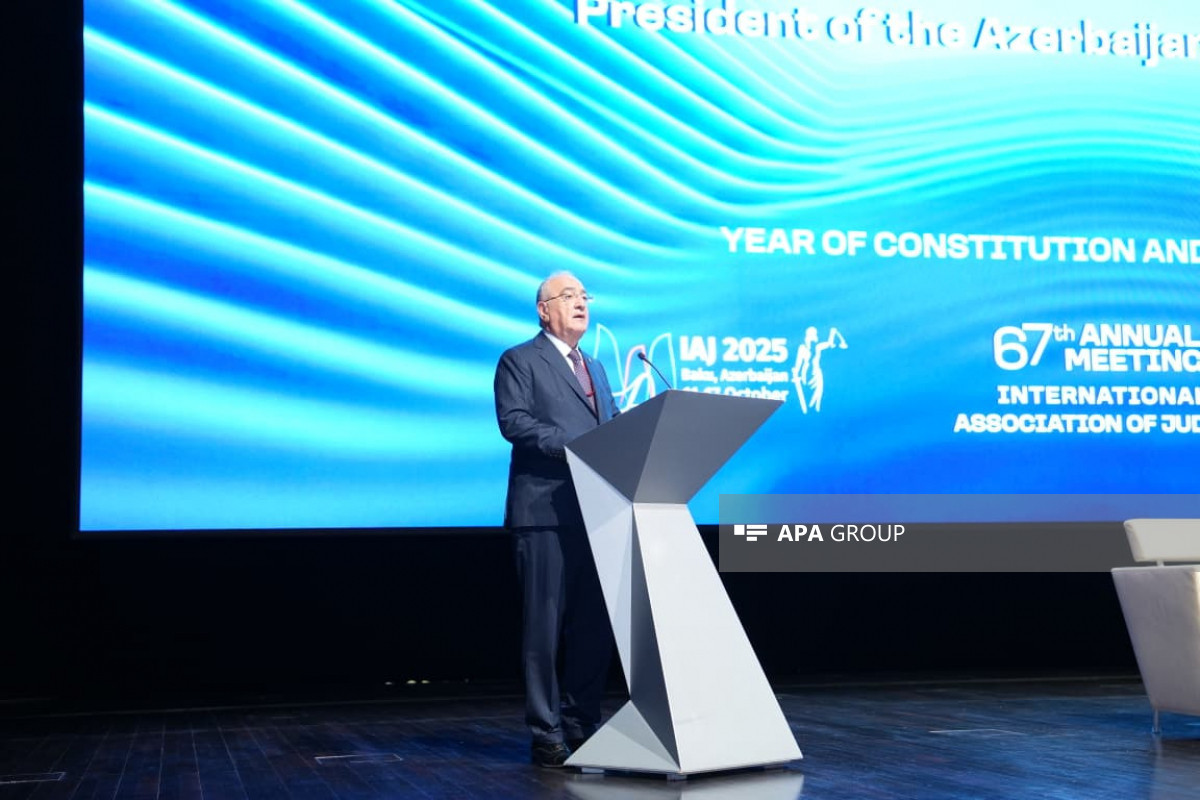


The implementation of the principle of separation of powers and the effective organization of relations between the branches of power are among the key requirements of a legal state, said the Chairman of the Judges’ Union of Azerbaijan, Ramiz Rzayev, at the international conference under the theme “The Relationship Between the Judiciary and the Other Two Branches of Government” dedicated to the “Year of Constitution and Sovereignty” as part of the 67th General Assembly of the International Association of Judges (IAJ), APA reports.
He stated that one of the main foundations of a democratic society is the legal state: “In the construction of a legal state, the implementation of the principle of separation of powers is a fundamental condition. As Charles Montesquieu noted in his famous work "The Spirit of the Laws," if the judiciary is not separated from the legislative and executive powers, there can be no talk of any freedom.”
He added that one of the fundamental bases of the modern constitutional system is the division of state power into legislative, executive, and judicial branches: “This factor is a necessary condition that prevents centralization and abuse of power, and serves to guarantee human and civil rights and freedoms, the supremacy of law, and democracy. The main element that ensures the separation of powers is the authorities held by each branch of power. It is precisely depending on the relationship between the powers belonging to various government bodies that one can determine how correct and strong the separation of powers is.”


 Follow us on Telegram
 t.me/apanewsaz
 Follow us on Instagram
 Follow us on TikTok
 Follow us on Facebook
 Follow us on X
 UPDATED'>