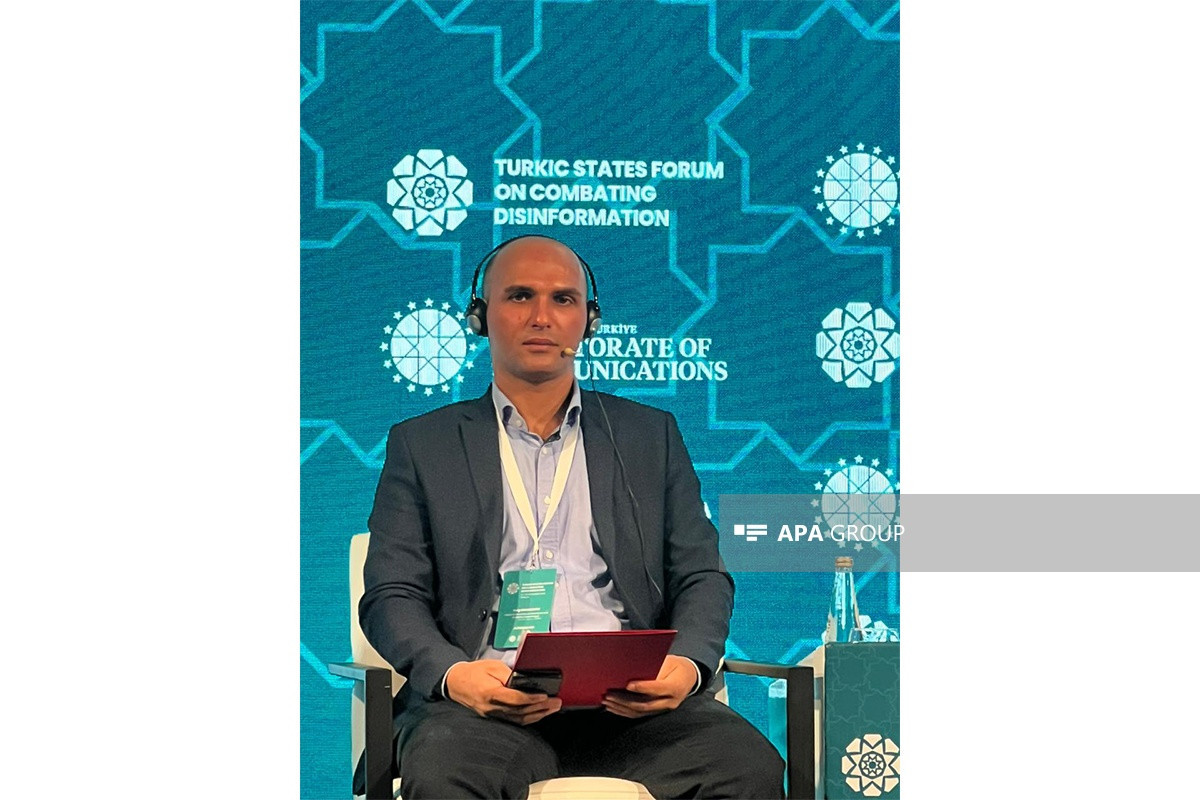


“Disinformation is not accidental; it is deliberately created and, in addition to shaping false public perceptions, targets relations between states,” said Faig Mahmudov, Head of the International Relations and Analytics Department of APA Information Agency, during his speech at the Turkic States Forum on Combating Disinformation held in Ankara under the organization of the Communications Directorate of the Presidential Administration of the Republic of Türkiye, APA reports.
He stressed that disinformation has become an integral part of traditional security concepts.
He noted that information containing Turkophobic and Islamophobic content, particularly targeting Turkic-speaking countries, creates confusion in societies and negatively affects public opinion. According to him, the most effective approach to counter such threats is to demonstrate a joint and principled stance: “Fake news directed at one country should also be a matter of concern for other countries and be assessed in a timely and coordinated manner.”
The department head emphasized that prompt information exchange, institutional cooperation, and professional media solidarity can significantly reduce the impact of disinformation.
He added that in Azerbaijan, immediate responses are provided whenever cases of disinformation are identified in order to safeguard both domestic stability and international relations. According to him, official state bodies, the Media Development Agency, and media outlets take swift and coordinated action within their respective mandates.
It was also noted in the speech that the recent deepening of cooperation among Turkic states and its increasingly institutionalized nature have not gone unnoticed by certain circles. It was emphasized that these processes are being accompanied by Turkophobic approaches, particularly through the dissemination of false and manipulative information aimed at undermining trust between brotherly countries.
Mahmudov further stated that in the current information environment, it is impossible to completely eliminate disinformation and fake news. However, failure to respond in a timely and appropriate manner to deliberately spread disinformation—serving destructive intentions and circulated through both traditional media and social platforms—could lead to larger-scale problems.


 Follow us on Telegram
 t.me/apanewsaz
 Follow us on Instagram
 Follow us on TikTok
 Follow us on Facebook
 Follow us on X