













APA presents an article by Mahammad Rahmanifer titled "The road to National Government" as part of the "Explore South Azerbaijan" project.
Previous articles within the project can be found here.
Introduction
Although the Azerbaijan National Government, which officially announced its establishment in the city of Tabriz on December 12, 1945, lasted only a year, it had a very serious historical significance for both its supporters and opponents. Thus, not only in books and articles written in the field of history, but also in the analysis of the current problems of Iran and South Azerbaijan, this government is widely referred to by both its opponents and supporters. The opponents of this government, ignoring the social context and social roots of the formation of such a movement, simplify the issue and try to prove that it was founded by the USSR. If they could supposedly prove that the Soviet Union was involved in this, they would have found the answer to everything. They deliberately try to hide how much this government was accepted and even loved by the South Azerbaijani Turks, and want to link everything to the Soviet Union. However, referring to historical documents, this government was the result of the national will of the South Azerbaijani Turks and received serious support from the people.
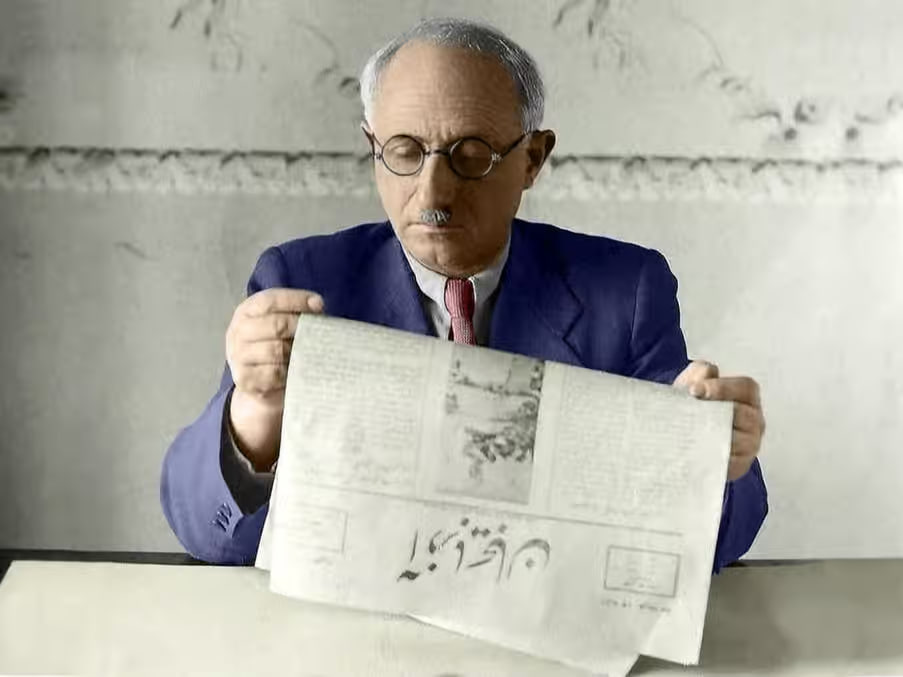
Chairman of the Azerbaijan Democratic Party Seyid Jafar Pishevari reads the newspaper "Azerbaijan" published in our native language
On the other hand, the South Azerbaijani Turks, especially the younger generation, who strive and struggle for the realization of their demands, see this one-year period of the Azerbaijan National Government as the only period in which many of the desires of the South Azerbaijani Turks, for example, the desire to be able to receive education in their native language, were realized to some extent.
On the eve of the anniversary of this historical event, we would like to briefly explain the structure of this government, its social roots, and the support it received from the Azerbaijani people.
The road to the National Government of Azerbaijan
For centuries, the Azerbaijani region, besides being the capital of various Turkish governments, has always been a center of special interest. This privileged situation, along with economic progress, has also created conditions for the formation of Azerbaijan-centered thinking. As Azerbaijan gradually lost its centrality and relative prosperity in the 19th century, decentralization tendencies strengthened and various movements began to appear against Tehran, such as the "Mashruta" and the "Azadistan" initiated by Sheikh Muhammad Khiyabani.
As a result of the coup supported by the British against the Qajar dynasty in 1921, Reza Khan entered the political power pyramid in Iran and officially ascended the throne in 1925, overthrowing this dynasty. Reza Shah seemed to want to take the bitterness of the Qajars becoming Turks out of the South Azerbaijani Turks. The centrist policies implemented during his time, the ban on the Azerbaijani Turkish language, and the ongoing discrimination and injustice against the South Azerbaijani Turks led to increased discontent among the South Azerbaijani Turks and their tendency to distance themselves from Tehran.
In the same years, an American diplomat who visited Tabriz in his report to the US State Department described the miserable economic and living conditions of Tabriz and the role of the Reza Shah government in creating such a situation, expressing the hatred of the Azerbaijani people towards Reza Shah. He wrote that if any danger threatened the Reza Shah government, the Azerbaijani people would never support it.
The American diplomat's prediction came true only a few years later. Thus, when the Soviet and British troops occupied Iran during World War II, the Azerbaijani Turks not only did not support Reza Shah, but on the contrary, they joyfully welcomed the news of his exile by the Allies. Just a few days after Reza Shah's exile, the "Azerbaijan Society" announced its presence in Tabriz and began publishing the newspaper "Azerbaijan". Although this newspaper, which published news and poems in Azerbaijani Turkish and Persian, could not last more than 6 months, the voice of protest in Azerbaijan did not cease with its closure and the dissolution of the “Azerbaijan Society”.
Widespread and even radical activities were being carried out in various parts of Azerbaijan against the return of the Pahlavi dictatorship. Azerbaijani peasants, who saw the beys (landowners) and gendarmes as representatives and symbols of the Tehran government in Azerbaijan, began to form local resistance groups and clashed with them. In fact, these popular resistance groups formed the initial core of the fedai groups that later became the main military force of the Azerbaijani National Government. That is, in fact, the fedai groups were formed before the establishment of the Azerbaijani National Government and even took control of some cities and villages of Azerbaijan.
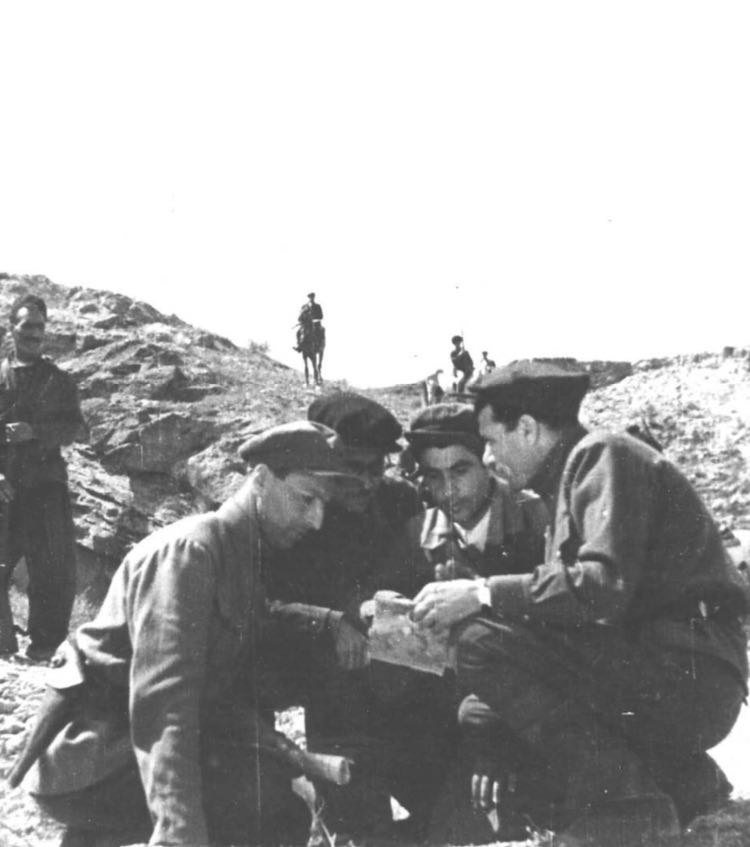
Commander of the Fedayeen detachments, Ghulam Yahya Daneshyan (first from right)
The situation in the cities of Azerbaijan was as tense as in the villages of Azerbaijan. Azerbaijani intellectuals, poets and writers, who had escaped from the oppression and censorship of Reza Shah, were drawing the people against the central government with their writings, poems and speeches. Meanwhile, the right to education in the mother tongue was seriously demanded. This demand was raised even within the largest and most organized party of that time, Tudeh, and caused serious tension within the party. In such a situation, a few days before the establishment of the Azerbaijan Democratic Party, the Tudeh party sent an inspector with special powers to Tabriz to expel supporters of mother tongue education and Azerbaijanis from the party.
Based on what has been mentioned very briefly here, it can be boldly claimed that the Azerbaijan Democratic Party and the Azerbaijan National Government are actually the result of the national will of the South Azerbaijani Turks. Indeed, one can see the most urgent demands of the Azerbaijani nation both in the manifesto of the Azerbaijan Democratic Party and in the programs announced by the Azerbaijan National Government. For these reasons, when the Azerbaijan Democratic Party was announced on September 3, 1945, tens of thousands of people from South Azerbaijan joined the party in a short period of time. Among those who joined the party were people from all walks of life, including peasants, city dwellers, clergymen, intellectuals, landowners, farmers, workers, merchants, and soldiers.
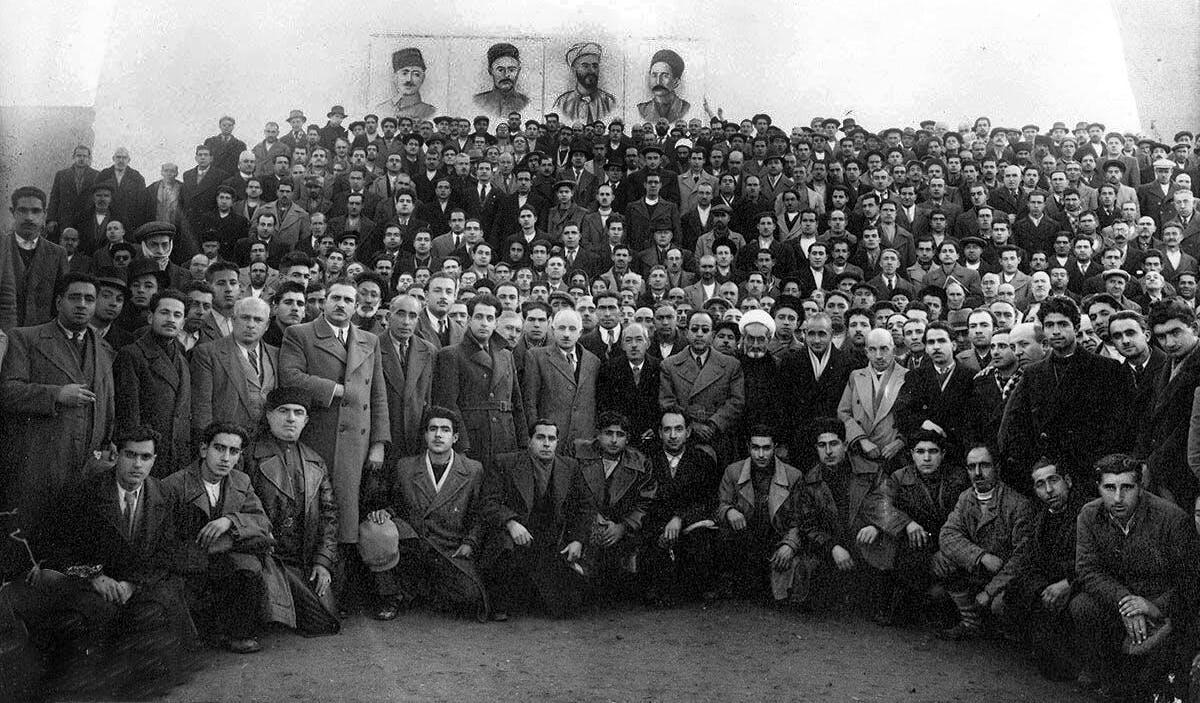
Seyid Jafar Pishevari with a group of members and leaders of the Azerbaijan Democratic Party
Azerbaijan People's Congress
The Southern Azerbaijan Constitutional Movement (1906-1911) also played a decisive and decisive role. Frankly, if it were not for the resistance of the Azerbaijani Turks led by Sattar Khan (1868-1914), the success of this uprising would have been impossible. Before the Constitutional Movement was included in the Constitution, Provincial and Provincial Councils (anjumans) were established in Southern Azerbaijan and played a very important role in the success of the Constitutional Movement. However, immediately after this success of the Constitutional Movement, these councils were closed.
Approximately 40 years after the Constitutional Movement, some Azerbaijanis, including some of those who participated in the same uprising, gathered in Tabriz and demanded that the government reopen the Provincial and Provincial Councils. Even on the opening day of the Azerbaijan People's Congress, the newspaper "Azerbaijan" put forward the demand for the restoration of the Provincial and Provincial Councils, emphasizing the preservation of Iran's independence and territorial integrity.
However, during the Azerbaijan People's Congress, these forty-year-old wounds slowly began to open and bleed again. Although the issue of national autonomy proposed by Pishevari for South Azerbaijan was not seen to be in agreement with the articles of the Iranian Constitution in terms of content at the congress, both Seyid Jafar Pishevari and Ali Shabisteri made speeches once again emphasizing the necessity of establishing Provincial and Provincial Councils within the framework of the Iranian Constitution.
However, at the third session of the congress, Meshkinshehir representative Fattahi emphasized in his speech that he believed that the establishment of the Milli Majlis was better and more necessary than the establishment of Provincial and Provincial Councils.
The next speaker, the representative of the match factory Khorramdel, stated that the Provincial and Provincial Councils had not solved the problems and concluded his speech with the words "Long live the Azerbaijani Milli Majlis".
Zamani, the representative of the city of Hashtrud (Saraskand), emphasized the necessity of establishing the Milli Majlis instead of the Provincial and Provincial Councils.
Another delegate, Hilal Naseri, expressed his views in favor of the establishment of the Milli Majlis as follows: “This congress is like the Constituent Assembly, and you are the representatives of five million people. I propose that this Constituent Assembly form our Milli Majlis instead of the Provincial and Regional Councils.”
Thus, the demand for Provincial and Regional Councils, which was cautiously voiced in the first speeches at the congress, was gradually replaced by the demand for the Milli Majlis, which was boldly voiced.
Later, Cheshamzer took these demands a step further in his speech, saying, “In order to complete the autonomy of Azerbaijan, let us call this parliament the Milli Majlis and let the Azerbaijan National Armed Forces be established,” and openly stated the demand for autonomy.
In his concluding speech, Pishevari proposed the establishment of a five-member commission to prepare decisions and report to the Congress in the afternoon, saying: “This is the Constituent Assembly. I think that the task of electing the Milli Majlis or the Provincial Councils should be clearly stated in the decisions of the [Constituent Assembly].”
The Azerbaijan People’s Congress, which favored the re-establishment of the Provincial and Provincial Councils, announced in a statement issued after two days of lengthy speeches and heated discussions that the National Congress, held with the signatures of one hundred and fifty thousand people and the participation of seven hundred representatives, had declared itself the Constituent Assembly by the will of the Azerbaijani people, that the decision to establish the Milli Majlis instead of the Provincial and Provincial Councils had been made, and that, not content with this, it had decided to establish the National Government as soon as possible in order to complete the process of national autonomy.
The 14-point declaration published by the Azerbaijan People’s Congress reflected all the radical proposals put forward at the congress, except for Cheshmazer’s proposal to establish the Azerbaijani National Armed Forces. However, it seems that this was not explicitly mentioned in the aforementioned declaration due to purely political considerations. Otherwise, it would not have been possible to protect the national government, its institutions and achievements without the formation of a national army.
In fact, as we have already mentioned above, the national army, called “Fedai” in the writings of the Azerbaijan Democratic Party, was established by the people before the Azerbaijan People’s Congress began its work, and at the time the congress was established, some cities of Azerbaijan such as Sarab and Miyana and many villages were under the control of these fedai groups. In our opinion, the change in the direction of speeches and decisions at the Azerbaijan People’s Congress can be attributed to the news that the representatives received about the successes of these fedai groups and the sense of self-confidence they experienced in this regard. Because it was precisely in those days that the fedai groups achieved great victories on several fronts.
Just a few days after the activities of the Azerbaijan People’s Congress were concluded, the Executive Committee held elections for the people to elect the members of the Milli Majlis. On November 27, 1945, elections to the Azerbaijani Milli Majlis were held in all the cities and villages of South Azerbaijan. The fact that this election, which had a great influence in the country, was held only in the Azerbaijani region and that women had the right to vote in this election for the first time has a very significant historical value.
On December 6, 1945, the results of the elections to the Azerbaijani Milli Majlis were announced. On December 11, 1945, the fedai groups took control of many cities and villages of Azerbaijan. However, the Iranian armies located in the cities of Maragha and Ardabil, Tabriz and Urmu still did not want to surrender. However, just one day after the official establishment of the Azerbaijani National Government, the commanders of the Tabriz army realized that resistance was no longer useful and prepared to lay down their weapons.
The Azerbaijani Milli Majlis opened on December 12, 1945 at 8:00 in the morning amidst great excitement. This session was attended by 75 out of 101 delegates elected by the South Azerbaijani Turks. Some delegates who did not attend the opening were volunteering to support the fedayeen groups on the front lines where fierce clashes were ongoing.
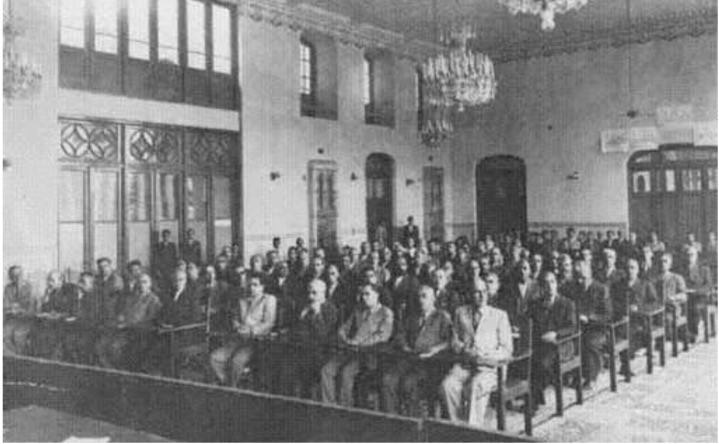
The first meeting of the Azerbaijani Milli Majlis in the South
After the swearing-in ceremony of the deputies, the approval of the internal regulations of the parliament, and the election of the chairman and deputy chairman of the parliament, the issue of establishing the Azerbaijani National Government was put on the agenda of the parliament, and Pishevari was instructed to present his cabinet to the parliament in order to receive a vote of confidence.
Thus, the Turks of South Azerbaijan established their own government 20 years after the establishment of the Pahlavi government in Iran. The Azerbaijani people were very happy that finally, the dark and gloomy period of the 20-year Pahlavi rule over Azerbaijan was over and from that day on they would determine their own destiny, spend their own income on themselves, go to school in their native language, play their own music…
But this was just the beginning. What decisions did the Azerbaijani National Government make? What work did it do? What achievements did it achieve? What happened to it in the end? Wait for our second article to read the answers to such questions...


 Follow us on Telegram
 t.me/apanewsaz
 Follow us on Instagram
 Follow us on TikTok
 Follow us on Facebook
 Follow us on X


