

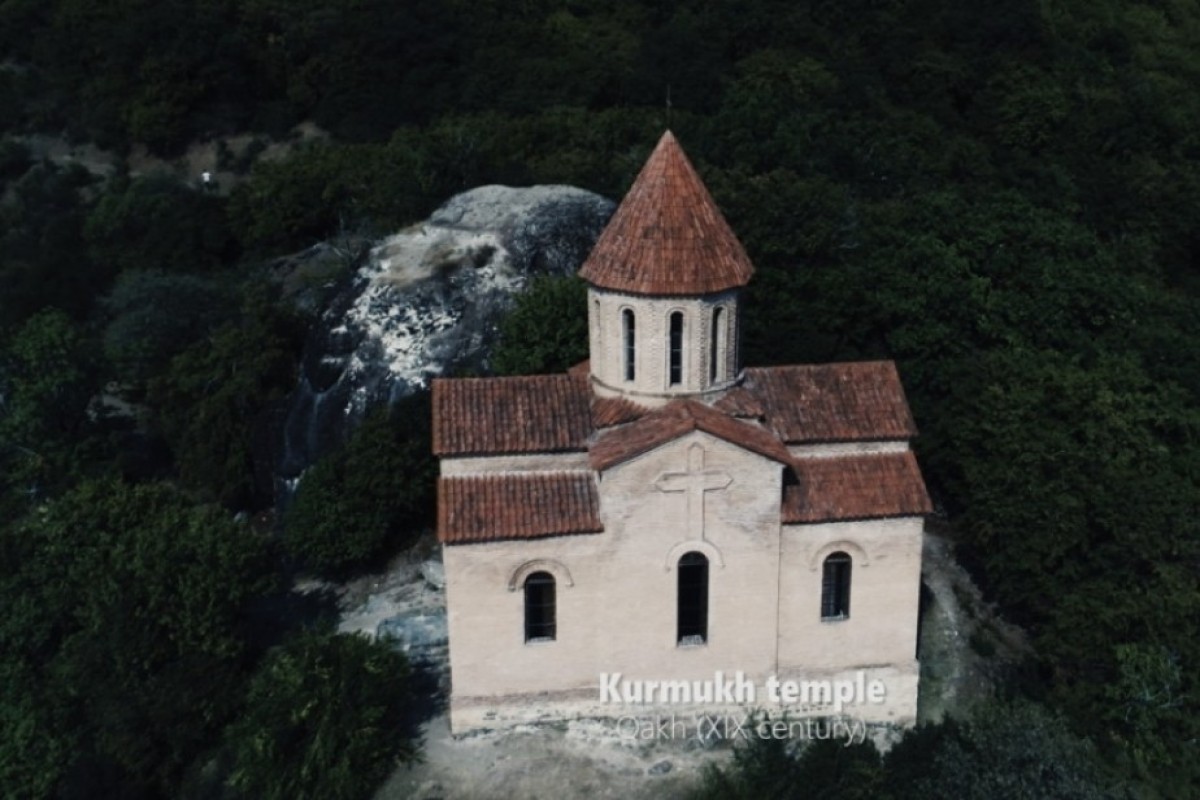


For days, we have been watching to see how the disputes surrounding the Kurmuk temple will end.
Finally, Armenians have found new voices to join their chorus.
Normally, there are cultural, religious, political and ethnic disagreements between Gregorian Armenians and Orthodox Georgians. Alongside Azerbaijan, Armenians also lay claim to certain territories of Georgia. Moreover, there has been an enduring rivalry over which Christian community in the Caucasus is older and more predominant.
Before examining the reasons behind this neighboring chorus, let us try to bring to light several issues that everyone in our country — above all, historians conducting research in this field — should know.
Kurmuk temple and its history
First of all, the Kurmuk temple, which the Georgian segment has recently rushed to defend, is located in Azerbaijan’s Gakh district, near the Kurmuk River. The earliest remains of the temple are attributed to the period of Caucasian Albania, approximately the 1st–3rd centuries. Archaeological research conducted in 2006 established that the site contains construction and reconstruction phases dating to different periods.
The existing structure is a religious building known as the “Church of St. George,” constructed in 1892–1894, during the period of Tsarist Russia, over the remains of the ancient temple.
Kurmuk is also a pilgrimage site visited by both Muslim and Christian residents of the region, where Kurmukoba ceremonies are held in May and November. Its belonging to the Albanian heritage is confirmed not only by historical sources, but also by the family ties and memories of the author of these lines.
How did the Albanian Apostolic Church disappear?
The Albanian Apostolic Church was officially abolished on March 11, 1836, under a decision and relevant regulation of the Holy Synod of Tsarist Russia, following a process that had begun in 1830.
After the abolition of the Albanian Apostolic Church — which should not be confused with the Armenian Apostolic Church — its dioceses, as well as its material and spiritual heritage and property, were placed under the authority of the Armenian Gregorian Church. In the initial period, many churches in the Azerbaijani provinces were subordinated to the Gregorian Church.
In the 1850s, Tsarist Russia came up with the idea of creating a religious community loyal to Orthodoxy in the territory of the Jar-Balakan community, which was rebellious, staged uprisings and refused to submit to the empire. Thus, Orthodox churches were built over the ruins of Albanian churches in the region, as the empire sought to create a support base for itself within the Christian community.
Kurmuk was one of them. The temple was restored, its crosses and altar section were altered, and it was renamed “St. George.”
Thus, some of the churches inherited from Caucasian Albania gradually deteriorated over time. The conversion of the local population to Islam also reduced interest in restoring the churches. At the same time, it was not possible for the Muslim population living under Orthodox Tsarist Russian rule to claim ownership of the ancient Albanian church heritage.
Since Kurmuk was turned into the Orthodox Church of St. George, the arrival of Georgians there for worship is, to a certain extent, understandable. Even today, no one has prohibited them from doing so. On the contrary, local executive authorities create the necessary conditions for them to worship normally on church days.
Moreover, churches have been built in all villages of Gakh inhabited by Christian Ingiloys, and they are free to worship. Although during the Soviet period some mosques in the region were closed to Muslim worshippers and converted into warehouses, storage facilities and other uses, the approach toward churches was different.
What happened to the “last Albanian”?
Who did the Kurmuk Albanian temple belong to before it was subordinated first to the Armenian and later to the Georgian Church?
According to accounts from members of the older generation of the local population, the last bishop of the Kurmuk diocese was Joseph (Yusif), originally from the village of Zayam in Gakh, who was known as the “Black Priest.”
Together with his community, he refused to accept the subordination of the Kurmuk temple to the Gregorian Church and therefore resisted from 1836 until the abolition of the Ilisu Sultanate in 1844.
To put an end to the church dispute once and for all, the Caucasus Viceroyalty sent its subjects to arrest the Black Priest. However, rather than changing his religious faith, he chose death.
Believing that the Tsar’s men would not touch someone who had taken refuge in a church, he did not leave the building for several days. Eventually, a decision was made to break down the church doors and arrest the priest. The priest escaped through a secret door in the church, unknown to anyone at the time, and threw himself from a cliff.
The Tsar’s men stood guard around the church for three days, preventing locals from retrieving the priest’s body. Three days later, they left the area. Courageous members of the community lit torches at night, recovered the priest’s body from the overgrown rocks and buried him inside the church. Archaeologists have confirmed that during restoration work at the Kurmuk church, bones of saints who had once been buried there were found inside.
His robe embroidered with crosses, torn when his body struck the rocks, a silver ring bearing an Albanian cross on its upper part, and other belongings were preserved in his family’s chest until the Soviet period. Later, the family handed them to the Shirak family, acquaintances living on the other side of the Ganikh River, in order to protect the items from the Soviet security services — the OGPU, or Joint State Political Directorate — and those belongings were never returned.
The descendants of the Black Priest, the last Albanian of the Kurmuk diocese, still live in the village of Zayam.
Claims extend beyond Kurmuk to the Seven Churches Monastery
In the territory of the village of Lakit in Gakh, in a mountainous area stretching from the famous Mamirli waterfall toward the village of Lakit-Kotuklu, there are the ruins of a large church complex known as the “Seven Churches Monastery.” It is dated approximately to the 4th–5th centuries, the period of Caucasian Albania.
Its remains are also sufficient to scientifically demonstrate that it was a circular Albanian temple complex. Since the site is in a mountainous area and difficult to access, few people visit it. Most tourists are unaware that such a complex exists there.
Albanians built their places of worship on the highest possible mountain slopes in order to be “closer to God” and so that “their prayers would reach Him more quickly.”
Driven by journalistic curiosity, I have visited the site many times together with my history teacher, Majid Mehrani, one of the best experts on the region, and have taken many local and foreign guests there to show them the traces of our ancient Albanian heritage.
During my visit last year, for the first time I saw groups of people arriving from Georgia, lighting candles and praying among the ruins, shedding tears, and taking photos and videos. There were Georgian journalists and bloggers among them. Their stand-ups caught my attention: they stated that “Saingilo” — the name Georgians use for the Gakh-Balakan area — was ancient Georgia and that these territories, together with their ancient churches, were part of Georgian heritage.
Once again, I became convinced that this approach is not limited only to the Kurmuk temple. However, this is not a new issue.
There is a book by Giorgi Gamkharashvili titled “Saingilo: A Brief Overview,” published in Tbilisi in 1960. The book contains illustrations of ancient temples and churches in the Gakh, Zagatala and Balakan districts. Beneath them are descriptions such as “ancient Georgian church” and “ancient Georgian monument.”
Even the village of Zayam, which today has completely moved away from its Ingiloy identity and become Turkicized, is presented as an “ancient Georgian village,” while the Albanian graves there bearing crosses are described as “ancient Georgian graves.”
The book was written with reference to works by earlier Georgian authors, including M. G. Janashvili’s “Saingilo” (Tbilisi, 1910, 231 pages), Z. Edili’s “Saingilo” (Tbilisi, 1947, 181 pages), M. Dumbadze’s “From the History of Eastern Kakheti (Saingilo)” (Tbilisi, 1953), and others.
It is reported that material from these books was later included in Georgian secondary school history textbooks and taught as part of the “History of Ancient Georgia.”
Policy of Georgianizing Muslim Ingiloys with Stalin’s backing
In the 1930s and 1940s, Georgians, taking advantage of privileges granted by Soviet leader Joseph Stalin, raised the issue of introducing Georgian-language education in schools attended by Ingiloys in the region.
The school in the village of Zayam was also switched to Georgian. Georgian teachers were brought from Georgia to teach the children. Although the older generation spoke the Ingiloy language, the younger generation did not know it well. There were also significant differences between the Ingiloy language and Georgian. Teachers and students had difficulty understanding one another.
Later, our Ingiloy family acquaintances also admitted that because they had not attended school, they did not know Georgian and therefore had difficulty understanding visitors from Georgia.
Subsequently, thanks to Georgian teachers, Ingiloy children learned Georgian. Many of them were granted privileges to continue their education in Georgia.
After some time, Muslim Ingiloys in the region, including in Zayam, began protesting en masse against education in Georgian. Following Stalin’s death, the language of instruction in Muslim schools was changed to Azerbaijani.
Christian Ingiloys, however, continued to study in Georgian. Their textbooks were adapted to Georgia’s education system and brought from Tbilisi.
As a result of these processes, some Ingiloys began referring to “Saingilo” as “Sakartvelo” and presenting themselves as “ancient Georgians.”
Controversy surrounding the Kurmuk church
The Georgian Patriarchate issued a statement expressing concern about works being carried out on the territory of the “Kurmuk–St. George” church. Although the Patriarchate acknowledges that the temple is currently located in the territory of Azerbaijan, it considers it an important monument of the historical and spiritual heritage of Georgia and the Georgian Church.
The Georgian Patriarchate accuses the Azerbaijani side of failing to provide information about the works being carried out around the church and stresses the importance of involving Georgian representatives and relevant specialists in the process.
The Azerbaijani Ministry of Foreign Affairs, meanwhile, issued a statement describing the Georgian Patriarchate’s approach as unacceptable. The Ministry said it was inadmissible to present geographical and historical toponyms located in Azerbaijani territory under other names. It stressed that just as Azerbaijan has always respected Georgia’s territorial integrity and sovereignty, it expects the same attitude from Georgia.
Of course, a monument located within a state’s territory falls under that state’s jurisdiction, and decisions concerning it are also within that state’s authority. After all, when someone repairs and improves their own house or yard, they do not ask their neighbor for permission.
It should not be forgotten that both during the August 2008 events and in the period that followed, Azerbaijan consistently provided Georgia with material, moral and political support.
For years, the dispute with Georgians over Keshikchidagh has also led nowhere. It, too, is part of our Albanian heritage.
It has now been announced that from October 2026, the Kurmuk church will be temporarily closed to tourists in connection with archaeological research and restoration work. Researchers tell us that the purpose is to conduct an in-depth study of the various historical layers of the Kurmuk church and examine its historical and genealogical development, including the period of Caucasian Albania.
This, then, is where the concern stems from. It will become clear that Kurmuk is not simply an Orthodox Georgian monument as described in their history books. The true owners of the heritage of Caucasian Albania will now demonstrate to the entire Christian world that some of the earliest centers where Christianity spread were not confined to Armenia and Georgia. Older civilizations, tribes and peoples lived here and created their own cultural and religious heritage. Later, successive brutal invasions led to the destruction of one of the greatest civilizations in the history of the Caucasus and to the disappearance of the indigenous Albanian tribes of the region.
Why should we claim the Albanian heritage?
I am an Azerbaijani born into a Mughal lineage on my father’s side and an Albanian lineage on my mother’s side. The Albanian monuments here are my heritage and part of my genetic memory. We have family memories worthy of a novel, including the story of the last Kurmuk bishop, Black Joseph. Based on these memories alone, we could produce world-class films, tell the world about our Albanian heritage and prove that we are its true heirs.
Azerbaijan must once again proclaim to the world the history of Caucasian Albania and its churches. Because this is not merely the history of early Christianity; it is the history of the entire region and of human values. Let us not forget that Echmiadzin, the center of the Armenian Church, was known as “Three Churches.” Yet the Seven Churches of Lakit were more influential and predominant.
Ulkar Abdullayeva


 Follow us on Telegram
 t.me/apanewsaz
 Follow us on Instagram
 Follow us on TikTok
 Follow us on Facebook
 Follow us on X