


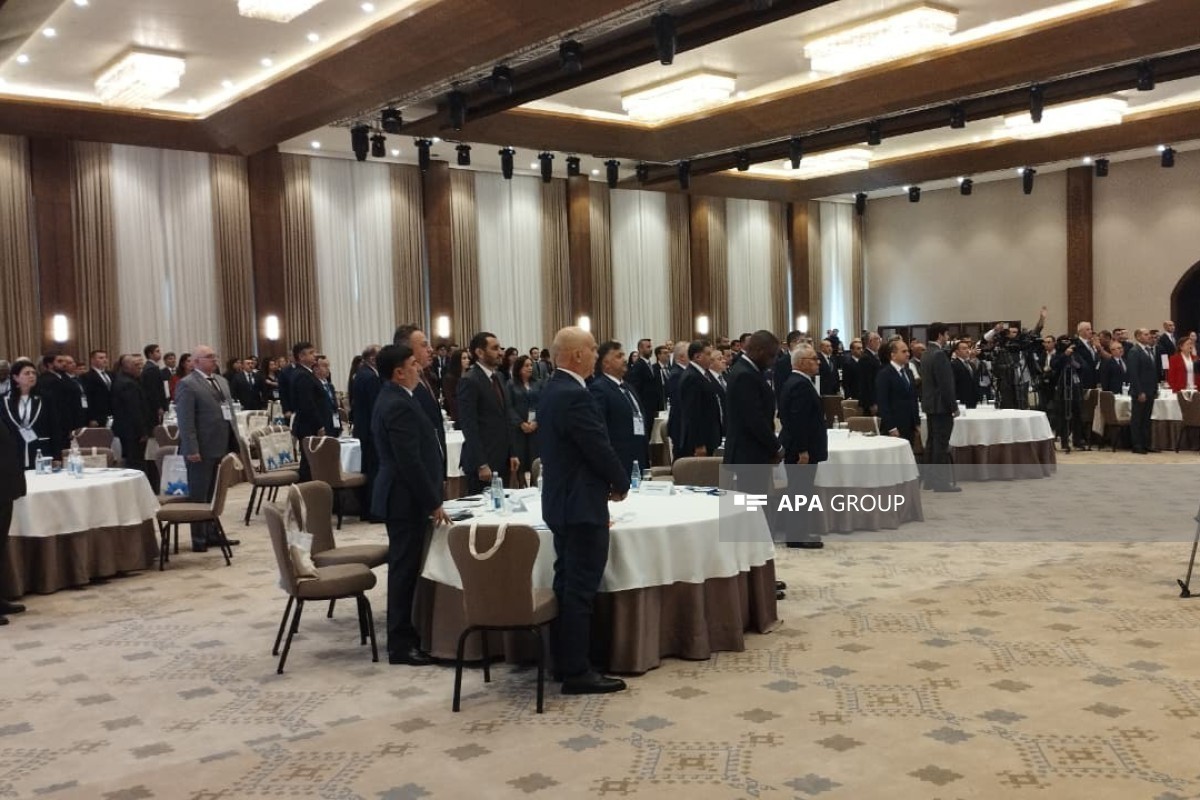
Philip Morris International (PMI) arranged an event on the topic, Technovation: Smoke-Free by PMI, in Abu Dhabi, the capital of the United Arab Emirates, APA reports.
The event started with a screening of the film ‘A Smoke-Free Future.’
Then, Tommaso Di Giovanni, PMI's Vice President for International Communications and Engagement, delivered a keynote speech titled: “Technology and Innovation: Driving Force Behind Global Solutions”.
He emphasized that innovations stand out as the primary driving force. Highlighting that even primitive cave dwellers were innovative, he noted that this was the reason humanity progressed ahead of other species, “Innovation drives society into the future. Applying an innovative approach to cigarettes and nicotine also yields positive results.”
Tommaso Di Giovanni noted that 1.1 billion people worldwide still smoke cigarettes and stated that PMI is focused on developing, manufacturing and commercializing alternative products to cigarettes. “Our goal is to replace cigarettes with better smoke-free alternatives. We adhere to three main principles: If you don’t smoke, don’t start; if you do smoke, quit; If you don’t quit, change.”
“Since 2008, we have invested $12.5 billion toward this goal. Over 1,500 scientists, engineers, technicians, and support staff, are working on this project. We believe that within 10-15 years, with the proper support of governments and civil societies many countries may become smoke-free”.
Speaking on the topic, PMI’s Smoke-Free Journey: Past, Present, and Future, PMI's Chief Executive Officer, Jacek Olczak, stated that the Company has created a $10 billion smoke-free business in under a decade, “This allows us to continue investing. When we launched our alternative IQOS products in 2014, we knew we had to present an appealing product to the public. This required work on the design as well. Over 36 million people have already switched from cigarettes to smoke-free alternatives, and we take pride in this.
However, we also know we could have done more. We face significant challenges due to obstacles created by opponents of new technologies.”
Jacek Olczak mentioned some countries that are currently banning smoke-free alternative products. “By restricting access to alternative options for smokers, we are losing time. Interestingly, no country bans cigarettes, yet some ban alternative products. One of our primary tasks should be to disseminate more information on our products. Science-based information on our products should be shared widely. People should be informed; they cannot be deprived of knowledge. We are also investing billions of dollars to further improve our products.”
He also pointed out that there is excessive misinformation on nicotine, “Combustion is the problem, not nicotine. Chemicals produced by combustion are the root cause of smoking-related diseases. Differently, nicotine, while not risk-free and addictive, is not the primary cause of smoking-related diseases, as we know from the assessment and categorization of the constituents in smoke by different public health organization.”
He recalled that alternative products to cigarettes were first introduced in Nagoya, Japan, 10 years ago, “Currently, Japan has reached a very high adoption of smoke-free product, with a sharp decline in smoking rate. Similarly, in Sweden, the number of smokers is at the lowest level ever and is the lowest in Europe.”
Next, PMI’s Vice President for External Affairs, Andrea Gontkovicova, made a presentation entitled Law. She stated that heat-not-burn tobacco products are better alternatives to cigarettes. Ms. Gontkovicova noted that in some Western countries, switching to smoke-free tobacco products has led to a 25-50% reduction in the number of smokers. “Achieving a smoke-free future requires collective effort. Alternative products are already available in more than 90 countries worldwide. However, we aim to cover all smokers. What needs to be done for this? We believe that products should be accessible and acceptable to consumers, and the flavor issues addressed. More information should be provided on the products, their relative benefits and risks explained, and awareness raised about why switching to these products is a better choice. People should also be informed on how to use these products. Also, one of the key factors is pricing. The tax on these products should be lower than cigarettes to incentivize manufacturers to continue investing and consumers to switch. We do not promote our products to non-smokers; we offer an alternative way and a smoke-free future for those who do not quit smoking.”
She added that New Zealand is leading in switching to alternative non-burning products, “We believe New Zealand will be a fully smoke-free country by 2025. In Europe, Sweden is the leader in this area. Among EU countries, Sweden has the lowest smoking rate, which has dropped to 5.3%.”
PMI’s President for Southeast Asia, the CIS, and the Middle East, Frederic de Wilde, made a presentation on the topic, Information on PMI’s Vision of a Smoke-Free Future.
He stated that the region will play a crucial role in switching to alternative products to cigarettes. According to Frederic de Wilde, the key issue is informing consumers, “Most people are unaware of the harms of smoking, the benefits of smoke-free tobacco products, or the advantages they offer. Economic factors and price alignment also play an essential role. These products should be accessible and banning them is not the right approach. If banned, the number of smokers will only increase. Governments should be influenced to make the right decisions. Our primary goal is to help those who do not want to quit smoking switch to smoke-free alternatives. It is crucial to understand that the issues stem from chemicals formed as a result of the combustion of cigarettes, not nicotine itself. Alternative products involve no burning, only heating. If the advantages of alternative products are scientifically supported, more people will quit smoking and switch to them. More than 36 million people have already switched. This figure shows the future potential.”
The event featured panel discussions on topics, ‘The Rhetoric and Reality of Regulating Smoke-Free Products’ and ‘Key Consumers: Policies That Do Not Sideline Even One Consumer’ and a presentation entitled “PMI’s Multi-Category Portfolio: Offering Choices to Consumers.”
Finally, an exhibition of smoke-free products was arranged. Visitors were provided with detailed information on the advantages and risks of the variety of smoke-free products.


 Follow us on Telegram
 t.me/apanewsaz
 Follow us on Instagram
 Follow us on TikTok
 Follow us on Facebook
 Follow us on X
 UPDATED'>