

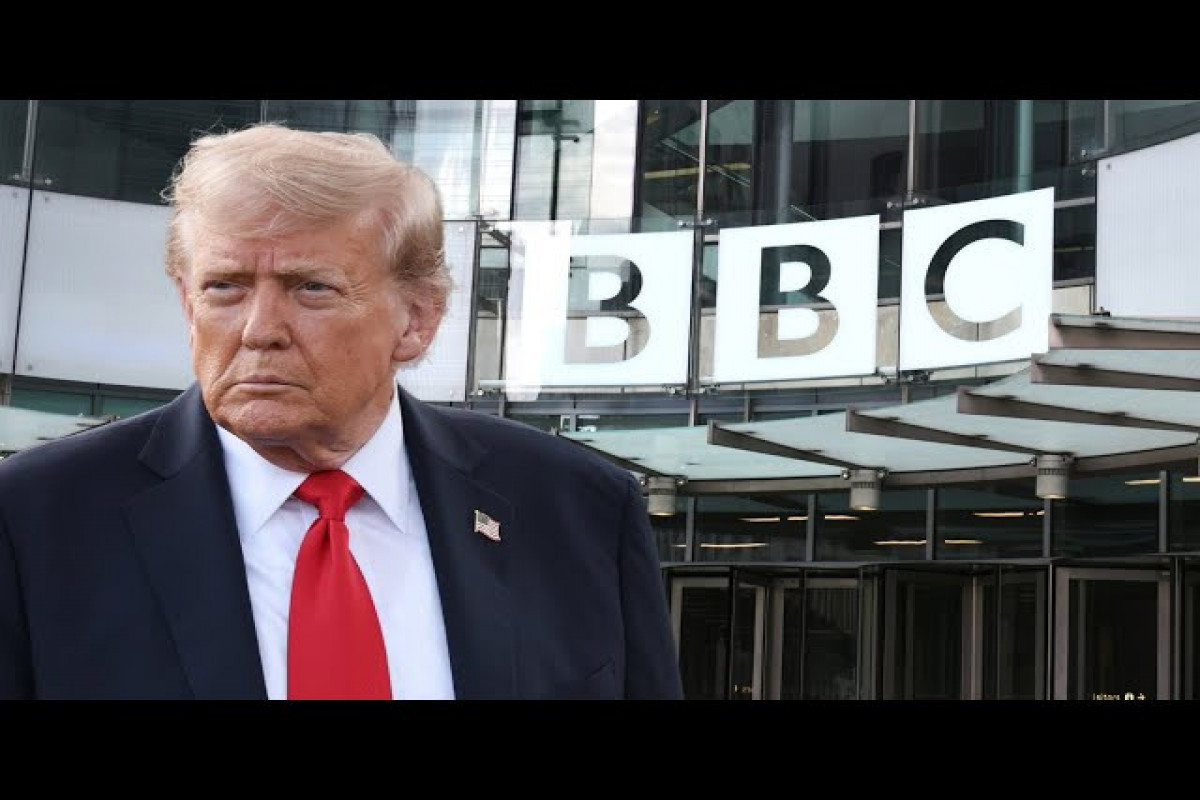


New facts which have emerged regarding the BBC’s distortion of U.S. President Donald Trump’s speech, once again revealed that the biased editorial policy of this media organization, which has been criticized for years, is not accidental but systematic. The source of the allegations is a letter addressed to the Board of Directors by the BBC’s former employee, journalist Michael Prescott. In the document, Prescott explicitly states that, prior to the events of January 6, 2021, Donald Trump’s speech was deliberately taken out of context by the BBC, the chronology was altered, and parts of the speech were selectively cut to give a different meaning to the president’s words. This was not merely an editorial mistake—it was a politically motivated edit aimed at shaping public opinion.
U.S. President's Press Secretary Caroline Levitt also confirmed the accusations in a more pointed manner, calling the BBC a "left-wing propaganda machine" and "an entirely fake media." According to her, the broadcasted video is a material deliberately crafted with bias, edited to portray Trump’s rhetoric as radical, and is another proof of the BBC’s long-standing ideological stance. Media experts argue that altering the context, disrupting the chronology, and using selective footage seriously calls into question the BBC’s claim of objectivity.
The same methodology against Azerbaijan: The information line redirected during the Patriotic War
This manipulative methodology applied by the BBC toward Trump had previously been used multiple times against Azerbaijan. In particular, during the Patriotic War, it was clearly observed that in Western media, including BBC publications, Azerbaijan’s position was either downplayed or completely discredited. Facts such as the killing of civilians during Armenia’s missile attacks on Ganja, Barda, and Tartar were presented in BBC reports either incompletely or as secondary topics. This was regarded not merely as a disruption of informational balance but as an act of political manipulation.
This information gap was also filled by journalists in a biased manner. The Canadian “journalist” Neil Hauer, even before coming to the region during the war, had already “angrily” criticized BBC’s report about Ganja — meaning that his stance was shaped not by facts but by ideological preconceptions. The materials he produced were based on the “WarGonzo” channel, which was proven to have spread false information during the war. Later, in an interview with the BBC, although he gave a detailed description of the situation in Khankendi, his failure to mention even a single word about Armenia’s missile attacks on Azerbaijani cities clearly demonstrated how deliberate the bias was.
The structure of disinformation: selective facts, biased sources, and political manipulation
The fact that Hauer's "sources were well-informed individuals in Stepanakert" fully confirmed the unreliability of his information. Presenting unverified allegations that represent only one side as “the single truth” is completely contrary to modern journalism standards. All these examples — BBC’s manipulation of Trump’s speech, its information policy directed against Azerbaijan during the Patriotic War, and the reinforcement of this narrative by individuals like Hauer — demonstrate that the problem does not lie with individual journalists, but within the BBC’s editorial culture itself.
For this reason, it is illegal for some employees of the BBC bureau, whose activities in Azerbaijan have been suspended, to once again send inquiries and conduct investigations within the country under the guise of “journalistic activity.” According to the statement of the Media Development Agency, there is no international agreement that grants permission for the BBC to operate in Azerbaijan, the bureau has been removed from the legal registry, and the accreditation of its employees has been revoked. This means that any information gathering carried out by the BBC is contrary to national legislation.
Distortion of Trump's speech confirms BBC's years-long information war against Azerbaijan
The facts that have emerged regarding the BBC’s distortion of Donald Trump’s speech prove that the bias in the organization’s information policy is not accidental but systematic. This exposure once again shows that the information narratives constructed against Azerbaijan during the Patriotic War were prepared using the same methods: altering context, selectively presenting facts, relying on one-sided sources, and politically motivated editing.
Today scandal surrounding the manipulation of Trump’s speech proves that the international media environment is facing serious problems and fully justifies the complaints that Azerbaijan has been voicing for years on all international platforms. In other words, the exposure coming from within the BBC itself shows that the organization’s information policy is based not on the principles of objectivity but on politically driven media engineering.
Thus, the Trump incident leaves a deep mark not only on the U.S. political system but also on the international information environment: the BBC’s distortion mechanism is openly exposed, and it becomes completely clear how this mechanism has been operating against Azerbaijan for years.
This reality once again shows that serious reforms are needed to protect information security and objective journalism.


 Follow us on Telegram
 t.me/apanewsaz
 Follow us on Instagram
 Follow us on TikTok
 Follow us on Facebook
 Follow us on X