



The official visit of President of Azerbaijan Ilham Aliyev to the United States of America on August 8–9, 2025, the meetings held in Washington, the agreements reached and the documents signed marked the beginning of a new chapter in the geopolitical history of the South Caucasus as a whole. The visit demonstrated that relations between Baku and Washington had entered a qualitatively new stage, while the United States had significantly reassessed its approach to the region.
In fact, this shift was not accidental. In recent years, Azerbaijan’s independent foreign policy, its restoration of international law during the 44-day Patriotic War, the full restoration of its sovereignty following the 2023 anti-terror measures and, ultimately, its emergence as one of the region’s principal political, economic and transport hubs significantly increased Baku’s international weight. It was precisely this new geopolitical reality that made it necessary for the United States to approach its South Caucasus policy from a different perspective.
President Ilham Aliyev’s visit to Washington once again demonstrated that Azerbaijan is no longer an object of regional processes, but one of their principal initiators. Today, Azerbaijan’s position is regarded as a decisive factor in discussions on security, transport, energy and economic cooperation in the region.
From the Biden Administration to the Trump Administration: A shift in US policy
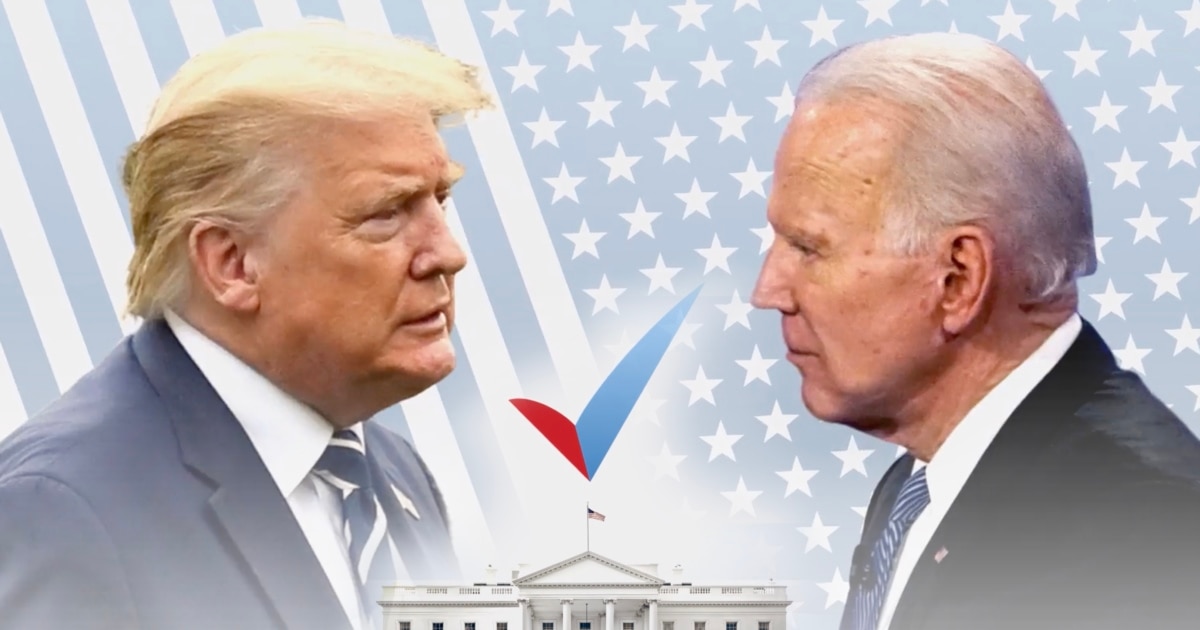
The tensions observed in Washington’s attitude toward Azerbaijan during the Biden Administration also had a negative impact on the pace of development of bilateral relations. During that period, various initiatives against Azerbaijan were put forward in the US Congress, Washington moved away from balanced mediation in the region and pursued a political course that was more supportive of Armenia. Baku naturally regarded these developments as factors contributing to an erosion of trust. In its approach to the regional security architecture, the Biden Administration also tended to view the South Caucasus primarily through the prism of geopolitical rivalry and confrontation and was reluctant to take into account the new realities necessary for lasting peace in the region.
It is worth recalling that Joe Biden, while still a senator, was among the initiators of sanctions against Azerbaijan, while after he was elected president, his administration’s approach to the region was framed around divisions, conflicts and confrontation.
This was one of the principal reasons why justice and peace could not be achieved in the region for a long period. The Biden Administration failed to properly assess Azerbaijan’s status as the leading state in the region and its potential, and consistently pursued a course that undermined relations with Azerbaijan.
Relations between Donald Trump and Ilham Aliyev, meanwhile, had always remained at a high level — during Trump’s first presidency, during the period when he was out of office, and after his re-election as president.
Even before Trump was elected president for a second time, Ilham Aliyev, speaking at the 2nd Shusha Global Media Forum in July 2024, responded with diplomatic finesse when journalist Mikhail Gusman asked whom he would prefer to see win the US presidential election scheduled for November that year: “...Perhaps it would not be entirely appropriate for me to give an unequivocal answer. I try and do my best to express my views as sincerely as possible. Before any audience, whether speaking to the press or at events involving the Azerbaijani public, I never share false information. However, there is such a concept as political culture, and this concept does not allow me to answer your question directly. But I understand that your question is entirely rhetorical. We have known each other for decades, and I am absolutely certain that you also know very well whom I would prefer. I think I am not the only one in Azerbaijan who holds this position on this issue.”
With these remarks, it was clear to everyone that President Ilham Aliyev was, in fact, expressing his preference for Donald Trump to defeat Joe Biden in the election. Naturally, this statement could hardly have escaped Donald Trump’s attention. There is little doubt that, after Trump’s victory was confirmed, Ilham Aliyev’s expression of support also played a role in the emergence of a different approach and a positive turn in US-Azerbaijan relations.
Following Donald Trump’s election as US President, the new Administration charted an entirely new course in its South Caucasus policy. Among other things, it declared the resolution of regional conflicts, the expansion of economic cooperation and the establishment of relations with partner countries based on mutual interests among its priorities.
As the region’s leading state, a partner playing an important role in Europe’s energy security and a key participant in the Middle Corridor connecting East and West, Azerbaijan began to occupy a special place in the United States’ strategic vision. The new approach taking shape in Washington reflected both recognition of the realities created by Azerbaijan in the region and acknowledgment of its growing geopolitical role.
Ilham Aliyev’s pragmatic policy and the new strategic partnership
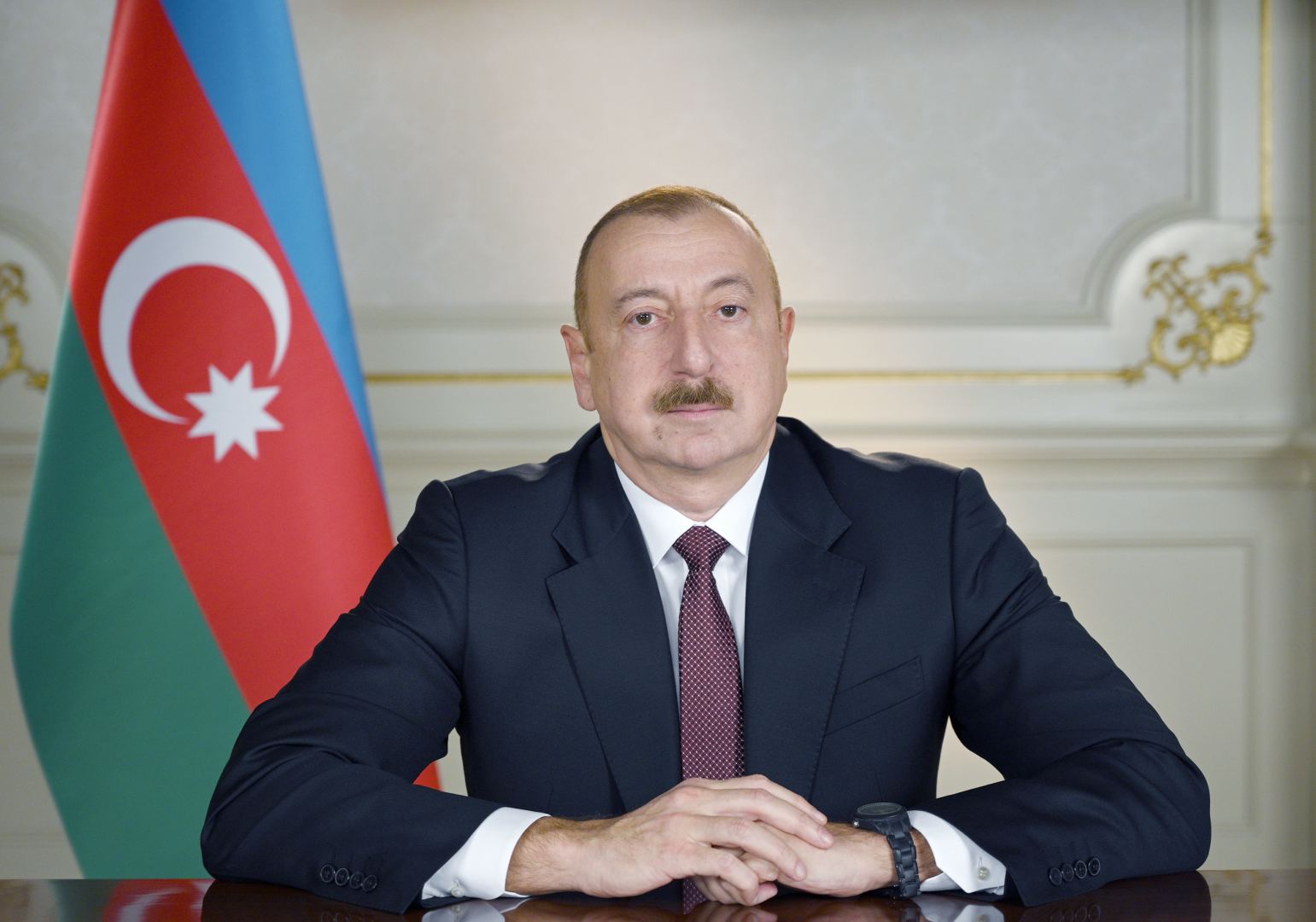
One of the principal reasons behind the transformation in US-Azerbaijan relations was the pragmatic, balanced and national-interest-based foreign policy pursued by President Ilham Aliyev over many years. Without becoming part of any geopolitical bloc, Azerbaijan established relations with the West, the East and countries of the region on the basis of mutual respect and equal cooperation.
Energy security, the development of international transport routes, the fight against terrorism, the strengthening of regional stability and the establishment of an image as a reliable partner reinforced Azerbaijan’s international standing. As a result of this policy, Washington began to view Azerbaijan not merely as an energy partner, but also as one of the key actors in ensuring stability in the region.
During the meeting in Washington, President Ilham Aliyev characterized this new stage by stating: “Today, we are establishing peace in the Caucasus. This will open up new opportunities not only for our region, but for the entire world. In fact, we are writing a new history of relations between the United States and Azerbaijan.”
This statement was a political assessment not only of the peace process, but also of the fundamentally new stage that Azerbaijan-US relations had entered.
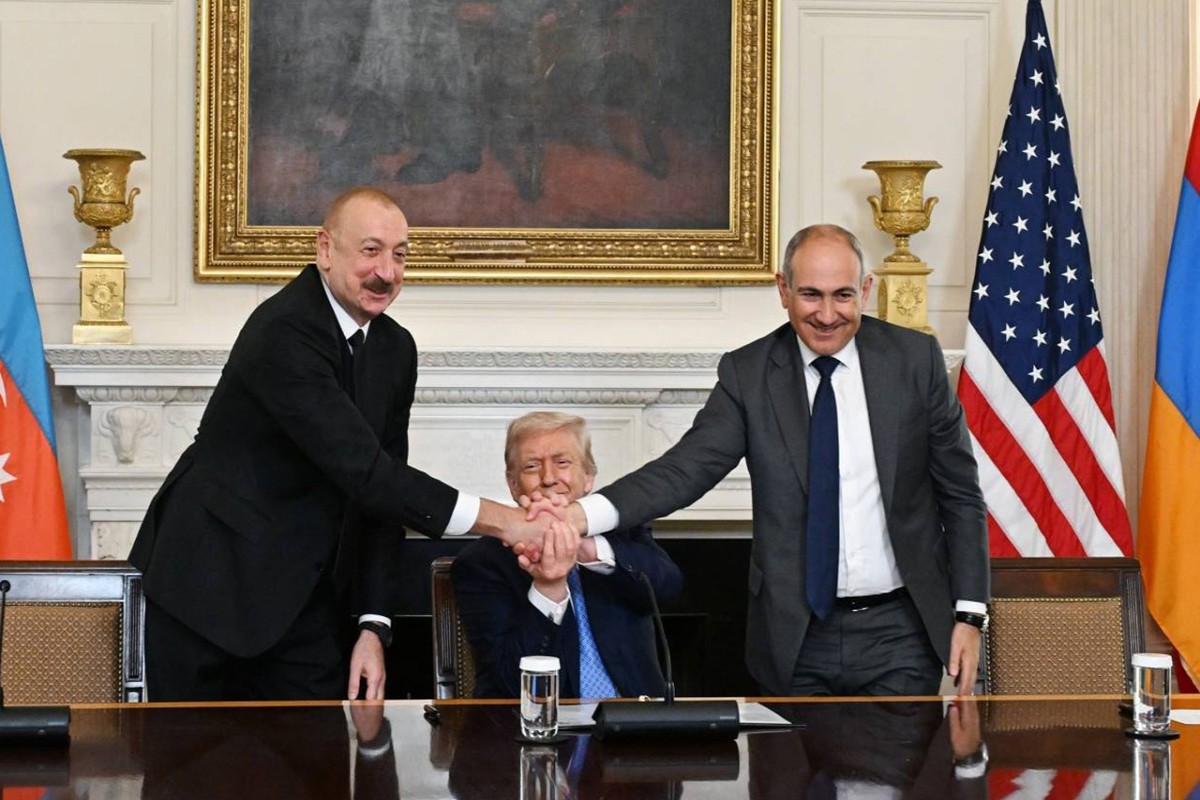
US President Donald Trump also highly praised the role of the Azerbaijani President, stating: “I congratulate President Ilham Aliyev and Prime Minister Nikol Pashinyan for coming to Washington and signing this historic Declaration. This document lays the foundation for a peace that seemed impossible for many years.”
Trump also emphasized in his remarks that ending a conflict that had lasted 35 years was an important development not only for the region but also for international security as a whole, and that the new environment created broad prospects for economic cooperation.
The Washington declaration opened a new chapter in US-Azerbaijan relations
One of the important outcomes of President Ilham Aliyev’s visit to the United States was the agreement to prepare a Charter on Strategic Partnership between the Republic of Azerbaijan and the United States of America. This established the legal and political foundation for relations between the two countries to move beyond cooperation in individual areas and enter the stage of institutionalized strategic partnership.
At the same time, the decision to suspend the application of Section 907 of the Freedom Support Act, which for many years had been regarded as a political obstacle in US-Azerbaijan relations, demonstrated that Washington had chosen a new political course toward Azerbaijan. The decision created new opportunities for expanding cooperation in security, defense, advanced technologies, energy and investment.
Thus, the developments in Washington in August 2025 not only marked a new stage in relations between the two countries, but also demonstrated the beginning of fundamental changes in US policy toward the South Caucasus. As a result of President Ilham Aliyev’s consistent policy based on national interests, Azerbaijan became one of Washington’s principal strategic partners in shaping the energy, regional security, economic integration and peace agendas. It was precisely this transformation that laid the groundwork for the subsequent successful advancement of the Azerbaijan-Armenia peace process and the formation of a new security architecture in the region.
A new strategic agenda launched in Washington
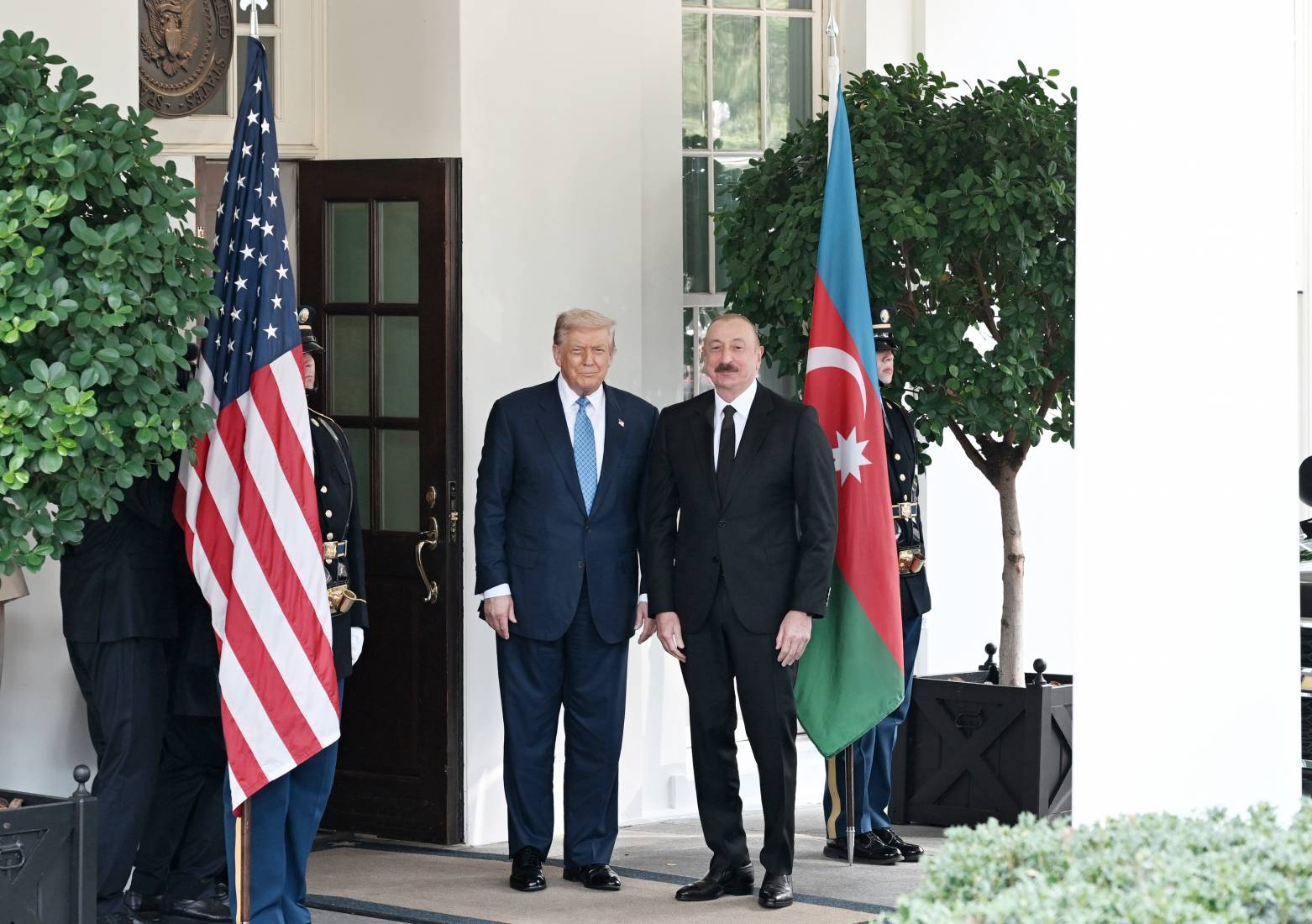
The significance of President Ilham Aliyev’s visit to the United States was not limited to high-level meetings. The agreements reached during the visit not only brought US-Azerbaijan relations to a qualitatively new stage, but also defined the main contours of the South Caucasus’ future political and economic architecture. The messages delivered in Washington demonstrated that the United States was moving away from a model of managing conflicts in the region and beginning to support an approach based on long-term peace and economic integration.
At the center of this approach was Azerbaijan. This was because all the new realities that had emerged in the region in recent years had been shaped by Baku’s initiatives. The restoration of international law through the 44-day Patriotic War, the full restoration of the country’s sovereignty in 2023, the development of transport and communication projects and the promotion of regional cooperation platforms had significantly increased Azerbaijan’s geopolitical weight.
For precisely this reason, the issues discussed at the Washington meeting extended beyond bilateral relations to encompass Eurasian transport routes, energy security, the development of the Middle Corridor and the future security model of the South Caucasus.
Azerbaijan as the principal initiator of regional cooperation
One of the central theses advanced by President Ilham Aliyev for many years has been that the South Caucasus should become a space of cooperation rather than competition. Although this policy was initially met with skepticism, subsequent developments demonstrated the validity of Azerbaijan’s position.
In addition to initiating major energy projects in the region, Azerbaijan became a key participant in transport routes connecting Europe and Asia. Projects such as the Baku-Tbilisi-Kars railway, the Southern Gas Corridor, the Baku International Sea Trade Port and the Middle Corridor demonstrated that Azerbaijan had become an important actor not only for its own national interests but also for global economic security.
These factors also received particular attention during the talks in Washington. The US Administration openly regarded Azerbaijan’s energy and logistics capabilities as a strategic advantage in the new geopolitical environment. This also signaled a new political vision in Washington that differed from its previous approach toward the region.
President Ilham Aliyev expressed this approach in one of his speeches as follows: “Azerbaijan is a reliable partner. We have fulfilled all our commitments, and we will continue to remain a reliable partner.”
This statement is regarded as one of the core formulas underpinning the international reputation Azerbaijan has built in recent years. It is precisely Azerbaijan’s image as a reliable partner that has enabled it to deepen relations with the European Union, the Organization of Turkic States and global powers such as the United States.
The TRIPP project and the international significance of the Zangezur Corridor
One of the important outcomes of the Washington meeting was the transition of regional transport and communication projects to a new stage. The US-backed TRIPP project and the agreements reached regarding the Zangezur route are of strategic importance for the region’s economic integration.
Azerbaijan had maintained for years that the opening of communications would serve the interests not of a single country, but of all states in the region. Restoring transport links would expand economic cooperation, increase interdependence and minimize the risks of conflict.
From this perspective, the Zangezur Corridor is not merely a route connecting mainland Azerbaijan with Nakhchivan. The project is regarded as one of the key elements in the formation of a new economic space extending from Türkiye to Central Asia and from the Caspian basin to Europe.
The agreements reached in Washington in this area demonstrated that the United States also recognized the contribution of these projects to regional stability and international trade.
From strategic partnership toward alliance
The agreement to prepare a Charter on Strategic Partnership between the Republic of Azerbaijan and the United States of America is regarded as one of the principal political documents defining the future trajectory of relations.
The decision to prepare the Charter was not accidental. The document establishes the institutional foundations for long-term cooperation in areas such as energy, security, the defense industry, advanced technologies, the digital economy, transport, cybersecurity and investment.
The subsequent visit of US Vice President JD Vance to Azerbaijan and the signing of the Charter on Strategic Partnership further confirmed that relations between the two countries had entered a new stage. The document demonstrated that Washington no longer viewed Azerbaijan merely as a regional partner, but as an important strategic actor within Eurasia’s geopolitical and geoeconomic system.
Thus, the new political environment created as a result of the Washington visit completed the transformation of US-Azerbaijan relations. This transformation was not confined to the development of bilateral ties. It also had a significant impact on accelerating the Azerbaijan-Armenia peace process, creating new regional cooperation platforms and, for the first time in many years, giving the South Caucasus a tangible prospect of lasting peace. At the next stage, it was precisely this new geopolitical environment that formed the main political foundation of the process leading to the initialing of the peace agreement between Azerbaijan and Armenia.
Azerbaijan’s peace strategy: Initiator, architect and victorious party
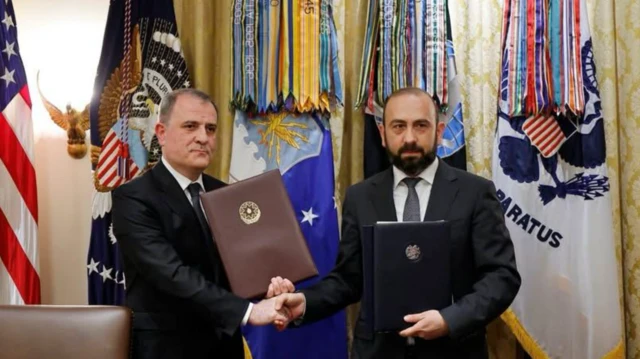
Naturally, the culmination of the August 8, 2025 Washington meeting was the signing of the Joint Declaration by President of Azerbaijan Ilham Aliyev, President of the United States Donald Trump and Prime Minister of Armenia Nikol Pashinyan.
The Joint Declaration stated:
We, the President of the Republic of Azerbaijan and the Prime Minister of the Republic of Armenia, having met on August 8, 2025, in Washington, D.C., United States of America, hereby declare the following:
1. We and President of the United States of America Donald Trump witnessed the initialing by the Ministers of Foreign Affairs of the parties of the agreed text of the “Agreement on Establishment of Peace and Inter-State Relations between the Republic of Azerbaijan and the Republic of Armenia.” In this context, we acknowledged the need to continue further actions to achieve the signing and ultimate ratification of the Agreement, and emphasized the importance of ensuring and strengthening peace between our countries;
2. We also witnessed the signing of a joint appeal to the Organization for Security and Co-operation in Europe (OSCE) by the Minister of Foreign Affairs of the Republic of Azerbaijan and the Minister of Foreign Affairs of the Republic of Armenia regarding the closure of the OSCE Minsk Process and its related structures. We call upon all OSCE participating States to adopt this decision;
3. We reaffirmed the importance of opening communications between the two countries for domestic, bilateral and international transportation in order to promote peace, stability and prosperity in the region and its neighborhood, based on respect for the sovereignty, territorial integrity and jurisdiction of states. These efforts include unimpeded connectivity between the main part of the Republic of Azerbaijan and its Nakhchivan Autonomous Republic, as well as reciprocal benefits for the Republic of Armenia in terms of international and domestic connectivity;
4. The Republic of Armenia will cooperate with the United States of America and mutually determined third parties to establish a framework for the “Trump Route for International Peace and Prosperity” (TRIPP) connectivity project in the territory of the Republic of Armenia. We reaffirm our determination to make good-faith efforts to achieve this objective as soon as possible;
5. In accordance with the UN Charter and the 1991 Alma-Ata Declaration, we recognize the need to embark on a path toward a bright future unburdened by the legacy of the former conflict. Following a conflict that caused profound human suffering, conditions have finally been created for our states to begin building good-neighborly relations on the basis of the inviolability of international borders and the inadmissibility of the use of force for the acquisition of territory. This reality, which is not and will never be subject to revision, paves the way for closing the chapter of hostility between our states. We firmly reject and exclude any attempt at revenge, now and in the future;
6. We express our confidence that this Summit will constitute a solid foundation for advancing mutual respect and peace in the region;
7. We express our deep gratitude to President of the United States of America Donald Trump for his warm hospitality in hosting this important Summit and for his important contributions to advancing the normalization of bilateral relations between the Republic of Azerbaijan and the Republic of Armenia.
This document represented both the military-political conclusion of Armenia’s 30-year occupation of Azerbaijani territories and the laying of the foundation for a new architecture in the South Caucasus and, more broadly, across an entire geopolitical space.
However, the signing of such a document between Azerbaijan and Armenia in Washington was not the work of a single day. It was the logical culmination of the consistent political, diplomatic and military strategy pursued by Azerbaijan following the 44-day Patriotic War in 2020. If the Patriotic War ended the occupation and created a new geopolitical reality, the peace agreement initialed in Washington went down in history as the formalization of that reality at the international political level.
Immediately after the war, President Ilham Aliyev repeatedly stated that Azerbaijan, as the victorious state, was offering a peace agenda rather than revanchism. In his speeches, the head of state emphasized that the only path toward lasting stability in the South Caucasus was for Armenia to accept the new realities and normalize relations with Azerbaijan on the basis of the principles of international law.
President Ilham Aliyev expressed this position as follows: “The peace initiative came from Azerbaijan. Azerbaijan also prepared the fundamental principles of the peace treaty and presented them to Armenia.”

This statement was fully confirmed by subsequent developments. The five basic principles that formed the legal and political foundation of the negotiations were prepared by Azerbaijan and accepted by the international community.
What were those principles?
- Mutual recognition by the states of each other’s sovereignty, territorial integrity, inviolability of international borders and political independence;
- Mutual confirmation that the states have no territorial claims against each other and the assumption of a legal obligation not to raise such claims in the future;
- Refraining in interstate relations from threatening each other’s security, from the threat or use of force against political independence and territorial integrity, as well as from other actions inconsistent with the purposes of the UN Charter;
- Delimitation and demarcation of the state border and the establishment of diplomatic relations;
- Opening transport and communications links, establishing other relevant communications and developing cooperation in other areas of mutual interest.
Although Armenia attempted for a long time to evade these principles, Azerbaijan’s consistent and purposeful steps ultimately compelled it to accept them.
How Did Armenia Come to Peace?
Although the Armenian leadership today seeks to present itself as a proponent of peace, the events of recent years paint a different picture. For many years, Armenia’s policy was aimed at perpetuating the occupation, preserving the status quo and occupying new territories. Even on the eve of the 2020 war, statements by the Armenian leadership such as “new war for new territories” reflected precisely this policy.
During the 44-day Patriotic War, Armenia’s missile attacks on Ganja, Barda, Tartar and other Azerbaijani cities also clearly demonstrated that it was not pursuing peace. After the war, under the influence of various revanchist forces, Armenia sought for a long time to delay the signing of a peace agreement.
However, Azerbaijan’s local anti-terror measures in September 2023 resulted in the elimination of all illegal armed formations in the region and the full restoration of the country’s constitutional order. This completely eliminated Armenia’s ability to use the Karabakh issue as a political instrument.
It was only after this that Yerevan was compelled to accept the new reality. The Armenian leadership agreed to continue negotiations on the basis of the principles proposed by Azerbaijan, ultimately making it possible to initial the peace agreement in Washington.
In this sense, it can be said that Armenia accepted peace not as a voluntary choice, but as an inevitable consequence of the new geopolitical reality that had emerged.
From victory in war to victory in peace
History offers numerous examples in which decades passed between the end of wars and the signing of peace agreements. Although World War II ended in 1945, the Élysée Treaty, which ensured the full normalization of relations between Germany and France, was signed only in 1963. The process took nearly two decades.
In Azerbaijan’s case, however, an entirely different picture emerged. Under the leadership of President Ilham Aliyev, the country first achieved a military-political victory and then, within just two years, compelled Armenia to accept the fundamental principles of a peace agreement.
From this perspective, President Ilham Aliyev’s status as a “victorious leader in war” was complemented by his status as a “victorious leader in peace” through the Washington Declaration. The new geopolitical reality created by Azerbaijan was also accepted internationally, and the region’s future development model began to be built on precisely this reality.
US President Donald Trump also specifically emphasized this during the ceremony in Washington, stating: “The step taken today is a new beginning for the South Caucasus. Conflict must give way to cooperation, economic development and stability.”
This statement demonstrated that Washington, too, now envisioned the region’s future not through confrontation, but through a model of cooperation.
Azerbaijan as the architect of the new security architecture
The security environment taking shape in the South Caucasus today differs fundamentally from the situation five years ago. The factor of occupation has been eliminated, Armenia has recognized Azerbaijan’s territorial integrity, the text of the peace agreement has been initialed, practical steps are being taken toward opening communications, and a reform process has begun in Armenia aimed at removing territorial claims against Azerbaijan from the Armenian Constitution.
None of these developments is accidental; they are the result of the consistent strategy pursued by President Ilham Aliyev over many years. Azerbaijan demonstrated that when a strong economy, a modern army, principled diplomacy and an independent foreign policy are applied together, it is possible to change the political landscape of a region.
The peace agreement initialed in Washington also demonstrated Azerbaijan’s role as an architect of regional peace. For this reason, the document is regarded not merely as the normalization of relations between Azerbaijan and Armenia, but as the beginning of a new stage of development for the South Caucasus as a whole.
Thus, the developments in Washington on August 8, 2025 represented another major success of President Ilham Aliyev’s strategic policy based on national interests. Azerbaijan consolidated its victory in the Patriotic War at the diplomatic level, emerged as the architect of the regional peace agenda, and elevated its relations with the United States to the level of strategic partnership, once again confirming its decisive role in shaping the future political architecture of the South Caucasus
A new geopolitical order and Azerbaijan’s growing international weight
For many years, the region had become an arena of competition among international powers, while the continuation of the conflict was one of the principal factors increasing the political influence of external actors. Azerbaijan, however, has sought to change this approach, consistently advocating that the region’s future should be built on regional cooperation, economic integration and mutual interests.
As a result of the policy pursued by President Ilham Aliyev, a post-conflict development model began to take shape in the South Caucasus for the first time. This model prioritizes not military confrontation, but economic cooperation, the development of transport and communication links, energy security and the strengthening of mutual trust.
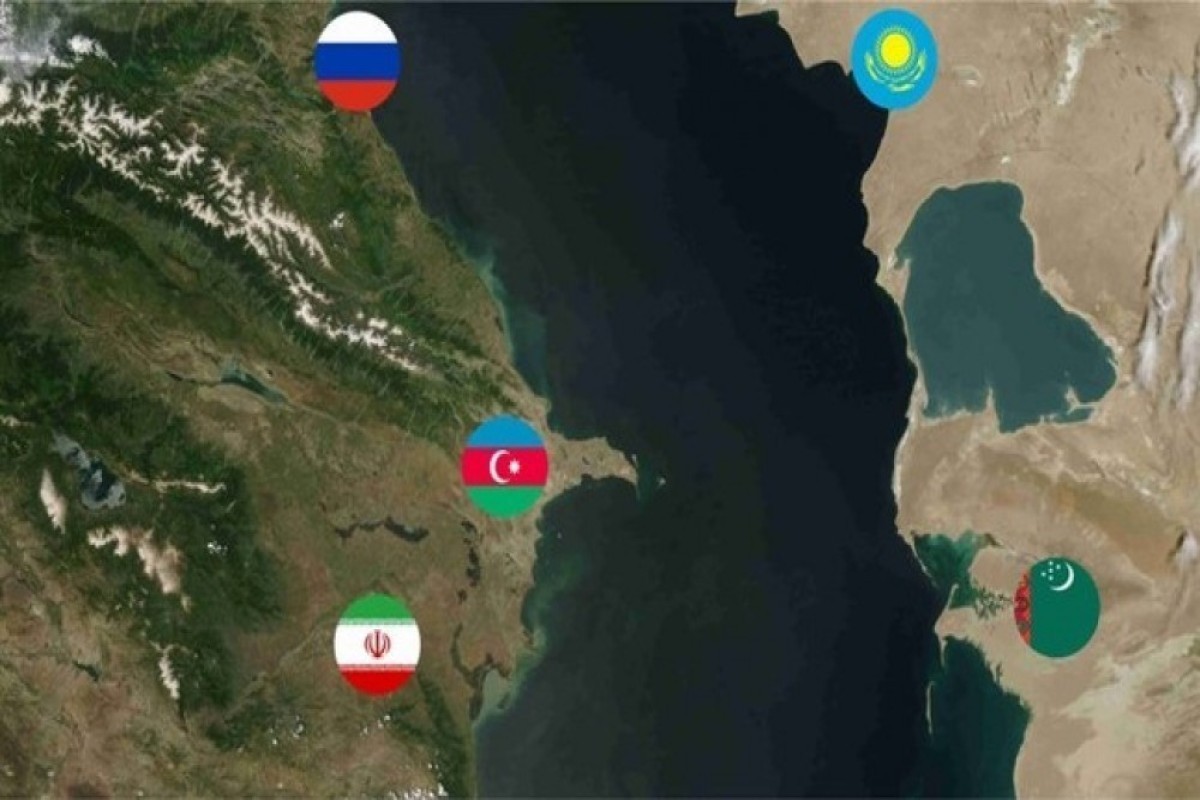
Today, Azerbaijan is one of the principal guarantors of the region’s energy security. At the same time, the development of the Middle Corridor, the growth of freight transportation between East and West via the Caspian Sea, and the country’s location at the intersection of the North-South and East-West international transport corridors further enhance its strategic importance. The US Administration’s decision to elevate relations with Azerbaijan to a new level precisely in recognition of this reality is therefore regarded as an entirely logical geopolitical step.
The Washington Declaration demonstrated that military and economic capabilities alone are not sufficient to secure a strong position in the international system. An image as a reliable partner, a consistent foreign policy and diplomacy based on national interests play an equally important role. In recent years, Azerbaijan has significantly enhanced its international standing precisely by adhering to these principles.
Ilham Aliyev’s leadership
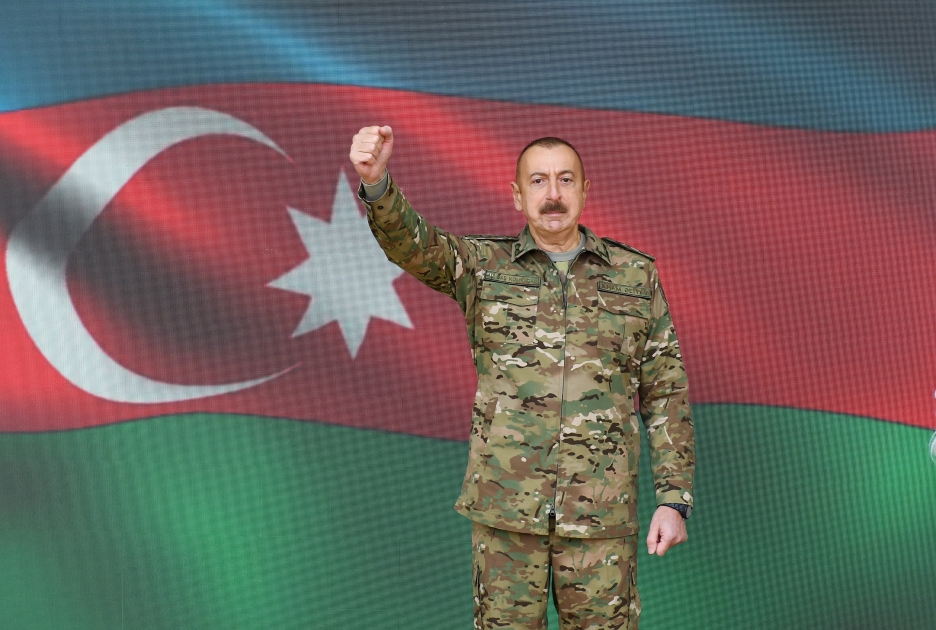
The events of the past five years demonstrate that President Ilham Aliyev’s political strategy has not been aimed solely at restoring Azerbaijan’s territorial integrity and sovereignty. The main objective of this strategy has been to ensure long-term peace and stability in the region, safeguard Azerbaijan’s security interests, and further strengthen the country’s international standing.
While the victory achieved in the 44-day Patriotic War in 2020 demonstrated Azerbaijan’s military and political strength, the local anti-terror measures carried out in 2023 ensured the country’s full sovereignty. The initialing of the peace agreement in Washington in 2025 marked the diplomatic culmination of this process. Thus, President Ilham Aliyev achieved the strategic objectives he had set in the military, political, and diplomatic spheres.
As the head of state has repeatedly emphasized, Azerbaijan’s objective has never been to create a new confrontation. On the contrary, Azerbaijan has sought to build the region’s future on cooperation and mutually beneficial relations.
President Ilham Aliyev’s following statement clearly expresses the essence of this policy: “We ended the war with victory. Now we are engaged in peacebuilding. Ensuring lasting peace in the South Caucasus serves the interests of all states in the region.”
This approach has constituted the main ideological line of Azerbaijan’s policy in recent years.
The Washington declaration laid the foundation for the future
The documents signed and agreements reached in Washington on August 8, 2025, while already having gone down in history as major political developments, also defined the trajectory of development for the decades ahead. The elevation of US-Azerbaijan relations to the level of strategic partnership, the Azerbaijan-Armenia peace process entering a new stage, the implementation of transport and communication projects, and the expansion of regional cooperation are regarded as factors transforming the political and economic landscape of the South Caucasus as a whole.
These processes once again confirmed that Azerbaijan is the architect of the new realities that have emerged in the region. It is precisely as a result of President Ilham Aliyev’s principled position, policy based on national interests, and strategic foresight that Azerbaijan has emerged not only as a state that achieved military victory, but also as a country shaping the peace agenda, initiating regional cooperation, and acting as a reliable strategic partner in the international system.
From this perspective, the Washington Declaration can be regarded as another major success of President Ilham Aliyev’s statehood strategy and as a practical outcome of the Donald Trump Administration’s new approach toward the South Caucasus. The strategic partnership model taking shape between the two countries, the initialing of the peace agreement between Azerbaijan and Armenia, and the emergence of a new security environment in the region demonstrate that the South Caucasus has begun to develop as a space of cooperation rather than confrontation.
It is precisely for this reason that the Washington agreements have gone down in history not merely as another important page in the diplomatic calendar, but as one of the greatest achievements of modern Azerbaijani diplomacy, another triumph of President Ilham Aliyev’s foreign policy course based on national interests, and another manifestation of Azerbaijan’s growing international standing.



 Follow us on Telegram
 t.me/apanewsaz
 Follow us on Instagram
 Follow us on TikTok
 Follow us on Facebook
 Follow us on X