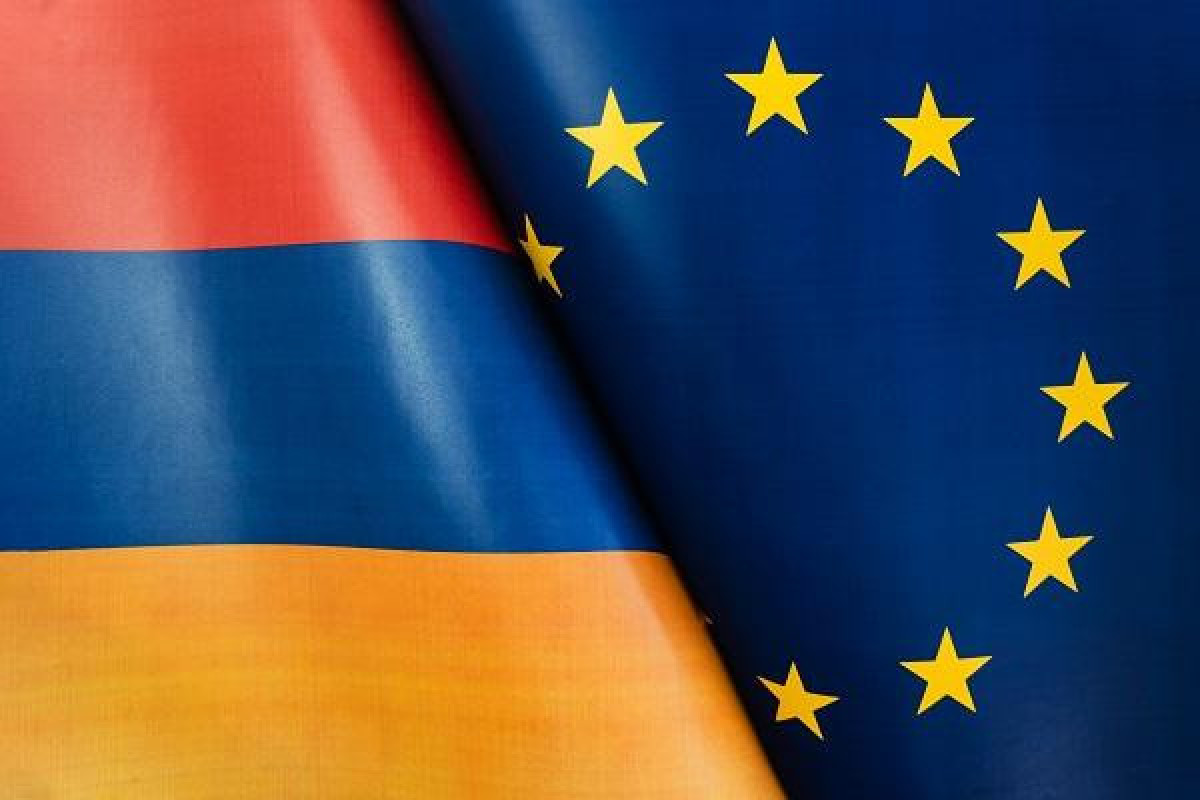


On December 2, a document titled “Strategic Agenda for Armenia–EU Partnership” was signed between the European Union (EU) and Armenia. The Armenian Ministry of Foreign Affairs states that this 64-page document envisions deepening bilateral cooperation. The document defines not only a cooperation framework but also the geopolitical contours of the future political course of the sides. Although the document presents goals related to economic reforms, democratic governance, and political integration, several provisions have the potential to harm the peace process in the region.
On page 4 of the document, describing the voluntary relocation of Armenians who once lived in Karabakh to Armenia as “being displaced” is incorrect and completely absurd. This process was carried out voluntarily as a result of the encouragement of the leaders of the illegal regime established in Karabakh by Armenia and the purposeful activities of structures financed from the Armenian state budget. In this context, even the EU’s hesitation between the terms “migrant/refugee” aims to frame the issue within a geopolitical context. This moment creates a biased perception of Azerbaijan's legitimate military operation, pushes Armenia's responsibility to the background, and creates a favorable ground for the strengthening of manipulative rhetoric in the future.
This approach is clearly an unfounded criticism directed at Azerbaijan, a political pressure and a biased accusation. Our state’s position is unequivocal: no international organization or partner country has the right to speak about Azerbaijan in an ultimatum or accusatory tone. This contradicts international law and the principles of mutual respect and is completely unacceptable. This approach also applies to the EU and its leadership.
It is worth recalling that the unbalanced and biased position of the EU leadership and Joseph Borrell, while serving as the High Representative of the European Union for Foreign Affairs and Security Policy, further aggravated the situation. Borrell’s statements regarding Azerbaijan were never based on facts and emerged as a product of political influence, seriously undermined the EU’s neutral mediator role. Such an approach did not contribute to the peace process; on the contrary, it eroded trust.
It seems that the same process is still ongoing. However, if the EU wants a real dialogue, it must first put an end to the leadership's biased rhetoric against Azerbaijan and demonstrate a position based on respect and in accordance with international law.
Contradictory statements and political irresponsibility

One of the most concerning points in the document signed by the EU with Armenia is the plan to include a military school located in Armenia and named after the terrorist Monte Melkonian, who is notorious for committing grave war crimes, into the training and education network operating within the EU framework. The purpose, political motivation, and strategic consequences of this step are not clearly presented and raise serious questions. Because legitimizing such a figure contradicts the EU’s system of values and may negatively affect the sensitive security balance in the region.
At the same time, the use of the term “Nagorno-Karabakh,” which no longer exists, in the document openly calls into question the EU’s objectivity and adherence to professional principles. Returning to this term is not only a distortion of facts but also carries a political message that does not hide the anti-Azerbaijani nature of the document. What is even more problematic is that the EU, in the same document, calls for respect for territorial integrity and sovereignty, yet on the other hand includes expressions that undermine Azerbaijan’s sovereignty. This is a clear example of diplomatic irresponsibility and conceptual inconsistency.
Against the backdrop of the developments, the Azerbaijani Ministry of Foreign Affairs is expected to provide an additional statement on the matter. However, in order to eliminate these uncertainties, it is also essential for the EU itself to present an open, consistent, and unbiased explanation regarding both issues.
Unbalanced humanitarian narrative: Why are Azerbaijan's security concerns ignored?
Although the document gives extensive space to Armenia’s humanitarian narrative amid the Karabakh issue, the EU does not mention Azerbaijan’s key demands at all — the former presence of Armenia’s armed groups in Karabakh, the threat to territorial integrity, and the security risks. This approach renders the document unbalanced and weakens confidence in the EU’s mediating role. The failure to consider Azerbaijan’s legitimate security concerns may both strengthen revisionist tendencies in Armenia and make real dialogue on a peace agreement more difficult.
The document states: ‘To support the release of Armenian prisoners and other detainees…’
Which prisoners are meant in this clause? It is unclear, and why does the EU see this issue as its responsibility? Instead of relying on legal mechanisms, this clause creates the impression of a political order, and as a result, this issue — which the EU considers its responsibility — further reinforces Armenia’s diplomatic rhetoric.
Such an approach politicizes humanitarian issues, damages mutual trust, and ultimately may be perceived as a potential tool of political pressure against the Azerbaijani side.
Unclear legal calls jeopardize the peace process
The document contains an unclear call regarding the “full, immediate and effective” implementation of International Court decisions.
It is stated: “To support the full, immediate and effective implementation of all relevant decisions of the International Court…”
Since it is not clarified which decision is meant here, this creates wide room for manipulation and increases the likelihood that Armenia may use this clause to achieve its own objectives. In terms of its impact on the peace process, this uncertainty deepens tensions and, and the document distances the parties from a clear legal framework, directs toward political interpretations.
Discriminatory humanitarian approach weakens the peace process
While the document mentions the rights of Karabakh Armenians who voluntarily migrated to Armenia, the fact that the EU does not make any mention of the rights of more than 300,000 Azerbaijanis deported from Armenia in the EU-Azerbaijan documents shows a violation of the balanced approach. The disregard for Azerbaijan’s position in this context clearly demonstrates that equal principles are not being applied between the parties. If the EU includes provisions in the document regarding the “social integration” of Armenians who voluntarily moved from Karabakh, then on the same principle, Azerbaijan would be fully justified in demanding the inclusion of a special clause regarding the rights of Western Azerbaijanis. However, the EU’s refusal to accept such an approach serves as an indication of a biased and unequal humanitarian attitude.
The document signed between the two sides contains certain damaging elements on the path toward establishing peace and stability in the region. Although the EU–Armenia strategic agenda is intended for regional cooperation, incorrect humanitarian narratives, the disregard of Azerbaijan’s security concerns, the introduction of obligations lacking legal basis, unclear international law calls, and unbalanced political assessments may negatively affect the peace process.
The EU’s 2 December document aims to overshadow the U.S. 8 August document

As a result, the “strategic agenda” document signed on 2 December between the EU and Armenia constitutes an open interference in the delicately forming peace process in the region.
Although this document was signed between the EU and Armenia, it does not serve to strengthen trust between Armenia and Azerbaijan; on the contrary, it contains provisions that may, to some extent, damage the emerging trust and creates potential that can be used by Armenia for manipulative purposes in the continuation of negotiations.
The progress achieved in Washington on August 8, mediated by President Ilham Aliyev, Prime Minister Nikol Pashinyan, and US President Donald Trump - the initialing of the text of the peace agreement and the Joint Declaration on the opening of communications - strengthened the prospect of real stability in the South Caucasus. However, the new document signed by the EU with Armenia aims to overshadow this positive dynamic.
Political analyst Sultan Zahidov, leading adviser at the Center of Analysis of International Relations said in his statement to APA that the Armenia–EU strategic agenda signed on 2 December in Brussels demonstrates the EU’s geopolitical objectives and its biased approach toward Azerbaijan.
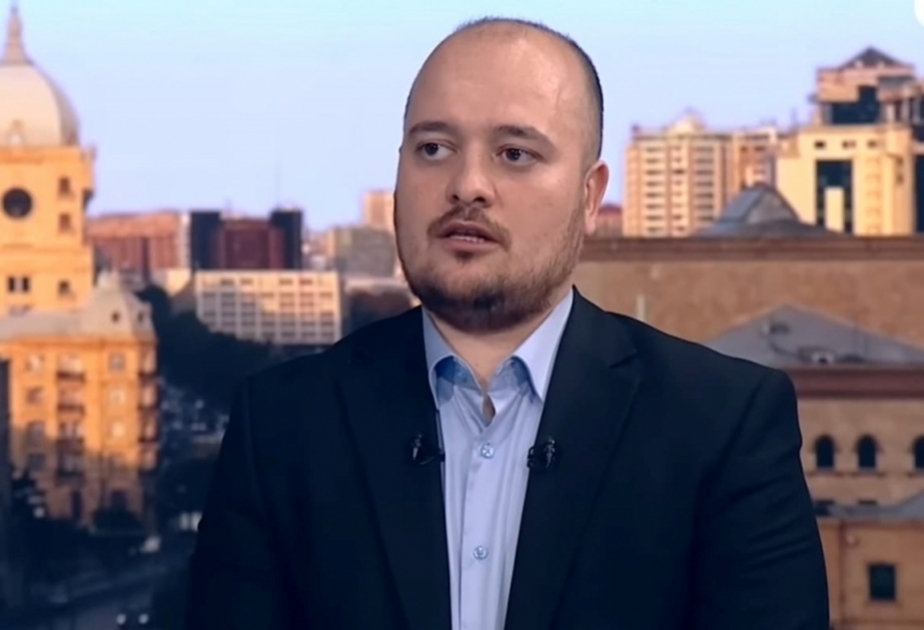
According to the political analyst, the new document does not take balance in the region into account and contains provisions that contradict security and political realities.
“In the new strategic agenda, the areas of partnership are further expanded, and three main directions—defense and security, sectoral cooperation, and visa liberalization—come to the forefront. The document also states that the European Union will provide 15 million euros of support to Armenia in combating hybrid and cyber attacks, including possible interference in elections. This shows that along with economic and democratic reforms, the EU is also actively pursuing geopolitical objectives in non-traditional areas. After the agreement was signed, EU Commissioner for Enlargement Marta Kos, citing Russia's interference in the elections in Moldova as an example, stated that the EU would provide support to prevent the same situation from happening in Armenia,” he added.
According to Zahidov, this document demonstrates the EU’s geopolitical objectives in the post-Soviet space: “This policy of the EU is risky because it does not take into account the interests of other actors in the region, especially Azerbaijan. The United States also made this mistake by pursuing a pro-Armenian policy during the Biden era and failed to achieve any of its goals.”
The political analyst notes that the document's introduction and conclusion state that the EU will "support the socio-economic integration of relocated Karabakh Armenians," which is unrealistic and biased: “There was no forced displacement from Karabakh; on the contrary, the Armenian residents left the region due to Armenia’s encouragement and the calls of the leaders of the separatist regime. Azerbaijan, meanwhile, had created conditions for them to stay and obtain citizenship. The European Union misapplies the concepts of IDP and refugee in the document, while these categories have specific meanings in international law. The fact that the EU makes no reference to the 700,000 Azerbaijanis displaced as a result of Armenia’s ethnic cleansing policy against Azerbaijan is yet another example of double standards.”
The political analyst also considers the use of the phrase “after Azerbaijan’s military operations” in the document to be incorrect. He notes that the EU does not indicate the reasons for the military operations—separatism, terrorism, landmines, and illegal armed groups. Azerbaijan carried out the September 2023 anti-terror operation precisely to restore its sovereignty and ensure security in the region.
According to the expert, with this approach the EU does not take Azerbaijan’s security concerns into account, nor does it address the issue of Western Azerbaijanis: “The failure to mention more than 300,000 Western Azerbaijanis is a clear indication of bias.”
Zahidov adds that the provision regarding “Armenian prisoners” in the document is also manipulative, because the Armenian origin individuals tried in courts in Azerbaijan are not prisoners, but members of the separatist regime who participated in terrorism and killings for many years: “The document also does not specify which tribunal the EU's support for the implementation of international court decisions refers to. The use of the expression ‘Nagorno-Karabakh’ in the document shows that the EU is acting on a political order without taking Azerbaijan’s position into account. The separatist regime became history after the September 2023 anti-terror operations.”
According to the expert, the inclusion of the school named after Monte Melkonyan in the EU’s military training network indicates either the EU’s lack of information or the influence of a political order: “Melkonyan was a terrorist and participated in killings against Azerbaijanis.”
Based on the document, the political analyst draws two conclusions:
- First, the EU again prioritizes geopolitical ambitions, putting aside pragmatic politics, and acts under the influence of the Armenian diaspora;
- Second, instead of creating an environment of trust, Armenia obstructs this process.

Armenia’s statement that the EU mission will “stay at the border as long as necessary” contradicts the provisions of the peace agreement that has not yet been signed.
Zahidov notes that for lasting peace, Armenia must first build trust with Azerbaijan. Signing documents with external powers that contradict Azerbaijan’s interests undermines peace.
The expert also points out that Armenia’s regional integration and the reduction of its dependence on Russia in energy and transport routes is only possible through Azerbaijan: “Without Azerbaijan and Türkiye, Armenia cannot join any regional project.”
Zahidov finally emphasized that the EU must understand that Azerbaijan is the center of the region’s vital East-West transport line and energy exports: “Ursula von der Leyen’s visit to Baku in 2022 and the signing of the strategic partnership document in the energy sector also confirm this.”
According to the political analyst, signing such a biased document with Armenia shows that the EU has moved away from pragmatism and has made mistakes under the influence of certain political circles.
The EU is biased against Azerbaijan, its actions do not serve peace
The document's unilateral support for Armenia's position, its complete disregard for Azerbaijan's security concerns, and its presentation of legally ambiguous commitments indicate that the EU is taking a party position, not an objective mediator. Taking such a step at a time when a conflict that has lasted more than 30 years is beginning to subside clearly demonstrates that the EU is interested not in peace in the region, but in expanding its sphere of political influence.



 Follow us on Telegram
 t.me/apanewsaz
 Follow us on Instagram
 Follow us on TikTok
 Follow us on Facebook
 Follow us on X