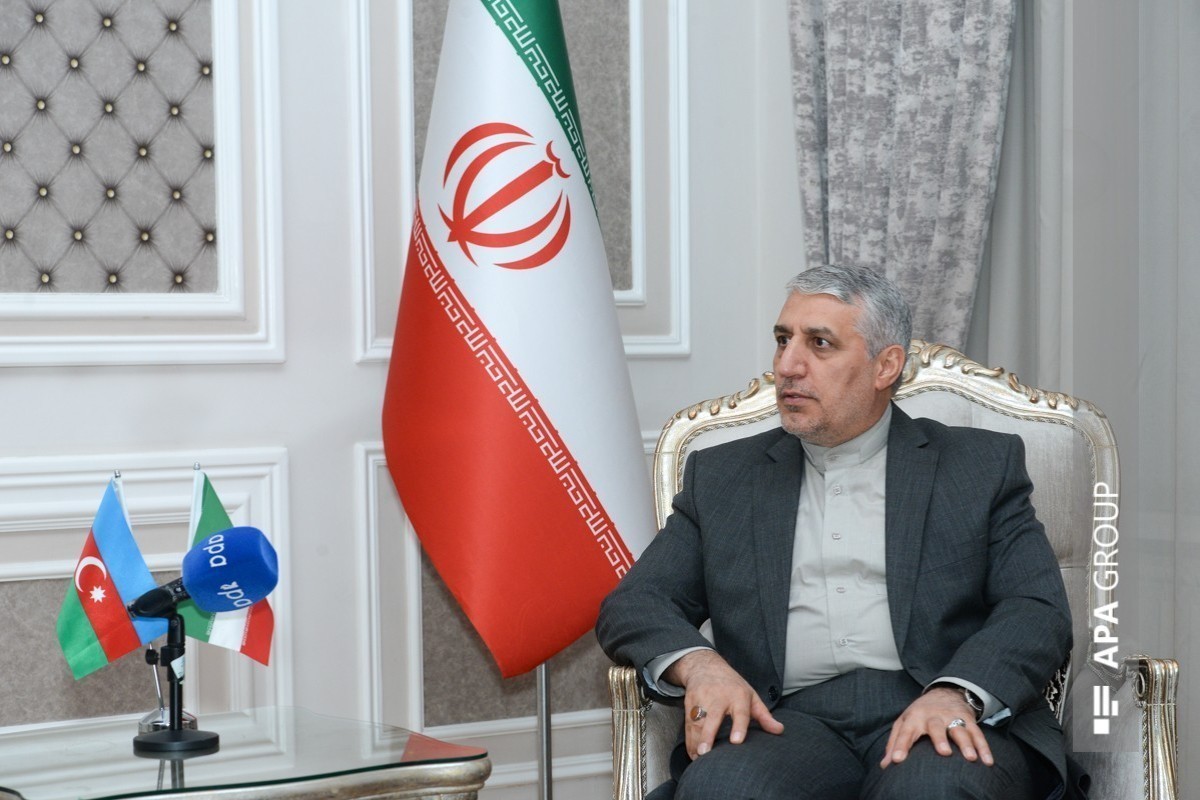

APA conducted an exclusive interview with His Excellency Mojtaba Demirchilou, Ambassador of the Islamic Republic of Iran to the Republic of Azerbaijan.
Today, Iran has demonstrated that any party committing an act of aggression against its territory or interests will incur a cost far heavier than they ever anticipated
Question: Mr. Ambassador, immediately following the announcement of the ceasefire, both parties—the United States and Iran—claimed victory. What are the arguments that define Iran’s success in this conflict?
Ambassador Demirchilou: To evaluate victory, one must analyze specific criteria. None of the objectives set forth by the aggressor forces were realized; indeed, we witnessed them issuing contradictory statements on a daily basis. Initially, they claimed their goals were regime change, the dismantling of Iran’s nuclear potential, the neutralization of our defensive capabilities, the seizure of Kharg Island, and, the opening of the Strait of Hormuz, which was already open before the war, and so on. All of this shows contradictions in their objectives. At present, none of these goals have been realized.
For us, victory is not found in slogans, but in the realization of the principles for which we stand. Today, Iran has demonstrated that any party committing an act of aggression against its territory or interests will incur a cost far heavier than they could have anticipated. This factor, alongside the preservation of the governance structure and the expansion of our defensive capabilities even amidst active combat, serves as a primary indicator of victory. It can be stated with absolute conviction that Iran is stronger today than at the onset of the war; despite human and material losses, it retains new levers such as the Strait of Hormuz.
Contrary to Western propaganda asserting Iran’s isolation, no such condition materialized throughout this crisis. On the contrary, through active regional diplomacy, Tehran has demonstrated that no regional process can yield a viable outcome without Iran’s participation. In this regard, the adversary’s acceptance of a ceasefire can be viewed as an acknowledgment of the failure of the military option to alter Iran’s strategic conduct.
Question: On the other hand, the reality of heavy casualties and the killing of prominent political and military figures cannot be overlooked. In your view, do these factors not undermine the victory declared by Iran?
Ambassador Demirchilou: In response to this, it is necessary to distinguish between the "costs of war" and "strategic outcomes." No significant victory is ever achieved without sacrifice and loss; this is a reality observed in every major conflict throughout history. From the perspective of the Islamic Republic of Iran, the targeting of prominent figures is not viewed as a sign of vulnerability, but is interpreted within a different framework of strength. That is to say, rather than leading to systemic collapse, the physical removal of individuals has, in many instances, resulted in the consolidation of internal unity and the emergence of new political and military generations who pursue the established path with redoubled motivation.
At the same time, the power structure in Iran is predicated not on individuals, but on an institutional framework and an indigenous doctrine. Consequently, despite the loss of life and the removal of certain key figures, fundamental processes in the defense, nuclear, and regional sectors have remained uninterrupted. This continuity serves as a vital metric in the evaluation of strategic outcomes.
Furthermore, in Iran's official rhetoric, the recourse to terrorism and the targeting of political-military personnel are characterized as signs of impotence in direct confrontation. Tehran maintains that such actions can strengthen Iran's legal and ethical standing on the international stage while simultaneously calling the adversary's reputation into question.
On this basis, while the heavy human toll is undeniable, within this analytical framework, these losses are viewed as an inherent part of the path toward safeguarding national independence and power. They do not, in any way, diminish the essence of 'victory'."

The aggregate of these strikes has demonstrated that Iran’s indigenously produced missiles and unmanned aerial vehicles (UAVs) are capable of penetrating multilayered defense systems
Question: The Iranian military launched 100 waves of aerial strikes against targets in Israel and U.S. bases in the region. Were the established objectives of these attacks fully realized?
Ambassador Demirchilou: The evaluation of these operations is not based solely on the scale of physical destruction; rather, they are analyzed within the framework of predefined strategic objectives. From this perspective, one of the primary goals was to shatter the perception of "impenetrability" surrounding advanced air defense systems. The aggregate of these strikes has demonstrated that Iran’s indigenously produced missiles and unmanned aerial vehicles (UAVs) are capable of penetrating multilayered defense architectures. This is assessed as a significant strategic achievement, one that could enhance Iran’s deterrent capabilities in future conflicts.
Furthermore, these strikes were intended to serve multiple objectives, including the disruption of communication and command-and-control (C2) capabilities. Military, intelligence, and logistics centers identified as primary sources of threat were the central targets of these operations. Based on this assessment, the strikes succeeded in impacting the adversary’s operational activities.
Question: As also noted by Iran’s foreign minister, it is stated that the ceasefire includes Lebanon alongside the United States. If Israel does not stop its attacks on Lebanon, is there a possibility that Iran may withdraw from the ceasefire agreement?
Ambassador Demirchilou: Yes, regional issues, specifically including Lebanon, were explicitly factored into the ceasefire agreement. This point was also clearly underscored in the statement released by the Prime Minister of Pakistan. Regional security is inherently interconnected; therefore, the ceasefire is not viewed merely as a limited bilateral arrangement, but as part of a broader process aimed at de-escalation across the entire region, including Lebanon. From this perspective, any continued aggression against Lebanon would be assessed as a violation of this agreement.

Question: If the talks in Islamabad fail and the issue of resuming military operations comes to the agenda, does Iran have the capacity to continue attacks against the United States and Israel?
Ambassador Demirchilou: This matter is assessed within the framework of national capabilities and strategic calculus. From Tehran’s perspective, the nation's defensive potential is built upon indigenous production and domestic infrastructure, which is regarded as a primary factor ensuring the sustainability of any confrontation scenario. Relying on domestic resources not only mitigates external dependencies but also enables the management of such situations over extended periods, thereby enhancing the country’s strategic flexibility.
Iran’s approach is not confined solely to deterrence; it possesses the capability to calibrate and escalate the level of response as conditions evolve. However, this factor should not be interpreted as an intent to escalate tensions, but rather as a means of conveying deterrent messages within a crisis management framework aimed at preventing the regional expansion of the conflict.
From an operational perspective, the US military presence in the region is accompanied by certain limitations and vulnerabilities, which are taken into account in strategic calculations. Furthermore, any decision on military action will be made based on a number of factors, including costs, regional consequences, and the international environment.
We have never been the instigator of war; indeed, both in June and on February 28, we were subjected to attacks in the midst of ongoing negotiations. Currently, although there is no trust in the other side, we are ready for talks, but strengthening our defense capabilities is also planned. As evidenced by the recent conflict, Iran’s defensive posture was superior to its standing in June, and in the event of a renewed war, Iran will undoubtedly deliver a significantly more severe response.


 Follow us on Telegram
 t.me/apanewsaz
 Follow us on Instagram
 Follow us on TikTok
 Follow us on Facebook
 Follow us on X