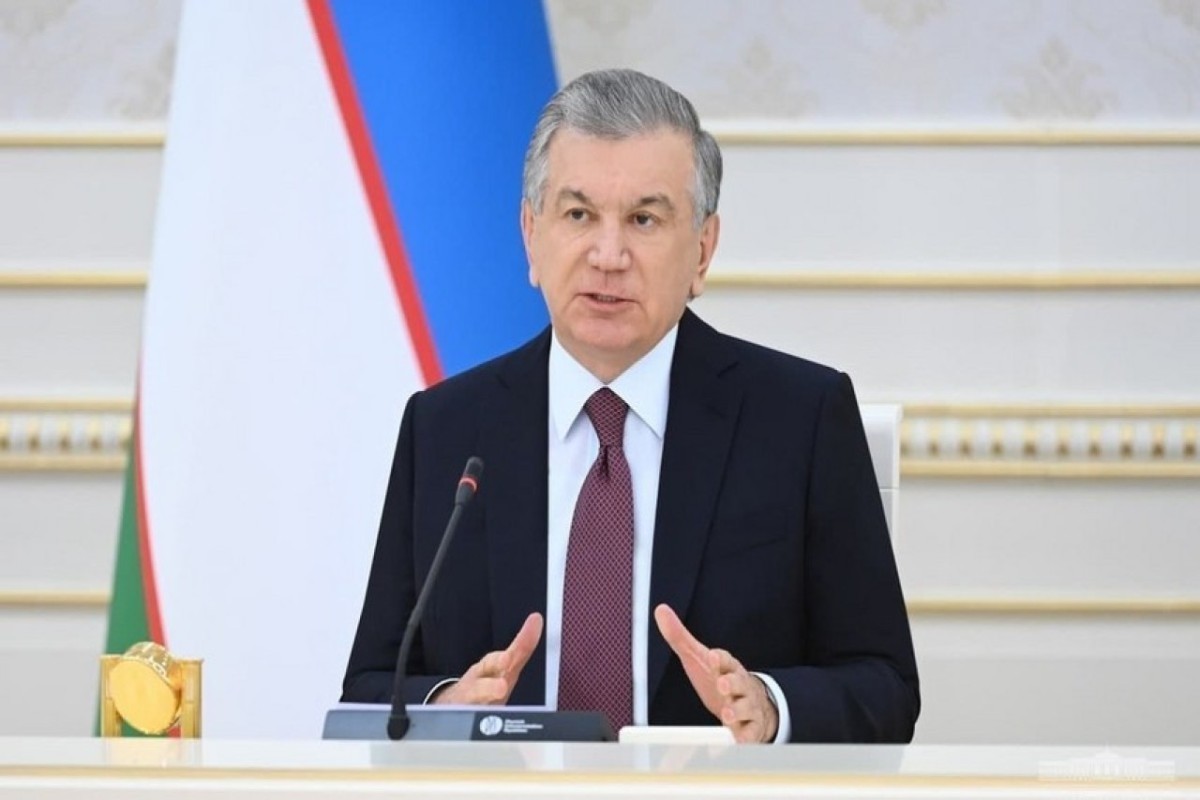

"I sincerely congratulate you, distinguished participants who have gathered with the noble goal of making a worthy contribution to the ancient and rich history of the Turkic world, its scientific and cultural heritage, its spiritual values, and its historical development, on the opening of today's congress," President of Uzbekistan Shavkat Mirziyoyev said in his address to the participants of the Turkic World Week dedicated to the 100th anniversary of the First Turkological Congress, APA reports.
He noted that the First Turkological Congress, held in Baku in 1926, was a major historical event that marked the beginning of a new era in linguistics, ethnology, history, and the literature, art, and cultural life of the Turkic peoples.
"We always recall with great pride that renowned Uzbek scholars, great thinkers, and intellectuals of Turkestan took part in this congress.
We highly appreciate the great services this community, established in Turkestan, has rendered to the Turkic world.
Indeed, the work carried out by the great educator Ismail Gaspirali at the end of the 19th and the beginning of the 20th century laid the foundation for a powerful national awakening movement across the Turkic world. Within this movement, devoted intellectuals from Uzbekistan, including Mahmud Khoja Behbudi, Abdurauf Fitrat, Munavvar Qari Abdurashidkhan, Abdulla Khoja, Ishaqkhan Ibrat, Abdulhamid Cholpan, and Abdulla Qodiriy, made significant contributions to the spread of science, enlightenment, education, cultural development, and the ideas of progress among the Turkic peoples.
Under extremely difficult and complex conditions, they established schools, newspapers and magazines, museums, libraries, and theaters, while working to reform the education and legal systems. Through their literary works, scientific research, and socio-political activities, they played an important role in the transition of the Turkic world to the modern era.
Unfortunately, as a result of repressive policies, many of these heroic ancestors suffered tragic fates. However, their noble ideals, scientific legacy, and enlightenment traditions continue to serve as a source of inspiration for us today.
In the new era, important work is being carried out to thoroughly study historical literature and the legacy of the Jadid movement, conduct extensive research into their scientific and literary works, honor their sacred names, and educate the younger generation in the spirit of their moral courage.
The struggle of our great figures for a free and prosperous life based on science, enlightenment, an open worldview, and national and universal values, as well as their rich scientific and cultural heritage, are of great importance to us.
Undoubtedly, important steps are being taken to further expand cooperation with the Turkic states in the fields of science, culture, education, and the arts, and to objectively study our shared past.
As the world enters a new stage of development today, Turkology faces new tasks. In particular, artificial intelligence, information technologies, the creation of common Turkic electronic resources and scientific platforms, joint research of historical sources, support for young Turkologist researchers, and the expansion of academic cooperation programs require us to unite our modern approaches and efforts.
In order to strengthen cooperation in this direction, on the occasion of the 100th anniversary of the First Turkological Congress, we propose establishing an international scientific project on the study of the heritage of Turkic world enlighteners with the participation of research centers of the Turkic states, as well as creating a unified digital archive of the works and historical documents of representatives of the Jadid movement.
We are confident that this remarkable congress will bring success to its participants in their scientific and creative activities and great achievements to the work of the congress."


 Follow us on Telegram
 t.me/apanewsaz
 Follow us on Instagram
 Follow us on TikTok
 Follow us on Facebook
 Follow us on X