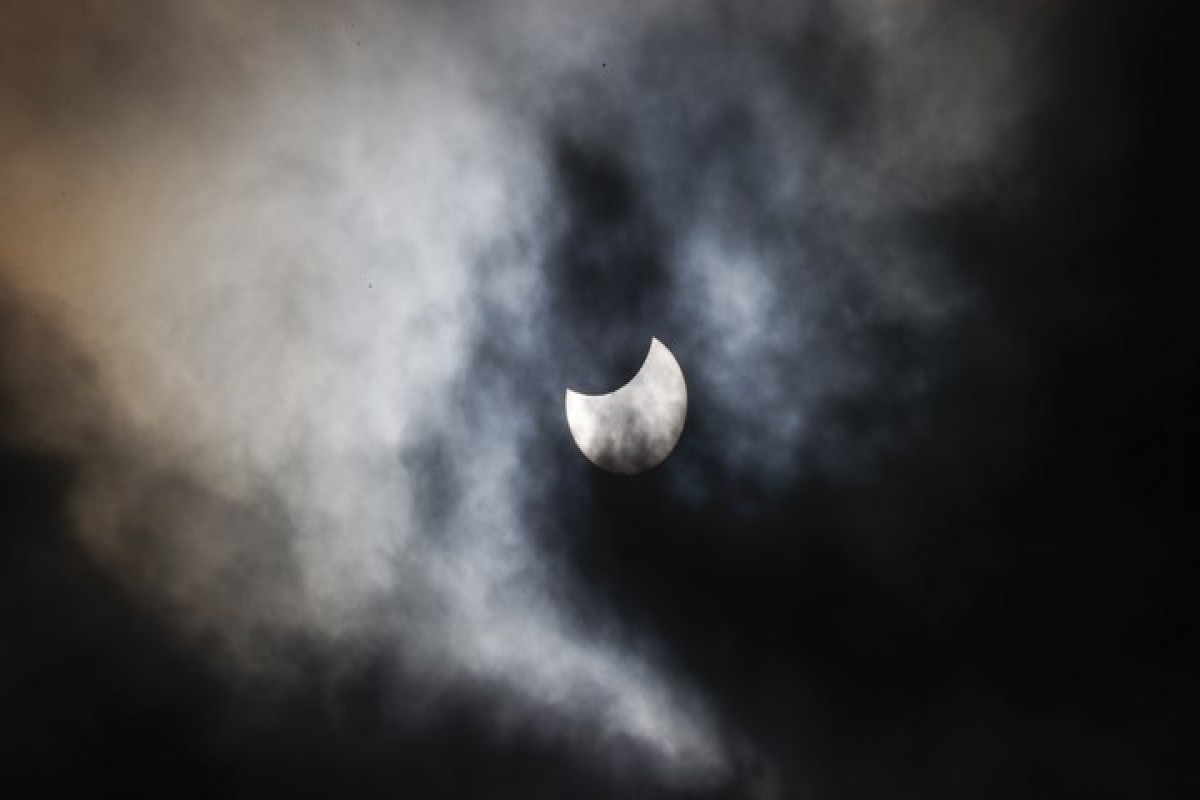

The second solar eclipse of the year has ended, Shamakhi Astrophysics Observatory told APA.
The partial solar eclipse started at 12:58 p.m and ended at 5:02 p.m.
*** 12:58
When the moon passes between the sun and Earth for the second time this year, it will block most light from the sun and cast its shadow onto our planet, resulting in a bright, fiery crescent shape in the sky, APA reports.
This solar eclipse will be happening this Tuesday and will be visible in parts of Greenland, Iceland, most of Europe, northeast Africa, and western and central Asia. It will last for nearly four hours beginning at 5 a.m. ET, or through the early afternoon most of for those in the Eastern hemisphere.
Since the sun, moon and Earth will not be perfectly lined up, it will be a partial eclipse — hence the crescent shape of the sun’s light, which will appear to peek out from underneath the moon. At the maximum eclipse, where there will be the most coverage of the sun, approximately 86% of the sun will be covered, according to EarthSky.
The moon will be nearly four days from its perigee, its closest point to Earth in its 27-day orbit, during the eclipse, and thus will appear the slightest bit larger than usual.
hose who can view the eclipse near the maximum will be able to see a crescent-shaped sun pointed upward, almost as if there were a bite taken out of it, according to Michael Kirk, the principal investigator of NASA’s Heliophysics Education Activation Team.
“When you go out and you see a solar eclipse, whether it’s a partial eclipse or whether it’s a total eclipse, which are really special, you end up feeling like you’re part of this whole celestial dance between the Earth and sun and moon,” Kirk said. “And it gives you a sense of place … this is where you are in the solar system, which is so vast.”
This upcoming partial solar eclipse will be followed by a total lunar eclipse of the full moon exactly two weeks later on Nov. 8, according to The Old Farmer’s Almanac. Unlike a solar eclipse, which is only visible in a relatively small area of the world, a lunar eclipse can be seen from anywhere on the night side of Earth.
Also unlike a solar eclipse, viewing a lunar eclipse does not require any safety gear.


 Follow us on Telegram
 t.me/apanewsaz
 Follow us on Instagram
 Follow us on TikTok
 Follow us on Facebook
 Follow us on X