
International Policy Digest published an extensive article on the protest action of Azerbaijani ecoactivists on the Lachin-Khankendi road, as well as the environmental concerns of the Azerbaijani state arising from illegal mining activities in Karabakh, APA reports.
In the article authored by the executive director of the School of Public and International Affairs of the University of Baltimore, professor Ivan Sasha Shihan, it was noted that the actions of Armenian and Azerbaijani eco-activists against the damages of the mining industry were shown a biased attitude in the West.
According to the author, the struggle to block roads and halt production at Amulsar has received the vocal support of progressive opinion makers from across the West. Yet, when protests against the destruction wrought by gold mining erupted in Azerbaijan they were met with outright suspicion.
It was noted that nestled in the dense mountain forests of southeastern Armenia, Jermuk is a picturesque spa town that has served as a medical tourism hotspot since the Soviet era. But in recent years, it has also become the flash point of an ecological struggle, where Armenian protesters have battled against an international mining conglomerate that they accuse of poisoning the local environment and devastating its natural beauty.
"The struggle to block roads and halt production at Amulsar has received the vocal support of progressive opinion makers from across the West. Yet, when protests against the destruction wrought by gold mining erupted in Azerbaijan they were met with outright suspicion.
This is what occurred late last year when Azerbaijanis blocked the Lachin corridor, a mountain road passing through the contested region of Karabakh and connecting it to neighboring Armenia."
The author noted that regarded as the sovereign territory of Azerbaijan under international law, Karabakh underwent a long period of occupation by ethnic Armenian separatists between 1994 and 2020 before most of the territory was reclaimed by Baku in a short-lived conflict two years ago.
It was noted that since December, protester setted up tents and staged a camp-in protest. According to one protester, the aim of the protest is to stop the illegal exploitation of Azerbaijan’s natural resources and “create conditions for the work of an environmental monitoring group.”
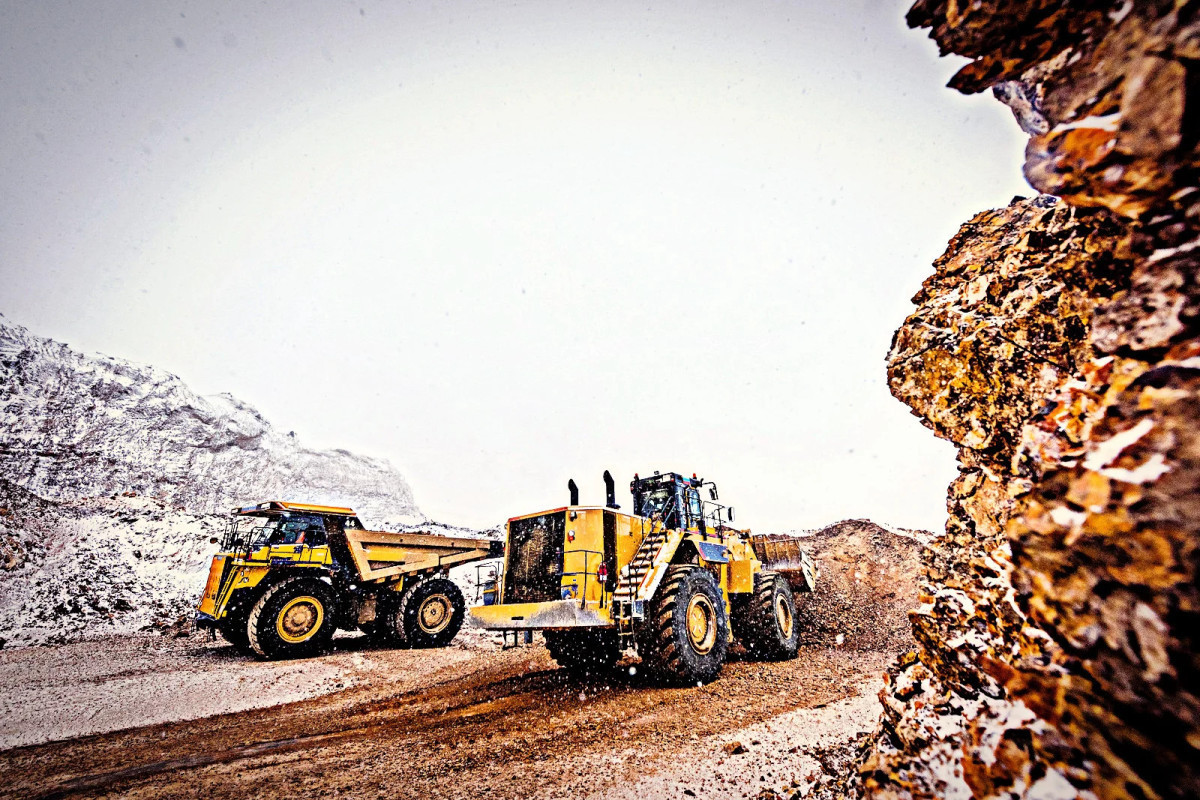
"Since November, Armenian political leadership in Karabakh has been led by a new state minister (effectively prime minister) – the Kremlin-linked Russian-Armenian oligarch Ruben Vardanyan. He is accused of reopening an illegal gold mine in the region and exporting its looted contents out of Armenian-controlled Karabakh via the Lachin corridor."
The article reads that the activists that have shut the route state they are protesting both Vardanyan’s plundering of natural resources legally owned by Azerbaijan as well as the environmental damage caused by his mining operation. In response, Karabakh Armenian officials have quickly turned this episode into a communications war in which they are the victims of a blockade.
A number of these claims, however, are rebutted in a video posted by Aykhan Hajizada, Baku’s spokesperson for the Ministry of Foreign Affairs, which shows Red Cross vehicles and Armenian ambulances being let through the protest camp. Hajizada dismissed the “claims about the blockade” as “fake news.”
The author noted that Beglaryan’s allegations of violations have been undermined by Vardanyan himself.
In an interview with The American Conservative, he contradicted his minister declaring that the Armenian leadership in Karabakh “have reserves that we have been planning for many years. And don’t forget that [Karabakh] is a rich land. We have some good meat and some grain. So, there are some basic foods, and starvation hasn’t started.” On the medical blockade his statements are even more at odds with Beglaryan’s: “Look, the road is open, the Red Cross is getting through.” There are some personal politics here: Vardanyan replaced Beglaryan as state minister, who was demoted when Vardanyan took up the post.
"The divergent versions of events presented by multiple sides make it difficult to have absolute certainty over what is really taking place on the ground. But what does seem clear is that Vardanyan and others in the Karabakh Armenian leadership are nonetheless using the opportunity – albeit with some contradictory messaging – to divert scrutiny away from their other, recent contentious activities. What is less divergent are fears Lachin is being used to ship military hardware, such as landmines, into Azerbaijan. There are serious concerns that Vardanyan’s confrontational leadership might drive new waves of violence after he proclaimed, in yet another interview: “the only choice now is to fight.”
In the early 1990s, Armenian separatists in Karabakh waged a war of secession against the national government in Baku. With Yerevan’s support, between 1994 and 2020, they controlled much of Karabakh as an autonomous parastate even though its independence was never recognized by a single member of the United Nations, Armenia included.
When Baku reclaimed most of the occupied lands during the 44-day Second Nagorno-Karabakh War, a Moscow-brokered ceasefire agreement stipulated the Lachin corridor connecting what remained of Armenian-controlled Karabakh with Armenia would henceforth be patrolled by Russian peacekeepers.
At EU-mandated peace talks in Prague in the fall of last year it was agreed that Baku, with Yerevan’s consent, would begin negotiations with the then-Karabakh Armenian leadership. The endgame was clearly to determine their future rights as a legally protected minority in Azerbaijan. But then, without warning, Vardanyan arrived: renouncing his Russian citizenship, relocating to Karabakh, and assuming the post of state minister. It is widely suspected that this move was orchestrated by the Kremlin as a means of derailing the EU-driven peace process.
This political subtext has been used by Azerbaijan’s opponents to dismiss the environmental protesters at Lachin as government stooges. By framing the activists as part of a green ruse, Azerbaijan’s other actions and claims can then be painted with suspicion.
Government-organized protestors or not, the Azerbaijani state has raised the alarm over the destructive effects that Armenian mining companies have had on the environment in Karabakh before. Minerals and metals make up nearly half of Armenia’s gross national exports and the country’s large mining industry has a long and well-reported history of corruption. After Vardanyan’s arrival, there were serious political and security concerns. But there are also genuine reasons to fear his environmental impact.
It is therefore wrong to dismiss Baku’s arguments as purely a tit-for-tat war. Even while these protests are being questioned, the ecological concerns themselves deserve to be treated with the same seriousness and urgency as those in Armenia," the article notes.


 Follow us on Telegram
 t.me/apanewsaz
 Follow us on Instagram
 Follow us on TikTok
 Follow us on Facebook
 Follow us on X