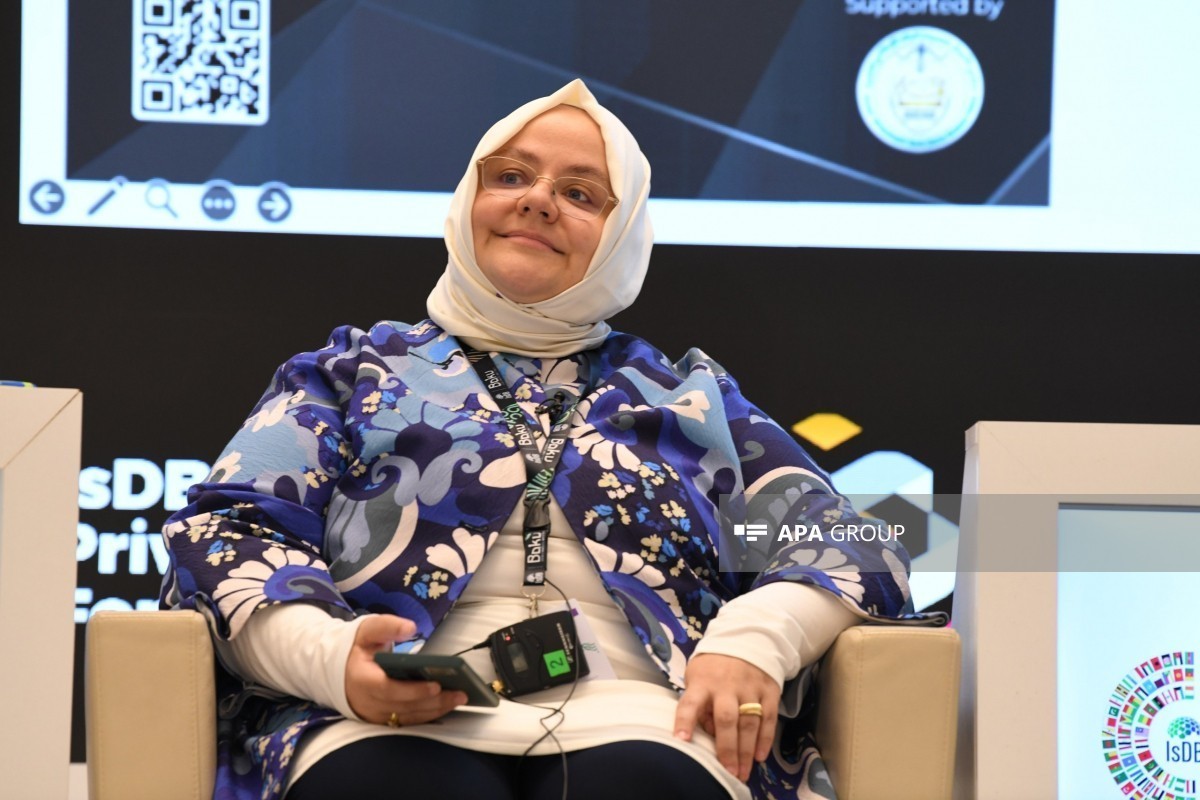

The future of the halal economy depends on regional integration, Zehra Selçuk, Director General of the Statistical, Economic and Social Research and Training Centre for Islamic Countries (SESRIC) operating under the Organization of Islamic Cooperation (OIC), and former Minister of Family, Labour and Social Services of Türkiye, during her speech at the session titled “Strategic Leadership Dialogue on Ethical Halal Business Models and Risk-Resilient Financing” held as part of the Islamic Development Bank (IsDB) Group Annual Meetings in Baku, APA reports.
“The future development of the halal economy will depend on how effectively we can establish links between finance, trade, investment, labor markets, standardization and certification systems,” she said.
She noted that regional cooperation institutions can play a strategic role in strengthening the integration of the halal ecosystem among OIC member states. According to her, the halal economy has already become a multi-trillion-dollar global ecosystem encompassing Islamic finance, halal food, tourism, pharmaceuticals, logistics and other sectors.
Zehra Selçuk stated that the size of the global halal market exceeded $7 trillion in 2023 and is projected to reach $11 trillion by 2028.
“OIC countries are home to approximately 81% of the world's Muslim population and represent around 80% of the global halal market. This creates significant opportunities for member states in terms of industrial development, integration of value chains and deepening regional cooperation,” she emphasized.
According to Selçuk, more coordinated and integrated cooperation mechanisms should be established among member countries in order to transform existing demand into production capacity, higher value-added exports, investments and quality employment.


 Follow us on Telegram
 t.me/apanewsaz
 Follow us on Instagram
 Follow us on TikTok
 Follow us on Facebook
 Follow us on X