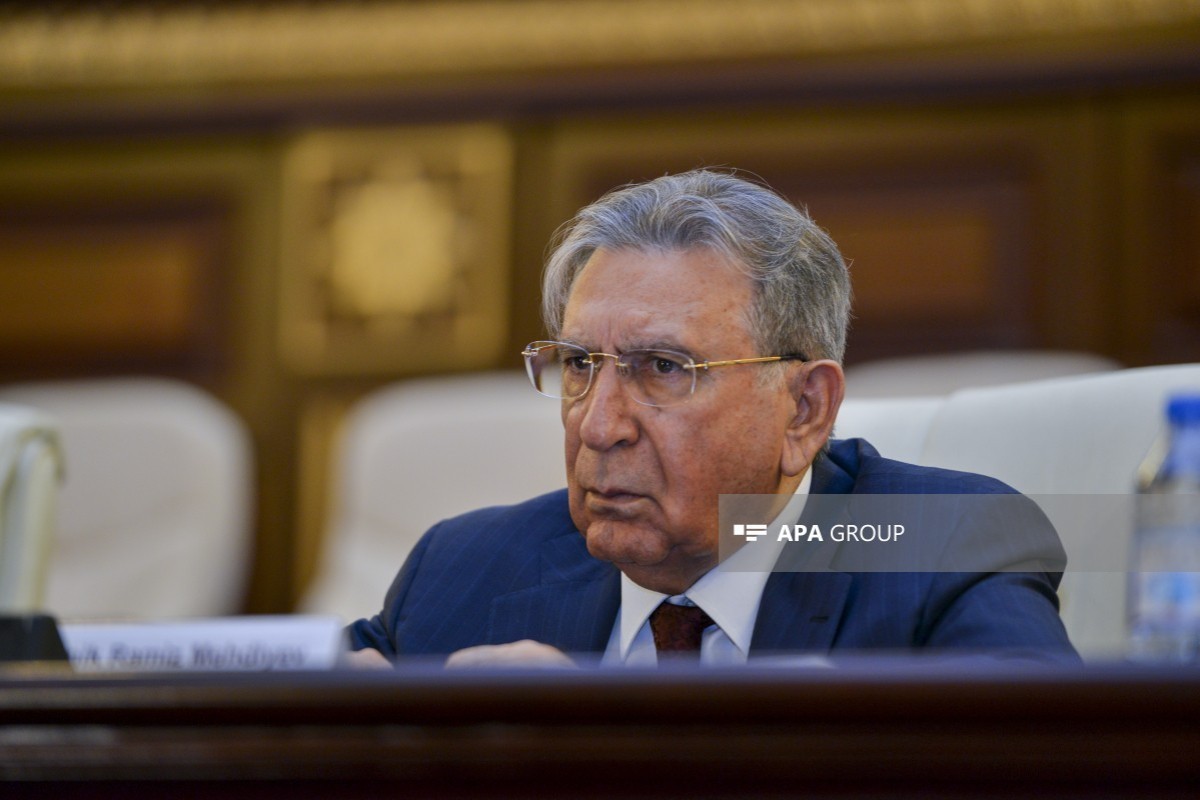
Baku – APA. “First of all, I would like to emphasize that the number of positive opinions and assessments of international observers is much higher than negative opinions and assessments. I should mention that there were 1295 observers and experts of the influential international organizations and they came from 100 countries. Almost all of them appreciated the level of transparency in the elections and respect for the principles of the voters to express their will freely,” said head of the Azerbaijani Presidential Elections, academician Ramiz Mehdiyev in his interview with some information agencies.
The PA head said that more than 400 observers and experts from CIS states monitored the elections: “The Centrist Democratic International Asia-Pacific Convention was represented by more than 50 observers, the International Conference of Asian Political Parties by about 20 observers, the Permanent Conference of Political Parties of Latin America and the Caribbean by 10 representatives, the Parliamentary Assembly of Turkic Speaking Countries by 10 observers and the Organization of Islamic Cooperation by 5 observers. Representatives of the Parliamentary Assembly of the Organization of the Black Sea Economic Cooperation, Russia’s Public Chamber, central election commissions of tens of states, as well as diplomatic missions of Asia and Oceania, African states accredited in Baku were among the observers. Their opinions are positive.”
Representatives of the European Parliament and Council of Europe, OSCE Chairperson-in-Office Leonid Kozhara, coordinator of the missions of the OSCE ODIHR Parliamentary Assembly Michel Voisin, EU High Representative for Foreign Affairs and Security Policy Catherine Ashton, EU Commissioner for Enlargement and European Neighbourhood Policy Štefan Füle and other authorized representatives congratulated Azerbaijan on the fair and transparent elections and specially underlined our country’s commitment to democratic values.
Such an opportunity was given to everyone, who expressed the desire to participate in the elections. The right of local observers, political parties, journalists, experts and members of the European Parliament to observe the voting process was not rejected.
No one was rejected to conduct an exit poll. Local and foreign organizations made alternative calculations and I should note that their results coincided with the data of the Central Election Commission of the Republic of Azerbaijan.
Unfortunately, there were biased cases. Despite the conditions of full transparency and openness, some European officials and the U.S. Department of State created a dissonance.
We don’t accept the assessment of the U.S. Department of State and the OSCE Office for Democratic Institutions and Human Rights on the presidential elections and regard it as disgraceful, biased and unworthy fact by the two official structures.
The OSCE Office for Democratic Institutions and Human Rights has never assessed the elections in Azerbaijan so negatively. The facts included in the first report of the organization are the results of assumptions and lies actively disseminated by the representatives of the National Council. As the National Council knew that their candidate had no chance to win, they began to sabotage the elections from the very beginning. For example, the representatives of the mission of the OSCE Office for Democratic Institutions and Human Right visited 84 polling stations in Surakhani district of Baku 156 times on the election day. They controlled the whole process of counting and filling in the ballot papers and protocols. They didn’t drop any remarks on the election process in three constituencies in this district. However, the candidate of the National Council declares that mass rigging and shortcomings were observed there.
I see a strange but an explainable synchronization in the assessment of the elections and characterization of the election process and its results by the two sides. It creates an impression that both of these centers closely cooperate only for one reason – to exert pressure on the Azerbaijani side, but there are no grounds, results and incentive motives for such a pressure.
The Azerbaijani authorities noted in advance and also confirm today that to conduct fair and transparent elections are first of all in our interests. We don’t impede the activity and development of political institutions as we are interested in democratization trough ensuring rights and freedoms, are carrying out clear activities towards development of civil society, ensuring the freedom of movement and freedom to express their will, what is the meaning of standing against our priorities in the conditions when we are coordinating our efforts with the relevant European institutions, Venice Commission and other centers?!
Frankly speaking, I do not only disagree with the assessment given by the sides you have mentioned, but even have become outraged for their position, because their views do not reflect the reality. It is impossible to understand the purpose of the OSCE Office for Democratic Institutions and Human Rights and US Department of State - why do they intentionally distort the clear and accurate scene and with this undermine the bilateral relations?!
In the recent years our country has always demonstrated openness, has not avoided dialogue, cooperation in the area of democratic reforms. Azerbaijan has made a great progress in this area.
By the way, facts of positive changes in the application of election technologies, which are significant part of the democratic reconstruction, prove how important the dialogue for us is.
It is strange that to criticize our practice has become a major purpose for some centers. Otherwise, it would have made no sense to cast doubt on the large-scale work in line with the international practice that fully meets serious standards and does not give rise to unfavourable criticism by unbiased experts from the leading countries of the world.
Comparing the presidential elections in Azerbaijan with the elections held in Armenia in February this year, the contradictions are obviously seen. Unlike Azerbaijan's realities, pre-election situation in Armenia was uncertain, even dangerous. The authorities threatened the candidates, persecuted them fiercely. The situation even resulted in assassination attempts, presidential candidate Paruyr Hayrikyan was shot.
Following this, the demonstrations and protest actions of the rivals of the authorities were dispersed rudely and cruelly. Those who opposed faced terrible sanctions, persecution, physical punishments not envisaged in the law. It would be appropriate to make a retrospective journey into the past, to mention the disgraceful practice in Armenia in 2008. According to official information, 10 demonstrators were killed in Yerevan during those elections. According to independent Armenian human rights activists, 30 were killed as the demonstration was dispersed."


 Follow us on Telegram
 t.me/apanewsaz
 Follow us on Instagram
 Follow us on TikTok
 Follow us on Facebook
 Follow us on X