












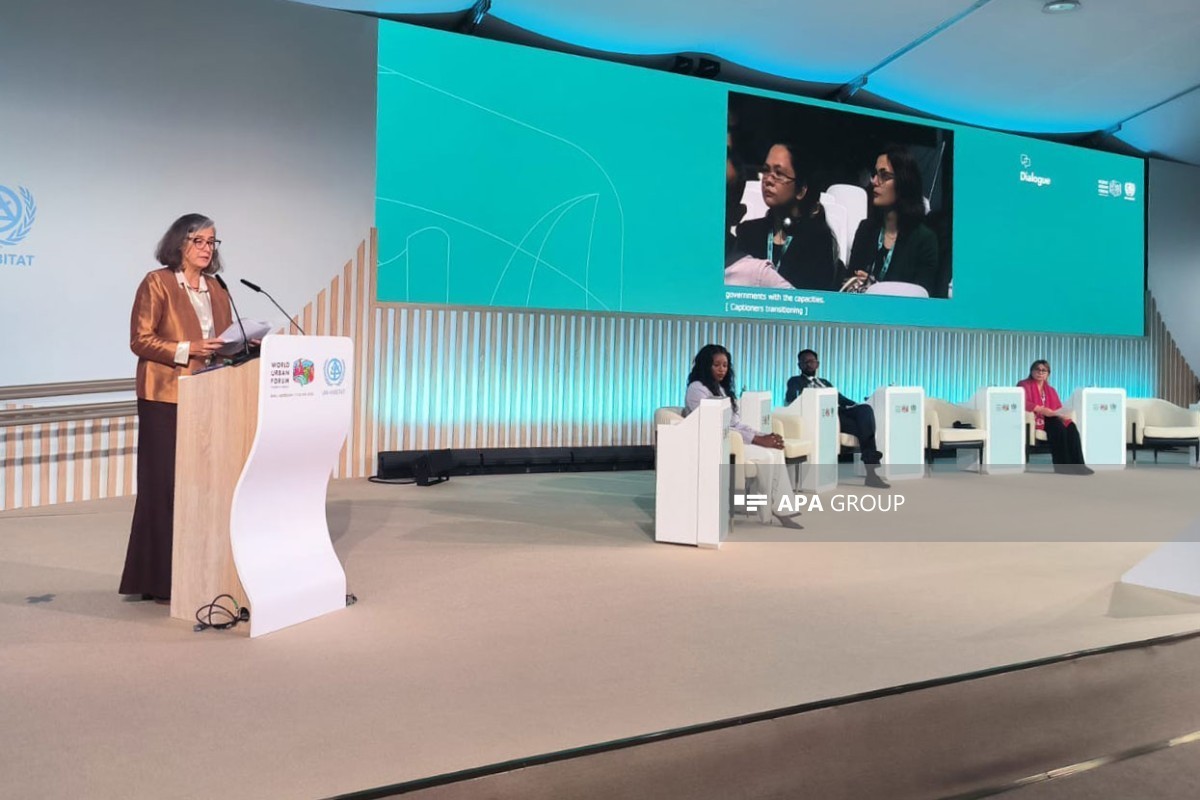


The global housing crisis and urban inequality have become among the most important urbanization challenges of our time, Executive Director of the United Nations Human Settlements Programme (UN-Habitat) Anacláudia Rossbach said during the panel discussion titled “Housing for Social Inclusion and Poverty Eradication” held within the framework of WUF13, APA reports.
Rossbach noted that around 3 billion people currently live in inadequate housing conditions.
According to her, more than 1 billion people live in informal settlements, while hundreds of millions face homelessness.
The head of UN-Habitat emphasized that cities are simultaneously facing serious pressures such as climate change, forced displacement, rising land prices, and deepening social inequality.
Rossbach stated that this situation demonstrates the importance of strong public governance, long-term planning, and broad partnerships in housing policy.
“Land and housing cannot be viewed solely as commercial commodities. They have social and environmental functions and must serve public welfare,” she said.
According to her, transforming housing systems is essential for building inclusive and sustainable cities. In this regard, expanding social and public housing stock, upgrading informal settlements, and improving access to land and basic services are among the main priorities.
Rossbach also noted that the Open-Ended Intergovernmental Expert Working Group on “Adequate Housing for All” is becoming an important multilateral platform for the implementation of the New Urban Agenda.
In her view, this platform creates opportunities for states, local authorities, and partners to develop practical solutions.
The head of UN-Habitat stated that the three panels to be held during the event are dedicated to interconnected topics such as social inclusion, urban well-being, and climate resilience.
Concluding her remarks, Rossbach emphasized that the main challenge is no longer the development of strategies, but their practical implementation. She stressed the importance of strengthening cooperation among governments and coordinating housing, land, infrastructure, finance, and climate policies.


 Follow us on Telegram
 t.me/apanewsaz
 Follow us on Instagram
 Follow us on TikTok
 Follow us on Facebook
 Follow us on X


