












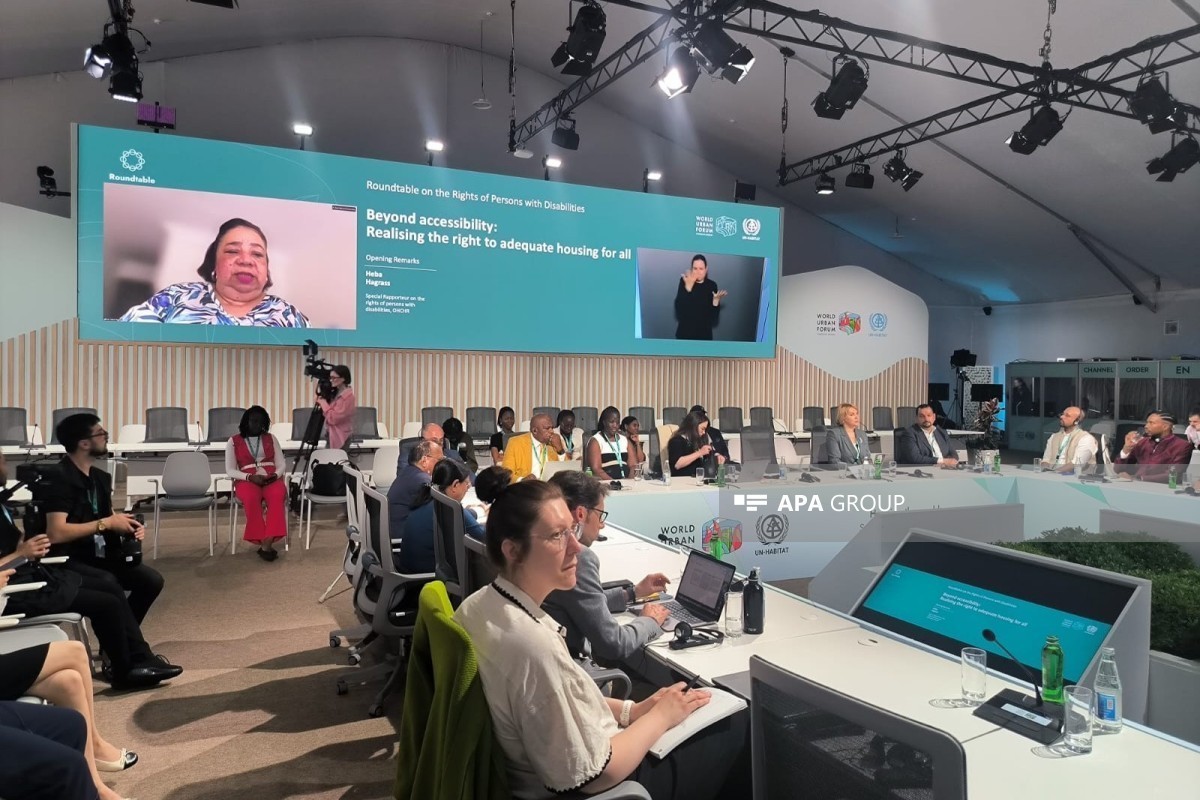


Universal design and the participation of persons with disabilities should be the main priorities for inclusive cities, Heba Hagrass, the United Nations Special Rapporteur on the rights of persons with disabilities at the Office of the United Nations High Commissioner for Human Rights (OHCHR), said during a roundtable on the rights of persons with disabilities held within the framework of the 13th session of the World Urban Forum (WUF13) in Baku, APA reports.
The UN representative stressed that existing urban planning and construction approaches in many cases deepen inequality and that the application of universal design standards should be the main direction for eliminating this problem:
“This approach is expensive, exclusionary and fundamentally incompatible with the principle of equality. What we need is for universal design to be accepted as a core standard in the construction sector.”
It was noted that persons with disabilities are more affected by housing shortages, forced displacement, climate disasters and rising living costs. It was stated that this situation is not accidental, but stems from systemic problems. “These impacts are not accidental, but the result of systemic discrimination embedded in planning, financing and governance systems.”
The speech noted that disaster-sensitive social protection and inclusive recovery are not only technical approaches, but also human rights obligations. Alignment with the UN Strategic Plan for 2026–2029 and the midterm review of the New Urban Agenda creates an important opportunity for inclusive urban planning.
The UN official stressed that the participation of organizations of persons with disabilities in decision-making processes is not a recommendation, but a legal requirement: “Organizations of persons with disabilities should participate not only in an advisory role, but also at the level of leadership and co-design.”
It was noted that these organizations should directly participate in policy formulation, determination of indicators and the conduct of accessibility audits.


 Follow us on Telegram
 t.me/apanewsaz
 Follow us on Instagram
 Follow us on TikTok
 Follow us on Facebook
 Follow us on X


