












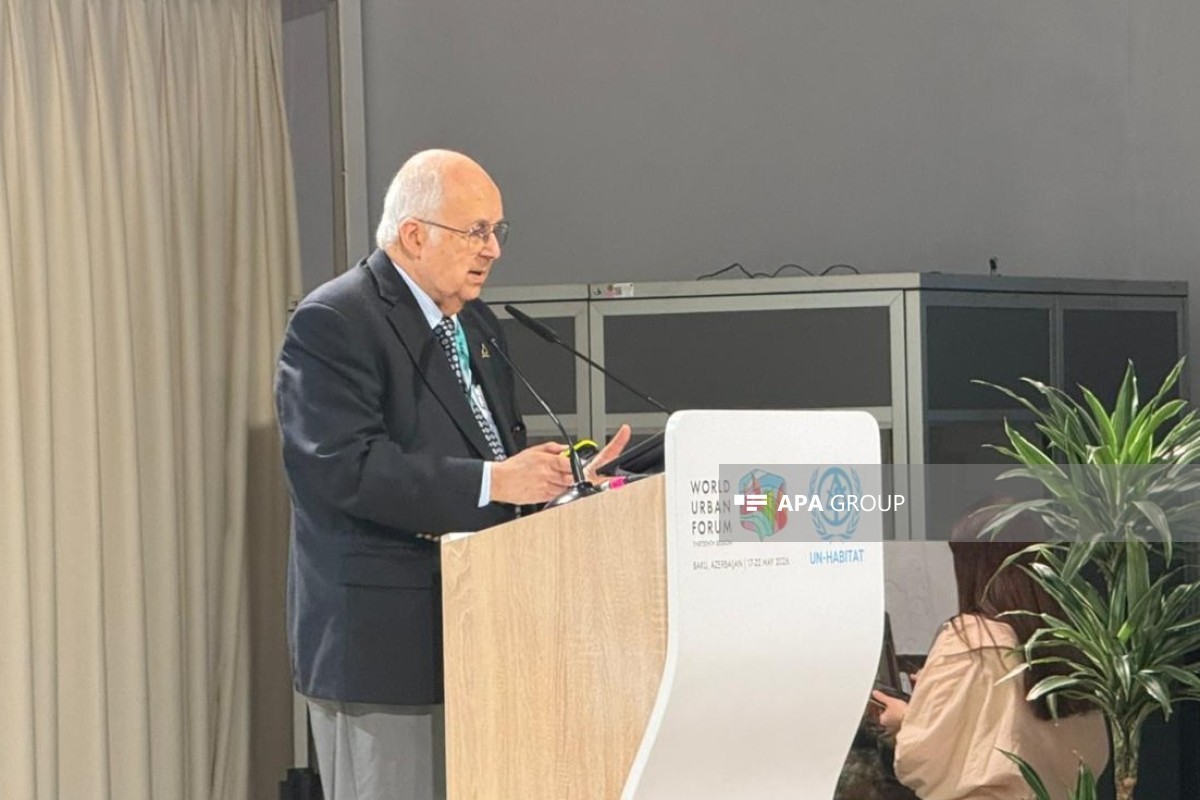


One of the most important issues is minimizing the displacement of the local population, Ismail Serageldin, founder of the Bibliotheca Alexandrina, former Vice President of the World Bank, and cultural expert, said during the forum titled “Rethinking Cultural Heritage and Inclusive Urban Regeneration” held within the framework of WUF13, APA reports.
“Because when people are displaced and new buildings are constructed in their place, the mutual support system within the community is destroyed. Therefore, it is important to carry out advance planning, involve the local community in the preparation and implementation of the project, and provide sufficient financial resources and opportunities for displaced families.
At the same time, when economic development and investment projects are implemented, the cost of services must remain affordable for low-income populations. Sometimes this requires the application of cross-subsidies. If investments are justified by the state or private investors, we should always ask the following question: ‘Who pays for this public funding and who benefits from it?’ Very often, governments provide tax incentives to wealthy foreign investors, but the tax burden falls on poor people. Therefore, we must carefully analyze who ultimately bears the tax burden,” he said.
He believes that all of this requires the establishment of national and local partnerships, as well as the involvement and empowerment of local communities in the process.
“The cost-benefit analyses we usually use to assess investments are not sufficient for cultural heritage sites. For example, relying solely on tourism revenues could lead us to incorrect conclusions. First, it may create the impression that heritage sites that do not attract tourists are not worth preserving. This is wrong. Second, in an attempt to increase tourist numbers, damage may be caused to the very heritage that should be protected. Third, for example, when working with the World Bank, if we focus only on tourism revenues, it would be possible to prove that a casino on the coast deserves more funding than a cultural heritage project. This does not reflect reality and is a flawed approach that fails to take into account the true value of cultural heritage,” he noted.


 Follow us on Telegram
 t.me/apanewsaz
 Follow us on Instagram
 Follow us on TikTok
 Follow us on Facebook
 Follow us on X


