












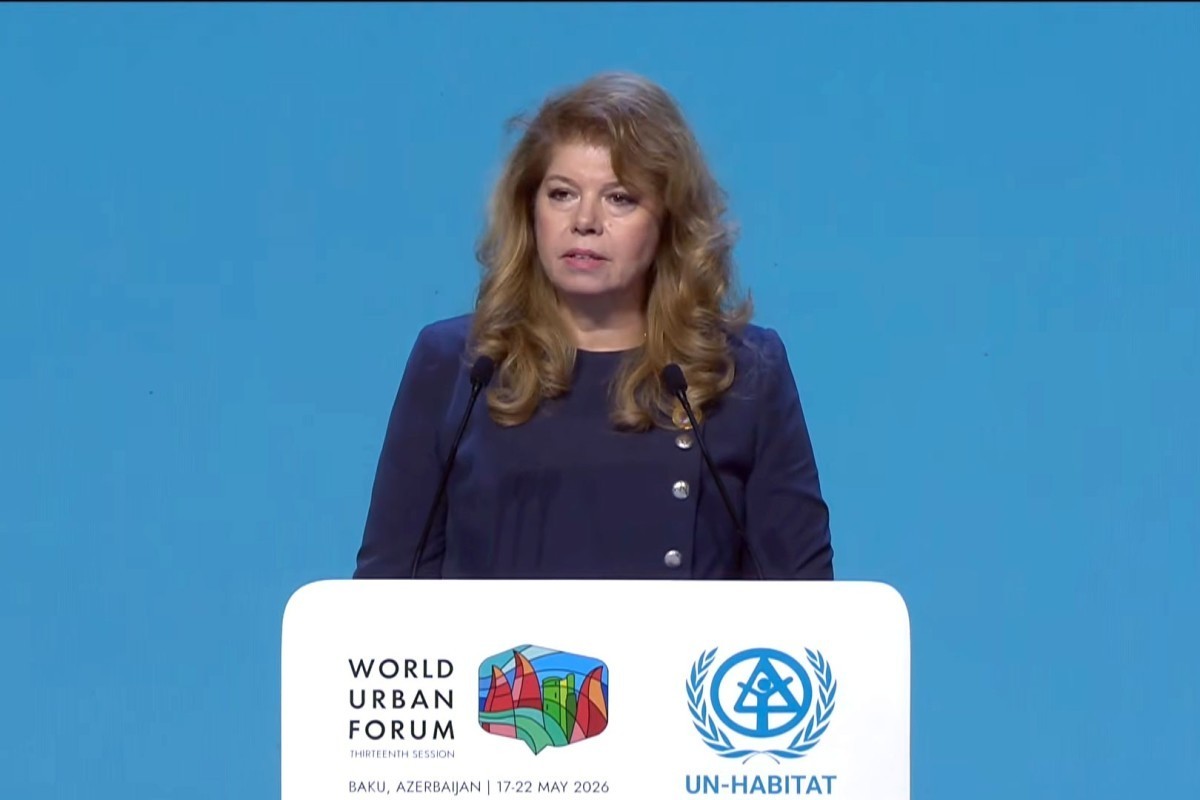


“If climate change continues, people on all continents will begin migrating for the simplest and most sacred right — the right to live," said Vice President of the Republic of Bulgaria Iliana Iotova during the Leaders’ Session within the framework of the 13th session of the World Urban Forum (WUF13) held in Baku, APA reports.
“As cities continue to grow, new flows of people are also directed toward them. Unfortunately, we live in a time of wars. At this very moment, while we are gathered here, conflicts taking place in different parts of the world are forcing millions of people to leave their homes. More than 60 percent of them seek refuge precisely in cities. Because the city is the first place where a person who has become a refugee looks again for safety, work, a school for their child and a small part of normal life. For too long, the world has spoken about migration mainly as a threat. Let us change this approach. This is not a threat. This is a reality for which we must be prepared. A prepared city turns the arriving person into a citizen, a worker, a taxpayer and a neighbor. An unprepared city pushes them into marginality, informal life, invisibility and isolation. The difference between these two approaches is the choice that we — political leaders — make or refuse to make,” Iliana Iotova noted.
The Bulgarian President said that in addition to wars, there is an even greater threat: “For years, climate change has been displacing not only individuals, but entire regions. Droughts, water shortages, rising sea levels and lands that can no longer support people are causing this. Scientists warn that if current tendencies continue, people across entire continents will begin migrating for the simplest and most sacred right — the right to live. Today, for millions of people around the world, housing has already become the frontline in the fight against climate change. Urban resilience is not an environmental luxury. A city that is not prepared for climate change can destabilize entire regions. In Bulgaria, we know these processes well. We are a member of the European Union and are located at the intersection of major connectivity corridors. However, our country, like much of Europe, faces an aging population, internal migration, depopulation of some regions and growing inequalities between large cities and small towns. We know what it means when one city develops while another nearby city gradually weakens. We understand the situation in which young families can no longer afford housing and entire generations lose confidence in the future. These realities confront us with the same challenges regardless of which part of the world we come from. If the problem is common, then the solutions can also be common. The world must share knowledge and achievements freely, not in isolation from one another. Because our homes and our future are shared as well. Our investments must be directed not simply toward infrastructure for its own sake, but toward people. Technology must serve humanity, not replace it. Artificial intelligence, digital systems and smart cities will gain real value only when they serve people, reduce inequality and make life more accessible, safe and dignified. Most importantly, housing policy must not remain merely a separate sectoral policy. It must become a policy concerning the future of society. Let us stop measuring the success of a city by the number of skyscrapers, its skyline or its gross domestic product. Let us evaluate a city by whether it can provide even its most vulnerable person with a home, opportunity and a voice. This means placing the issue of housing at the center of international, national and local policy. A city does not become great simply because of its large size. A city becomes great and strong when no one there is considered unnecessary. Let us leave Baku not only with another declaration. Let us leave Baku with the determination that the ‘Baku Call to Action’ will be remembered not for speeches, but for the homes that will be built thanks to it,” Iliana Iotova noted.


 Follow us on Telegram
 t.me/apanewsaz
 Follow us on Instagram
 Follow us on TikTok
 Follow us on Facebook
 Follow us on X


