












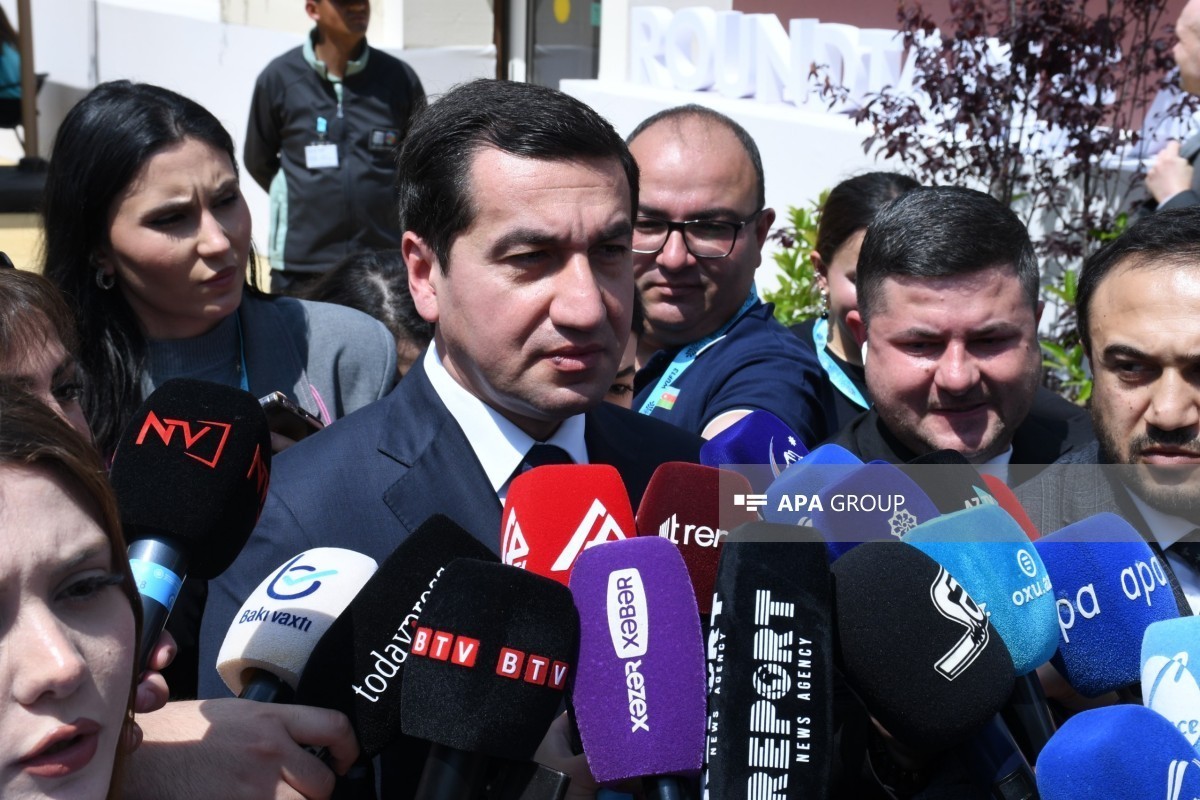


Today, there is almost no other country besides Azerbaijan that is rebuilding nearly 9 cities and more than 300 villages and settlements using its own national and financial resources, Hikmat Hajiyev, Assistant to the President of Azerbaijan and Head of the Foreign Policy Affairs Department of the Presidential Administration, told journalists, APA reports.
“Azerbaijan is one of the important venues where international-level events are held, and numerous such events are organized in our country. Azerbaijan hosted COP29, one of the largest events held within the framework of the United Nations. Following this, the holding of the World Urban Forum in Azerbaijan is an indicator of the trust of both the international community and the UN family in our country. It should be taken into account that at the present stage, not all countries in the world are capable of hosting events of this scale. Due to the security situation, wars, organizational capacity, the preparedness level of cities and other factors, not every country and every city is ready for such events. Azerbaijan’s gaining of international trust, its level of preparedness and its successful hosting of multilateral diplomatic events have led to the holding of such a prestigious event as the World Urban Forum in our country.”
Hikmat Hajiyev stated that this is the second largest event on the UN scale after COP29, and the holding of two such major events in Azerbaijan within a short period of time is of particular importance: “As for the significance of holding the World Urban Forum in Azerbaijan, first of all, I would like to touch upon the points emphasized by Mr. President at the opening of the forum. First, it was noted that the Azerbaijani people possess a rich urban planning culture. The history of the emergence of cities in Azerbaijan dates back to the pre-Christian era. Gabala, which was the capital of ancient Caucasian Albania, Nakhchivan and other ancient Azerbaijani cities, as well as our medieval cities, can be cited as examples.
Based on these rich traditions and experience, modern cities are still being developed in Azerbaijan today. At the same time, historical heritage is being preserved within the framework of the urbanization process. Today’s Baku is the best example of this, and this is also recognized worldwide. The inclusion of several historical sites of Baku in the UNESCO World Heritage List is an indication of this. Our cities located in other regions of Azerbaijan are also of particular importance in this regard.
The issue of rebuilding cities and settlements in the post-conflict period should also be particularly noted here. The activities carried out by the Republic of Azerbaijan in this direction are of a unique nature, as Mr. President also emphasized.”
The Presidential Assistant stressed that when looking at settlement and housing problems in the global context, the refugee and internally displaced persons problem that emerged in the early 1990s as a result of Armenia’s occupation against Azerbaijan should be especially noted: “During that period, internally displaced persons living in difficult conditions were settled in tents. However, within a short period of time, this situation was changed by the Azerbaijani state, and residential houses and apartments were built for internally displaced persons. All this shows that Azerbaijan has today become an important platform where global problems are discussed, and the World Urban Forum serves precisely this purpose.”


 Follow us on Telegram
 t.me/apanewsaz
 Follow us on Instagram
 Follow us on TikTok
 Follow us on Facebook
 Follow us on X


