












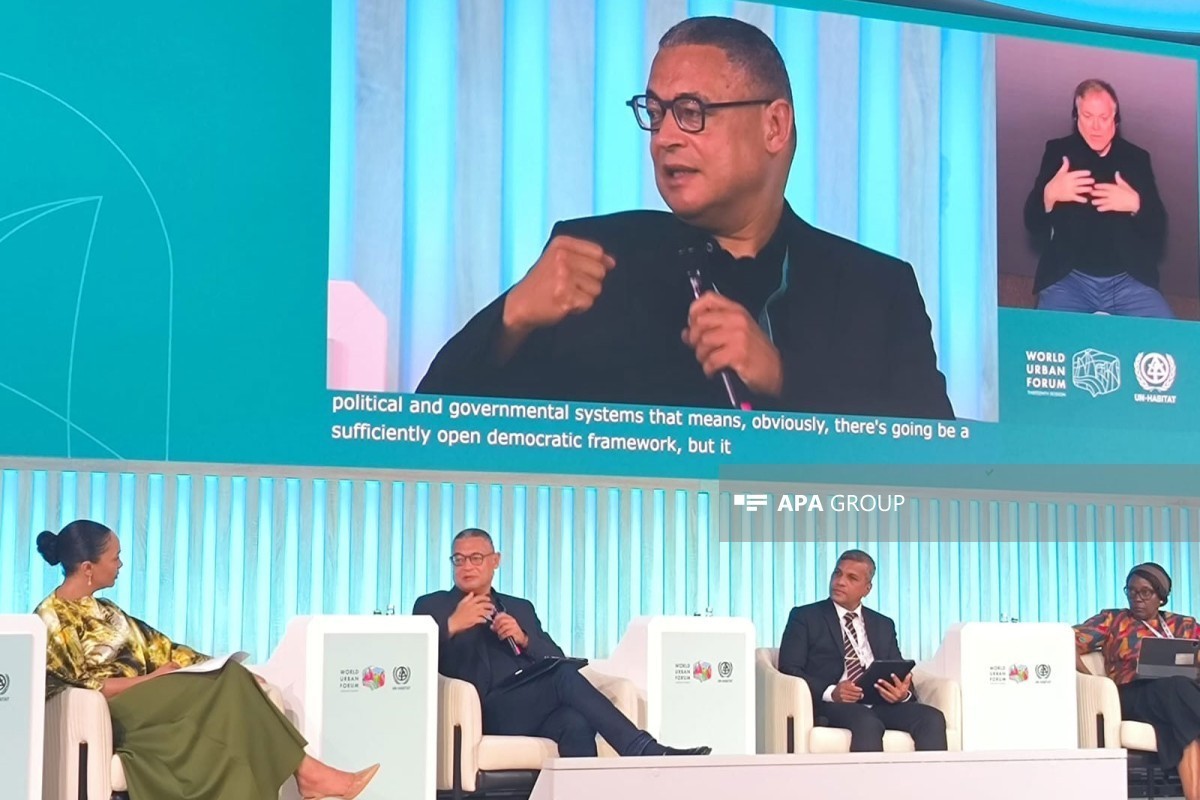


Only the participation of the private sector is not enough to solve the housing affordability crisis, and market participants do not want to take on the risks of the transition period, Edgar Pieterse, founding director of the African Centre for Cities and a leading international expert on the future of global south cities, said during the event titled “Climate and Housing Nexus” organized within the framework of the 13th session of the World Urban Forum (WUF13) held in Baku, APA reports.
He noted that within the framework of the conducted research, interviews were held with all participants in the construction chain, including banks, construction companies, insurance institutions, audit firms and contractors. According to Pieterse, although all parties acknowledge the existence of the problem, no one is ready to share the financial burden and risk of transitioning to sustainable and environmentally friendly solutions.
The expert emphasized that incentive mechanisms alone are not sufficient and that strict regulatory tools forcing market participants to change their behavior should also be applied: “Additional tax and penalty mechanisms should be applied to those who continue carbon-intensive and unsustainable construction methods. Otherwise, no one will come to real negotiations to share transition costs.”
Touching upon the issue of satellite cities, Edgar Pieterse stated that this approach does not produce the same result for every region. According to him, in European cities facing population decline, satellite cities are not considered a solution, because those cities are already facing economic and social sustainability problems: “In African countries, however, the situation is different. Although the urbanization model consisting of one large city and numerous small cities makes the idea of satellite cities attractive, experience shows that this does not always work. People still move toward large cities. Because job opportunities, education, healthcare and social mobility opportunities are mainly concentrated in those cities.”
He added that building satellite cities from scratch requires enormous financial resources and creates additional costs: “A more appropriate approach is to renovate existing urban centers, solve the problem of adequate housing in those areas and strengthen infrastructure.”


 Follow us on Telegram
 t.me/apanewsaz
 Follow us on Instagram
 Follow us on TikTok
 Follow us on Facebook
 Follow us on X


