












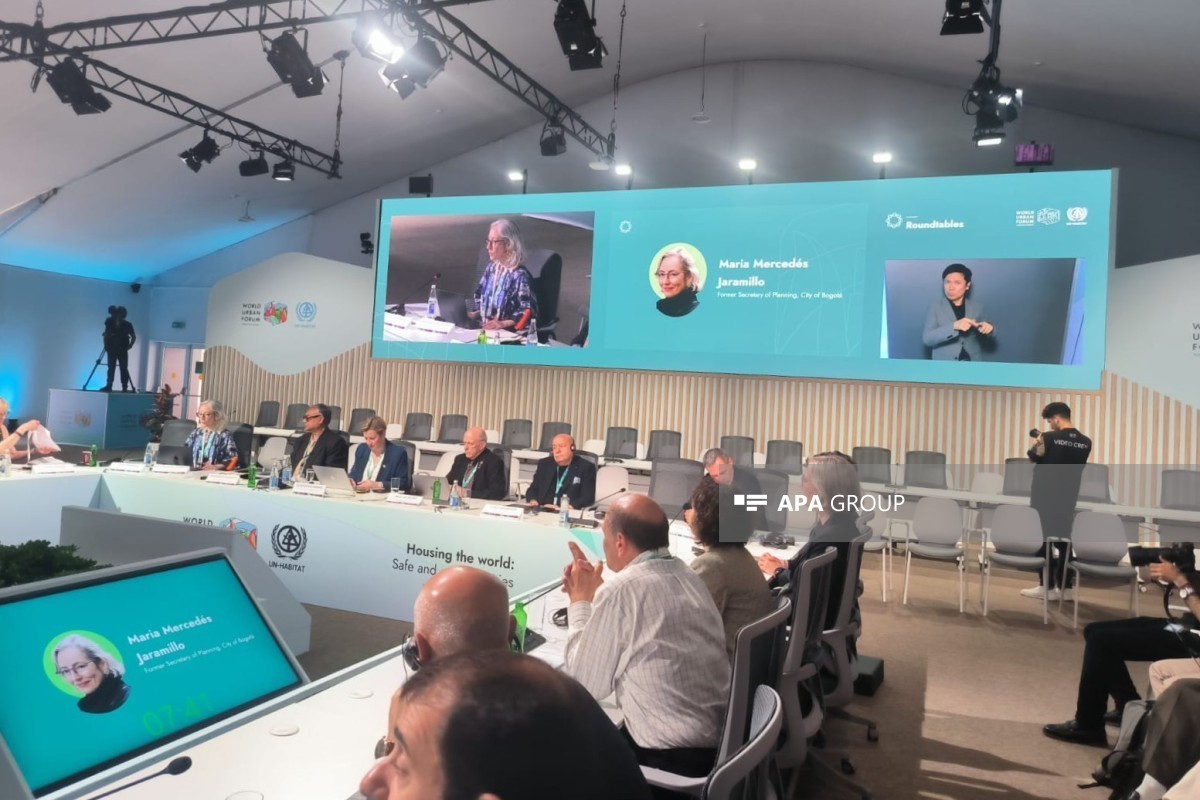


“Planning for sustainable cities must be multidimensional," Maria Mercedes Jaramillo, former Secretary of Planning of Bogotá, said during the roundtable titled “Addressing the Global Housing Crisis: Advancing Sustainable and Adequate Housing Through Tackling Capacity Gaps Across Professions and Sectors” held within the framework of WUF13, APA reports.
“Building sustainable communities requires new approaches from us as professionals,” she stressed.
Jaramillo stated that urban planning should not be limited only to housing issues: “It is impossible to solve the housing problem without planning employment, transportation, food, energy, and water security.”
According to her, planning also requires a multi-level approach: “Our daily lives depend not only on global, regional, and metropolitan conditions, but also on proximity to people, services, and spaces.”
Jaramillo emphasized that the world is currently going through a period of systemic crisis.
Touching upon the issue of urban resilience, the expert noted that urbanism often views cities as isolated spaces: “Cities do not produce the water we drink, the food we eat, or the energy we use. Yet urban planning still treats the city as an object confined within borders.”
Maria Mercedes Jaramillo also referred to her experience working in Bogotá: “After serving as Secretary of Planning in Bogotá — one of the world’s most complex, unequal, and climate-vulnerable cities — I know that traditional urban planning alone is not enough to make cities safe and sustainable.”


 Follow us on Telegram
 t.me/apanewsaz
 Follow us on Instagram
 Follow us on TikTok
 Follow us on Facebook
 Follow us on X


