












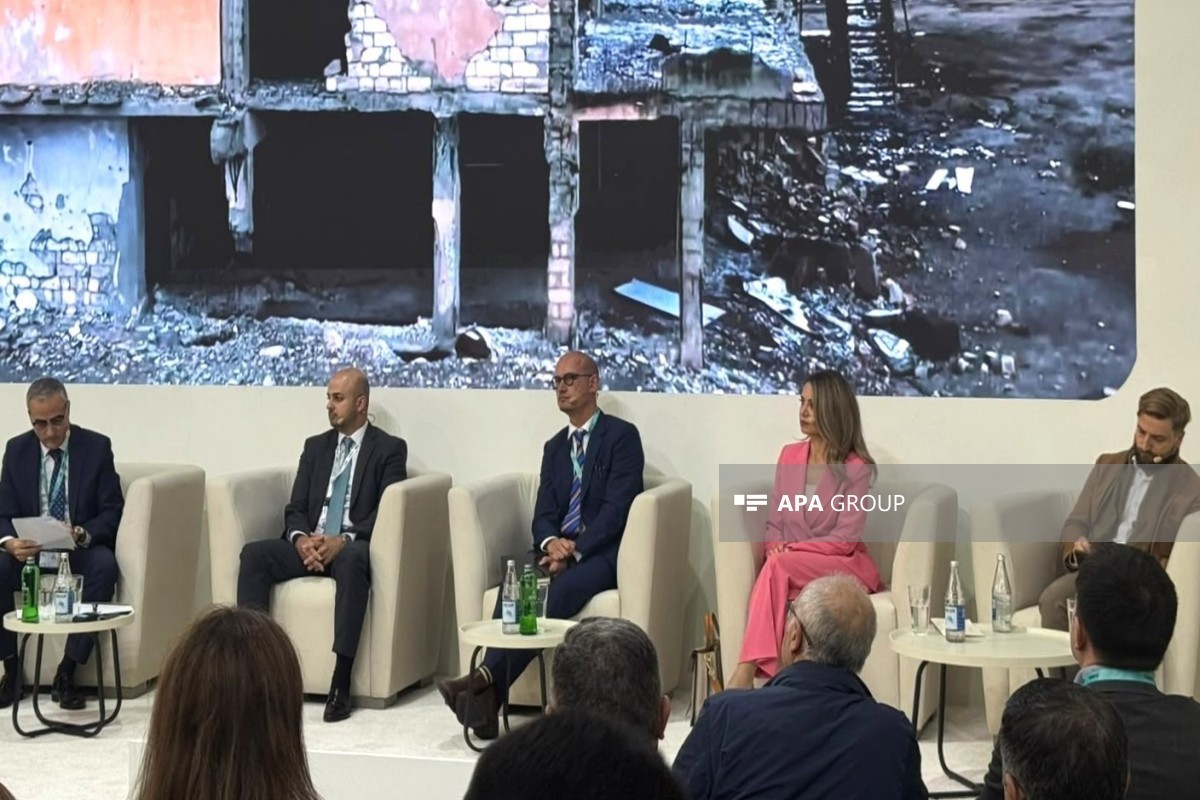


Master plans for 8 cities and more than 100 villages have been prepared to date, Ramil Jahangirov, head of department at the State Committee for Urban Planning and Architecture, said during the international panel titled “Revival and Urbicide: Sustainable Urban Planning and Resilient Communities” held within the framework of the 13th session of the World Urban Forum (WUF13) in Baku, APA reports.
He noted that these master plans, based on the general plan, have become development roadmaps for each settlement:
“It was precisely thanks to this hierarchical and systematic approach that we were able to launch work simultaneously in different parts of the region. I think this is one of the most difficult issues. Of course, some important institutional steps also helped Azerbaijan achieve this result. One of the most important points was the high-level coordination of the entire process. Another important issue was the creation of a regional governance model. For this purpose, special representative offices were established.”
R. Jahangirov stated that a total of six special representative offices are operating and managing this process:
“Why was the creation of this institution important? Because the challenge ahead is completely unique. This is not a traditional local governance model. This is a governance model under reconstruction conditions, where construction continues every day and people return every day. This is a very important point. Speaking about people, the main goal of the entire process is to ensure that people live happily on their native lands. The uniqueness of this process lies in the large time gap between when people left and when they are returning. This is extremely important from sociological, architectural, and urban planning perspectives.”


 Follow us on Telegram
 t.me/apanewsaz
 Follow us on Instagram
 Follow us on TikTok
 Follow us on Facebook
 Follow us on X


