












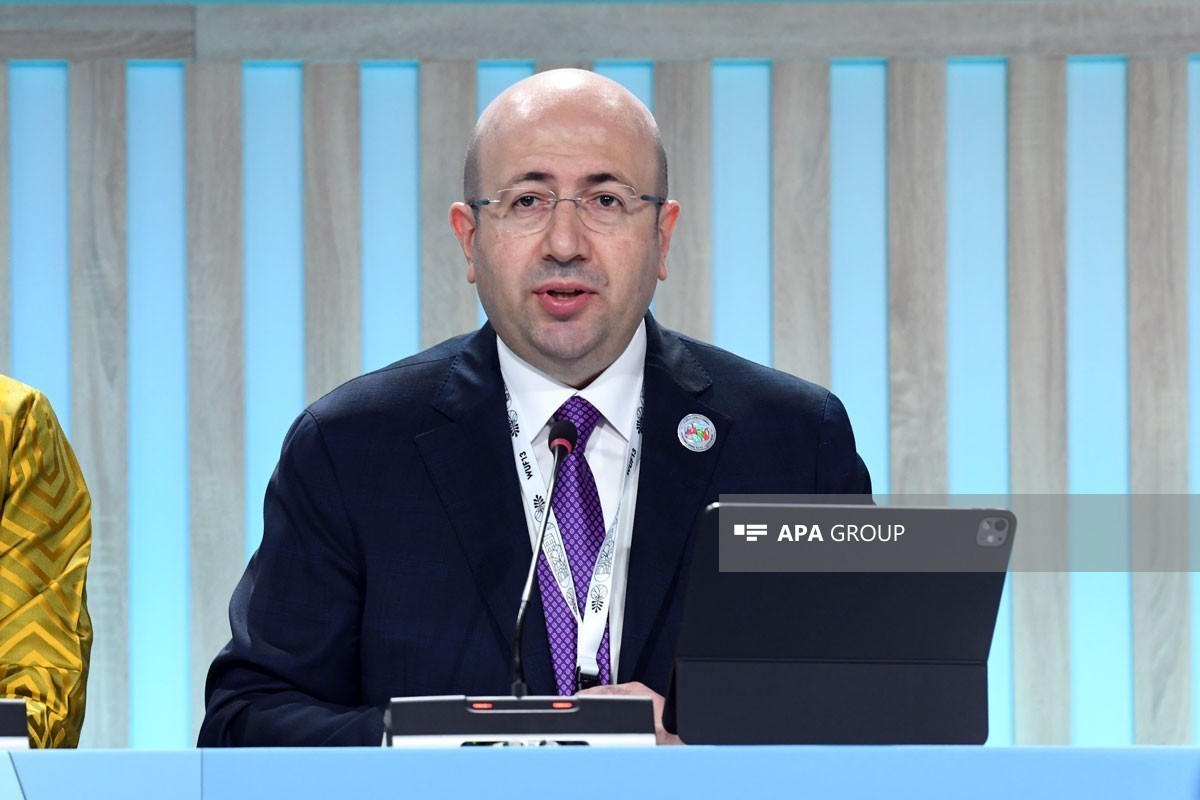

The plan approved in 2022 serves as the main special and strategic framework document guiding the development of Azerbaijan’s economic regions – Karabakh and Eastern Zangezur, Chairman of the State Committee on Urban Planning and Architecture of the Republic of Azerbaijan Anar Guliyev said during the special session titled “Cities at the Center of Connectivity: Urban Reconstruction and Regional Cooperation” organized within the framework of WUF13, APA reports.
According to him, the document combines urban infrastructure, environmental management, resource allocation, energy systems, industrial development and demographic forecasting within a unified coordinated development framework.
“The liberated territories cover an area of approximately 13,600 square kilometers and include 12 cities, as well as nearly 300 villages and settlements. It is planned to settle approximately 1.1 million people in these territories. The strategic plan defines a coordinated development model between urban planning, transport infrastructure, economic activity, ecological systems and rural settlements in Karabakh and Eastern Zangezur,” Anar Guliyev noted.
He added that the construction of modern transport infrastructure is one of the main priority areas of the reconstruction process. Currently, road projects with a total length of more than 3,300 kilometers are being implemented in the liberated territories. Within the framework of these projects, 48 tunnels, 500 bridges and 16 viaducts are being constructed.
At the same time, two new railway lines with a total length of 160 kilometers and three international airports significantly expand the region’s internal and international connectivity opportunities.
“The liberated territories have been declared a ‘green energy zone,’ reflecting Azerbaijan’s commitment to sustainable development and climate-adapted strategies. The regional development model envisages a transition to clean energy sources, especially in the fields of hydropower, solar and wind energy,” Anar Guliyev emphasized.


 Follow us on Telegram
 t.me/apanewsaz
 Follow us on Instagram
 Follow us on TikTok
 Follow us on Facebook
 Follow us on X


