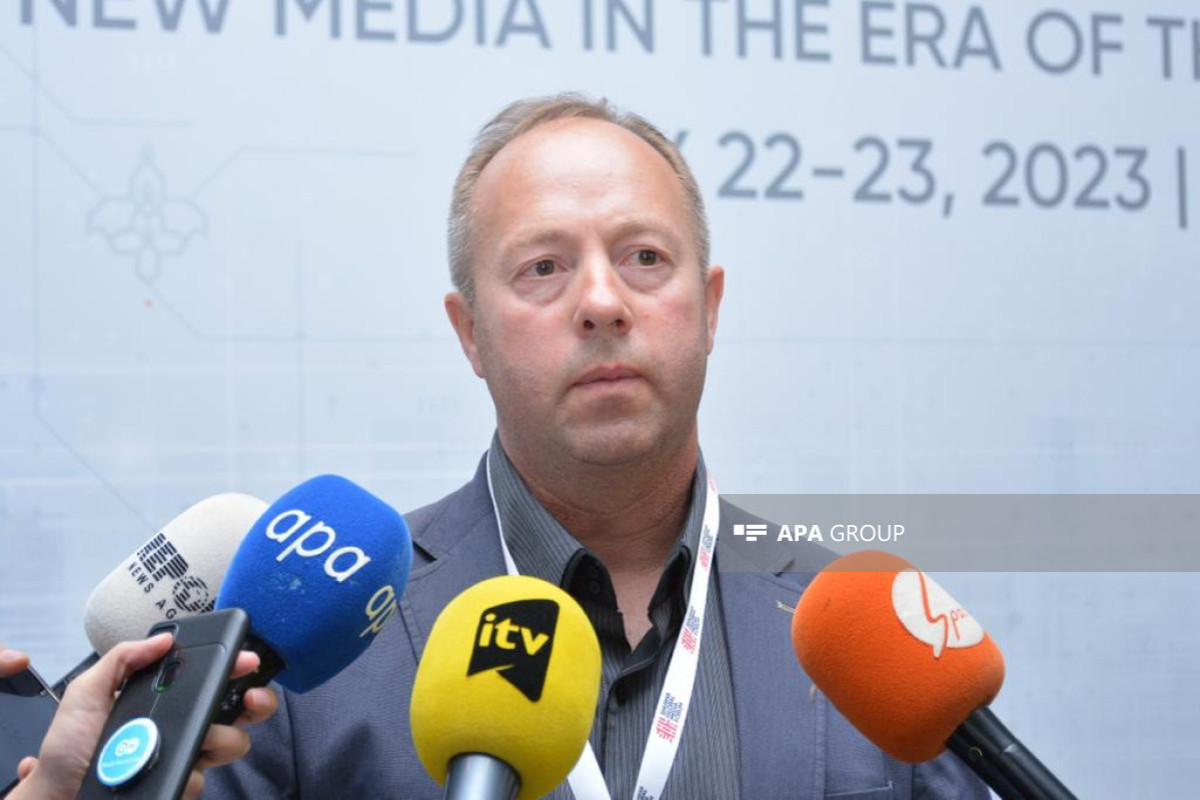

"After the Khojaly tragedy, and the Khojaly genocide which was committed in February 1992, only a handful of people came there. International media kept silence," said Richard Lapaitis, a Lithuanian journalist, who witnessed the Khojaly massacre, in his interview with journalists at the Shusha Global Media Forum on "New Media in the 4th Industrial Revolution", APA reports.
The journalist emphasized that if the international media was not silent when the tragedy committed, other tragedies would not have happened.
“More than 600 Khojaly residents, children, women were killed at one night. I understand that there was a huge disinformation policy by Armenian politicians. They were hiding the Khojaly incident. The most influential Media representatives, agencies like BBC, "Reuters" did not come there. If a journalist has promised and undertaken this job, he should fear nothing. There were threats against me. Let me tell you about something that happened: There were only two journalists in total after the Khojaly tragedy. One local journalist and me from Lithuania. They brought two Azerbaijani girls, aged 4 and 5. Their clothes were covered with blood. The girls were murdered. There was a deathly silence. Their father was sitting next to them, he was silent as well. The girls were shot with a bullet in the temple, they had bullet and stab wounds on them. Someone approached and put a pillow under the girls’ heads. I asked the reason and he said that the children are lying on an iron table, they are cold. However, the girls were dead. Then I left and thought that I am alone here. I promised myself that I will never bow to any threat”.
Ricardas Lapaitis added that journalists should always fight for justice.
"After returning to their countries, the media representatives should convey to the world what they saw here. On our way here, we saw what the land of Azerbaijan has become. There is no such thing as the pain of others, we all have red blood, we all have one God. You never have to follow provocations. I bow to everyone who arrived here. 30 years ago, I could only dream that I would come here and drink tea and coffee. Even some Azerbaijanis did not believe that they would return to their hometown, but I told them then that if I believe in it, we will return to that city."
The Lithuanian journalist also shared his impressions about the city of Shusha: “I got up at 5 in the morning today. This is not just a castle. The city of Shusha is native to Azerbaijanis, it is their own. This is the homeland of mugham. This is the homeland of the ancestors of Azerbaijanis. This is the homeland of great poets, writers and thinkers. If we did not turn a blind eye to injustice somewhere, the events in Ukraine, the Baltic countries and Europe would not have happened. I mean what happened in Kosovo and other places. Therefore, I hope that many media representatives present here today will have the courage to objectively convey the information to the world. What is happening in Ukraine should also be communicated to the whole world. If you are afraid, you should stay at home. I wish Azerbaiajn sustainable prosperity," Richard Lapaitis underlined.


 Follow us on Telegram
 t.me/apanewsaz
 Follow us on Instagram
 Follow us on TikTok
 Follow us on Facebook
 Follow us on X