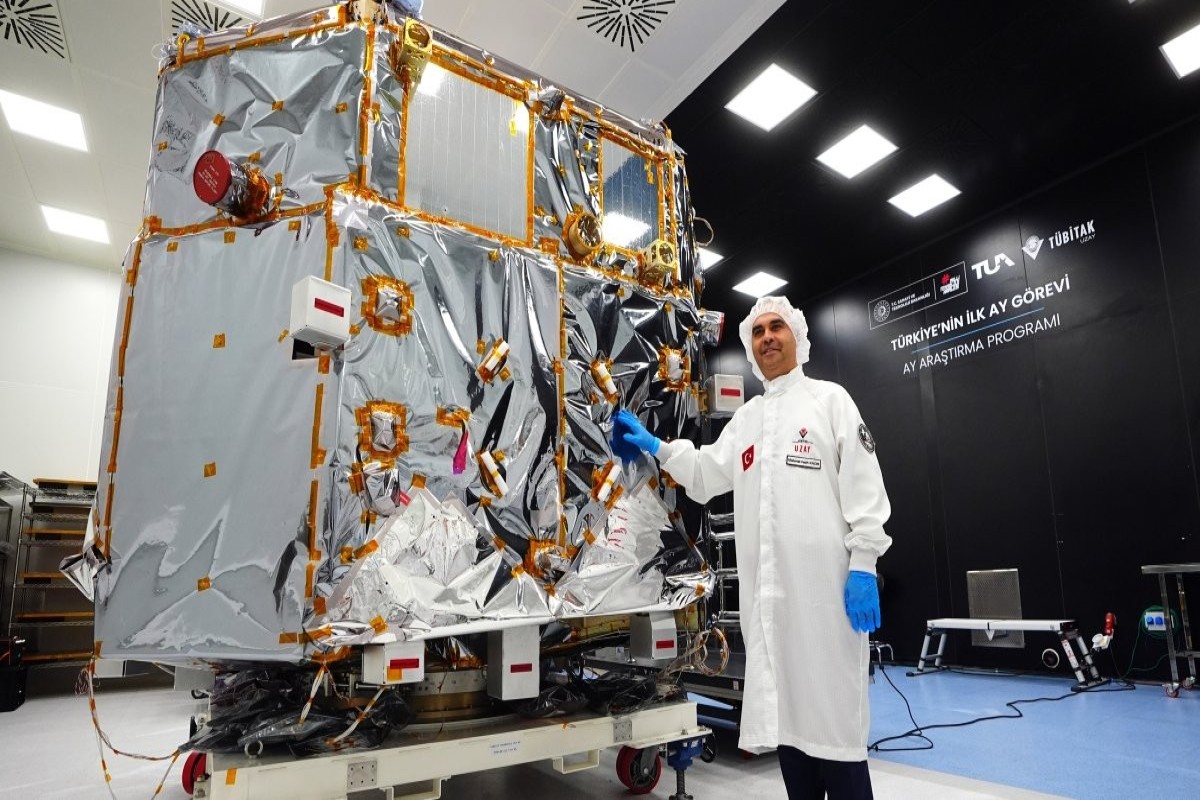

Türkiye has completed the production, assembly and integration of the spacecraft being developed for the country's first Moon mission, Industry and Technology Minister Mehmet Fatih Kacır said Monday, APA reports citing Daily Sabah.
The spacecraft has been sent to the Turkish Aerospace Industries (TAI) Space Systems Integration and Test Center for system-level environmental testing, Kacır said at a press briefing.
Türkiye aims to become the ninth country in the world and the first Muslim nation to carry out a Moon mission with its own engineering capabilities, Kacır said.
The approximately 3.5-ton spacecraft is planned to launch in the first months of 2027and is expected to reach a polar, circular orbit about 100 kilometers above the Moon's surface after a journey of roughly two months.
The spacecraft is initially scheduled to operate for at least three months, Kacır said, with the mission potentially extended to up to 18 months depending on performance.
During the mission, the spacecraft will study the interaction of solar winds with the lunar surface, the mechanisms behind the formation of water on the Moon, the Moon's magnetic fields and the thermal properties of its surface. It will also conduct radiation measurements using scientific equipment developed domestically.
Following completion of the scientific mission, Kacır said Türkiye plans to guide the spacecraft toward the lunar surface through controlled deceleration maneuvers.
"As part of this mission, the hybrid propulsion system, which we developed and manufactured entirely with domestic and national resources, will be fired in deep space for the first time in history," said Kacır.
More than 80% domestic content
The spacecraft was produced with a domestic content rate of more than 80%, drawing on capabilities developed through Türkiye's previous satellite programs, including the Imece earth observation satellite and Türksat 6A.
These capabilities include flight computers, communications, power systems, thermal control and orbital operations.
"The production, assembly and integration work on our spacecraft, which is the product of the knowledge accumulated over the years in satellite technologies, has been completed," Kacır said.
The upcoming testing campaign will assess the spacecraft's ability to withstand the conditions it will encounter during launch and in space. Thermal vacuum tests will simulate the space environment, structural tests will assess its resilience to launch conditions, and electromagnetic compatibility tests will verify that its systems can operate safely and compatibly with one another, Kacır said.
Once the tests are completed, the spacecraft will be transferred to a new clean room and integration facility under construction at the Scientific and Technological Research Council of Türkiye (TÜBITAK) Space's Middle East Technical University (METU) campus in Ankara.
Following final checks, it will be sent to Kennedy Space Center in the United States for launch, said Kacır.
Kacır said the Moon Research Program had reached a completion rate of 77% since its launch in early 2022. TÜBITAK UZAY, DeltaV firm and other domestic technology companies and startups have contributed to the spacecraft's development and production.
A domestically developed hybrid propulsion system will be one of the key components of the mission, according to the minister. The system will be used for orbit-raising maneuvers as well as the final firing sequence to leave lunar orbit and approach the Moon's surface.


 Follow us on Telegram
 t.me/apanewsaz
 Follow us on Instagram
 Follow us on TikTok
 Follow us on Facebook
 Follow us on X