

An article has been published in The National Interest stating that the Iran war has increased the role of the Middle Corridor, APA reports.
The article notes that the outbreak of war between Iran, the United States, and Israel in February 2026, followed by the crisis around the Strait of Hormuz, highlighted the Middle Corridor not merely as an alternative transport route but as a necessity for the global economy.
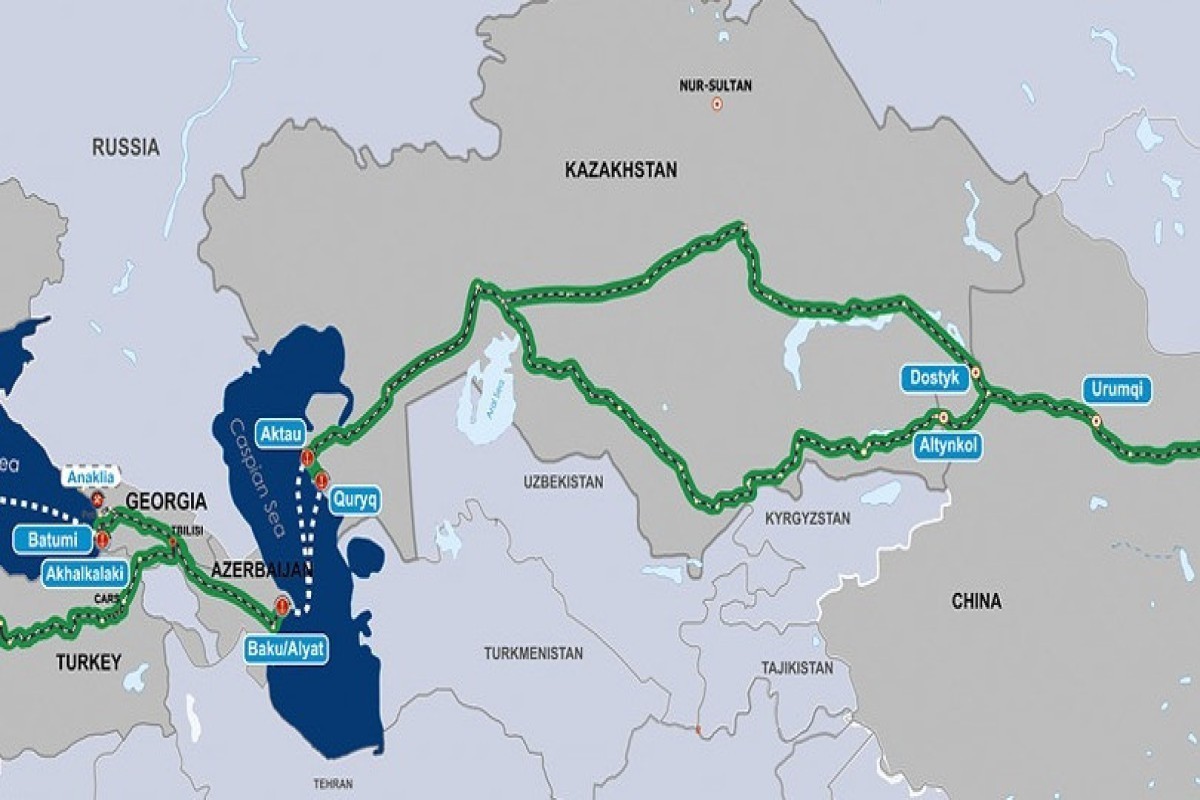
The article places particular emphasis on Azerbaijan's importance in this context, describing it as a key geopolitical hub of the Middle Corridor. This thesis is supported by facts. It notes that Azerbaijan's role is significant due to its position as one of the Caspian littoral states, with goods arriving from China to Kazakhstan and then being transported across the Caspian Sea through Azerbaijan to other regions. According to the author, the Middle Corridor cannot function without the Caspian Sea crossing.
"When Iran restricted commerce through the Strait of Hormuz, demand for container transportation on the Middle Corridor surged by 450 to 500 percent within a single week compared with the same period the previous year. Cargo volumes at the ports of Aktau and Baku surged," the article emphasizes.
Another important factor highlighted in the article is the Baku-Tbilisi-Kars railway. It emphasizes that through this railway, Azerbaijan connects the Caucasus, Türkiye, and Europe.
"The BTK railway’s annual capacity has been upgraded from roughly 1 million to 4.5 million tonnes, with long-term targets of up to 17 million by the mid-2030s. But the investment required to reach those targets has not been committed," the article states.
It also notes that expanding the capacity of the Port of Aktau is essential, which will require the port to be enlarged.
"The Alat terminal in Baku plans to expand capacity to 260,000 containers from the current 150,000," the text says.
In addition, the article notes that 80% of Kazakhstan's oil exports are transported through Russia's Port of Novorossiysk, but that recent Ukrainian drone attacks have made this route unreliable. As a result, the Trans-Caspian route has emerged as an important alternative for Kazakhstan.
According to the author of the article, the Middle Corridor has its own "chokepoints," similar to the Strait of Hormuz, and Azerbaijan is one of them as it provides the Caspian crossing and serves as a key component of the Baku-Tbilisi-Kars railway.
The other key transit points are Georgia, due to its access to the Black Sea, and Türkiye, because of the Bosporus Strait and its access to European markets.
The publication suggests that coordination between Baku and Ankara is crucial for the Middle Corridor. This is because Türkiye serves as a bridge between Western institutions and the Turkic world, while Azerbaijan is the corridor's main logistics hub.
In addition, the article discusses the ongoing trade and energy competition among the United States, Russia, and China, emphasizing that the United States should support the Middle Corridor not only through statements but also with concrete actions and investments. Otherwise, it could lose the competition with Russia and China.
The author pays particular attention to the need for substantial investments by the United States and Europe in the development of the Middle Corridor's key ports, including those in Azerbaijan, and states that the corridor's future development will depend on the development of regional infrastructure and the volume of international investment directed toward this route.


 Follow us on Telegram
 t.me/apanewsaz
 Follow us on Instagram
 Follow us on TikTok
 Follow us on Facebook
 Follow us on X