






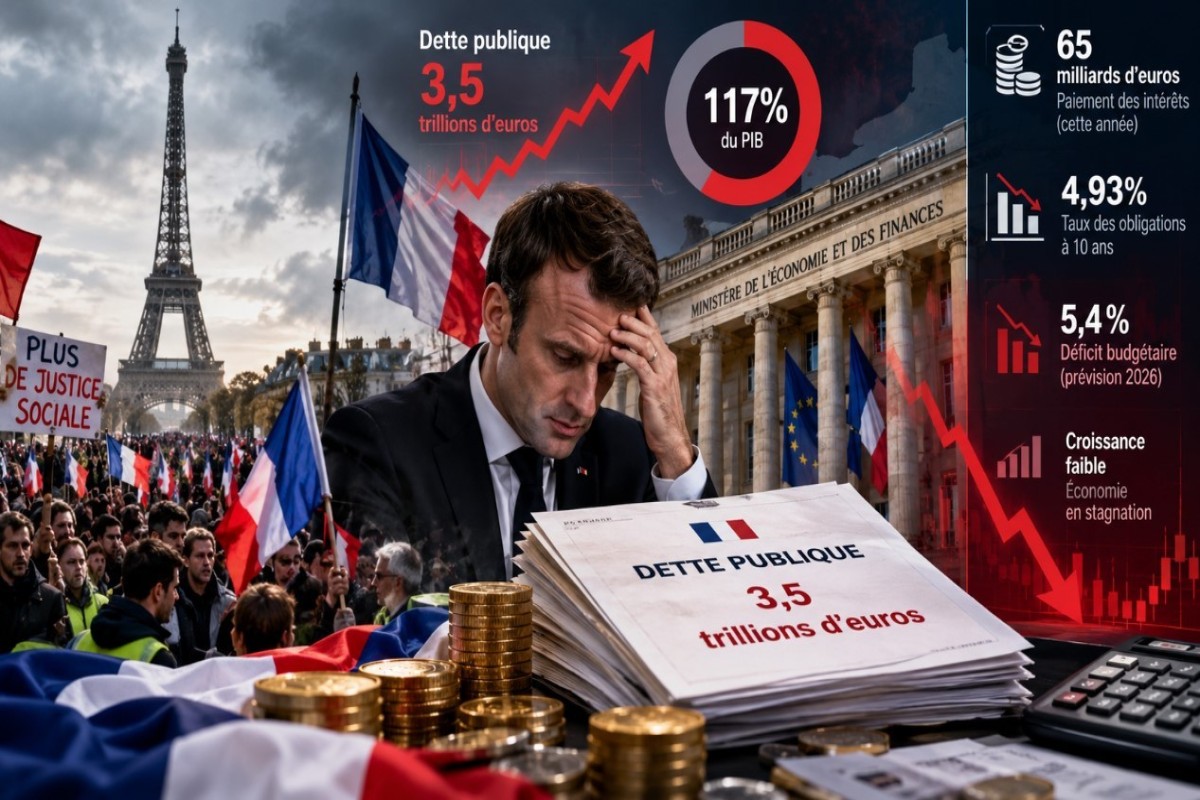


France, one of Europe's leading economic powers, is facing mounting financial pressure driven by rising public debt, persistent budget deficits, political instability, and widespread social protests. Problems surrounding the sustainability of public finances have become increasingly pronounced during President Emmanuel Macron's tenure. Paris's struggle to address long-standing structural economic weaknesses is no longer merely a domestic concern but is emerging as a potential risk to financial stability across the eurozone.
According to figures released by France's National Institute of Statistics and Economic Studies (INSEE) on September 29, the country's public debt reached €3.5955 trillion by the end of the second quarter of 2026, equivalent to 119% of gross domestic product (GDP). An increase of €59.6 billion in just three months highlights the persistence of structural weaknesses in French public finances.
More concerning than the continued accumulation of debt is the growing cost of financing it. The French government must repeatedly borrow to refinance existing obligations and cover budget shortfalls. Consequently, public finances are becoming increasingly vulnerable to fluctuations in interest rates on international capital markets.

Source: DNA.fr / The French Ministry of Economy and Finance building in Paris
Investor confidence weakens as borrowing costs rise
One of the clearest indications that France's financial difficulties are entering a more challenging phase is the sharp increase in yields on government bonds. On October 19, yields on French 10-year government bonds approached 4.9%, reaching one of their highest levels in more than two decades.
The widening yield spread between French and German government bonds also demonstrates that investors are demanding a higher risk premium for holding French sovereign debt. In practical terms, Paris is being forced to pay more to finance its borrowing requirements.
Nevertheless, it would be inaccurate to suggest that international investors have completely abandoned the French market. The country retains access to capital markets and continues to issue government securities. The central concern is therefore not the immediate availability of financing but its increasing cost.
Persistently elevated interest rates make refinancing older, lower-cost debt more expensive. Over time, this could restrict the government's capacity to allocate funding to education, healthcare, infrastructure, and social protection.
The growing consequences of fiscal indiscipline
Another major factor complicating France's financial position is its chronic budget deficit. Under the European Union's fiscal framework, government deficits are generally expected to remain below 3% of GDP. France's budget deficit, however, is estimated at approximately 5.4% for 2026.
The government aims to reduce the deficit to 5% in 2027 through spending restraint and fiscal adjustments amounting to tens of billions of euros. Yet proposed expenditure reductions and changes to taxation continue to encounter substantial political resistance.
The long-standing nature of the problem is evident from earlier government decisions. In April 2025, France's finance minister warned that achieving the country's fiscal objectives would require approximately €40 billion in additional savings.
The subsequent deterioration in fiscal indicators demonstrates that the problem cannot be resolved through isolated rounds of spending cuts. Unless structural changes to public expenditure are accompanied by stronger economic growth and a sustainable revenue base, France is likely to face continued pressure from rising borrowing requirements.
Social unrest compounds the financial crisis
France's economic difficulties are increasingly accompanied by dissatisfaction among broad sections of society. Rising living costs, concerns about the financing of public services, and government austerity policies have become major sources of public anger.
Serious clashes between demonstrators and police erupted across several French cities on October 17. Police deployed tear gas against protesters in Paris, while vandalism and violent incidents were reported in Lyon and Marseille.

Clashes between protesters and police amid growing social unrest in France.
The situation escalated further on October 18. More than 2,000 people were detained during the mass demonstrations, says French Interior Ministry figures. The unrest has affected not only public security but also commercial activity and the broader investment environment.
These developments expose a fundamental contradiction in France's current economic predicament. While the government seeks to reduce its budget deficit by limiting public expenditure, citizens are protesting against what they perceive as the erosion of social protections and declining public services.
The expansion of street demonstrations makes it increasingly difficult to secure political support for fiscal reforms. At the same time, delays in implementing those reforms risk further weakening investor confidence.
The government is therefore confronted with a cycle in which financial constraints intensify public dissatisfaction, while social unrest complicates efforts to restore fiscal stability.
Macron faces increasingly difficult economic choices
With the 2027 presidential election approaching, political disagreements over France's economic direction are becoming more pronounced. Debates surrounding pension reform, public-sector expenditure, and taxation are complicating the adoption of budgetary decisions.
The central difficulty is that the government's available policy options carry competing economic and political consequences.
Aggressive austerity measures could deepen social dissatisfaction and weaken domestic demand. Conversely, postponing fiscal consolidation may lead to further debt accumulation, increased borrowing costs, and additional pressure on public finances.
The International Monetary Fund has also emphasized the importance of credible medium-term fiscal consolidation in France. Although the country's borrowing costs remain manageable, maintaining financial stability requires a consistent strategy to contain deficits and stabilize public debt.
At the same time, comparisons between France's current difficulties and Greece's previous sovereign debt crisis must be approached cautiously.

French President Emmanuel Macron at a government cabinet meeting in Paris. Photo: AFP
France possesses a substantially larger and more diversified economy, sophisticated capital markets, and the advantages associated with membership in the eurozone. Its financial system also operates within the monetary policy framework of the European Central Bank.
Nevertheless, these advantages do not eliminate the consequences of persistent fiscal imbalances. Even economies with substantial institutional and financial resources can encounter growing vulnerabilities when public debt rises faster than their capacity to service it sustainably.
France's predicament illustrates that the fundamental problem extends beyond the absolute size of government debt. At its core lies the difficulty of maintaining a sustainable balance between long-term public expenditure commitments and the revenues available to finance them.
Rising debt-servicing costs, sluggish economic growth, social unrest, and political uncertainty are increasingly interconnected, with each reinforcing the effects of the others.
The resulting pressure threatens to reduce the government's fiscal flexibility at precisely the moment when additional investment may be required to stimulate productivity, modernize infrastructure, and strengthen economic competitiveness.
Ultimately, France has not lost its ability to meet its sovereign debt obligations, but its room for financial maneuver is narrowing.
The challenge facing Paris extends beyond managing its outstanding debt. The government must simultaneously preserve the confidence of international investors and maintain public trust in the country's social welfare system.
Failure to establish a credible and sustainable balance between these objectives could transform the current fiscal difficulties into a prolonged period of economic stagnation, with consequences extending beyond France to the wider European economy.



 Follow us on Telegram
 t.me/apanewsaz
 Follow us on Instagram
 Follow us on TikTok
 Follow us on Facebook
 Follow us on X