













Baku - APA-Economics. A promising push toward a novel, biologically-inspired "chemical computer" has begun as part of an international collaboration, according to BBC.
The "wet computer" incorporates several recently discovered properties of chemical systems that can be hijacked to engineer computing power.
The team’s approach mimics some of the actions of neurons in the brain.
The 1.8m-euro (£1.6m) project will run for three years, funded by an EU emerging technologies programme.
The programme has identified biologically-inspired computing as particularly important, having recently funded several such projects.
What distinguishes the current project is that it will make use of stable "cells" featuring a coating that forms spontaneously, similar to the walls of our own cells, and uses chemistry to accomplish the signal processing similar to that of our own neurons.
The goal is not to make a better computer than conventional ones, said project collaborator Klaus-Peter Zauner of the University of Southampton, but rather to be able to compute in new environments.
"The type of wet information technology we are working towards will not find its near-term application in running business software," Dr Zauner told BBC News.
"But it will open up application domains where current IT does not offer any solutions - controlling molecular robots, fine-grained control of chemical assembly, and intelligent drugs that process the chemical signals of the human body and act according to the local biochemical state of the cell."
Lipids and liquids
The group’s approach hinges on two critical ideas.
First, individual "cells" are surrounded by a wall made up of so-called lipids that spontaneously encapsulate the liquid innards of the cell.
Recent work has shown that when two such lipid layers encounter each other as the cells come into contact, a protein can form a passage between them, allowing chemical signalling molecules to pass.
Second, the cells’ interiors will play host to what is known as a Belousov-Zhabotinsky or B-Z chemical reaction. Simply put, reactions of this type can be initiated by changing the concentration of the element bromine by a certain threshold amount.
The reactions are unusual for a number of reasons.
But for the computing application, what is important is that after the arrival of a chemical signal to start it, the cell enters a "refractory period" during which further chemical signals do not influence the reaction.
That keeps a signal from propagating unchecked through any connected cells.
Such self-contained systems that react under their own chemical power to a stimulus above a threshold have an analogue in nature: neurons.
"Every neuron is like a molecular computer; ours is a very crude abstraction of what neurons do," said Dr Zauner.
"But the essence of neurons is the capability to get ’excited’; it can re-form an input signal and has its own energy supply so it can fire out a new signal."
This propagation of a chemical signal - along with the "refractory period" that keeps it contained within a given cell - means the cells can form networks that function like the brain.
’Real chance’
Frantisek Stepanek, a chemical computing researcher at the Institute of Chemical Technology Prague in the Czech Republic, said the pairing of the two ideas was promising.
"If one day we want to construct computers of similar power and complexity to the human brain, my bet would be on some form of chemical or molecular computing," he told BBC News.
"I think this project stands a real chance of bringing chemical computing from the concept stage to a practical demonstration of a functional prototype."
For its part, the team is already hard at work proving the idea will work.
"Officially the project doesn’t start until the first of February," said Dr Zauner, "but we were so curious about it we already sent some lipids to our collaborators in Poland - they’ve already shown the lipid layers are stable."


 Follow us on Telegram
 t.me/apanewsaz
 Follow us on Instagram
 Follow us on TikTok
 Follow us on Facebook
 Follow us on X
Infrastructure

Heydar Aliyev International Airport to switch to autumn-winter flight schedule
 14:39
14:39
 16 October 2026
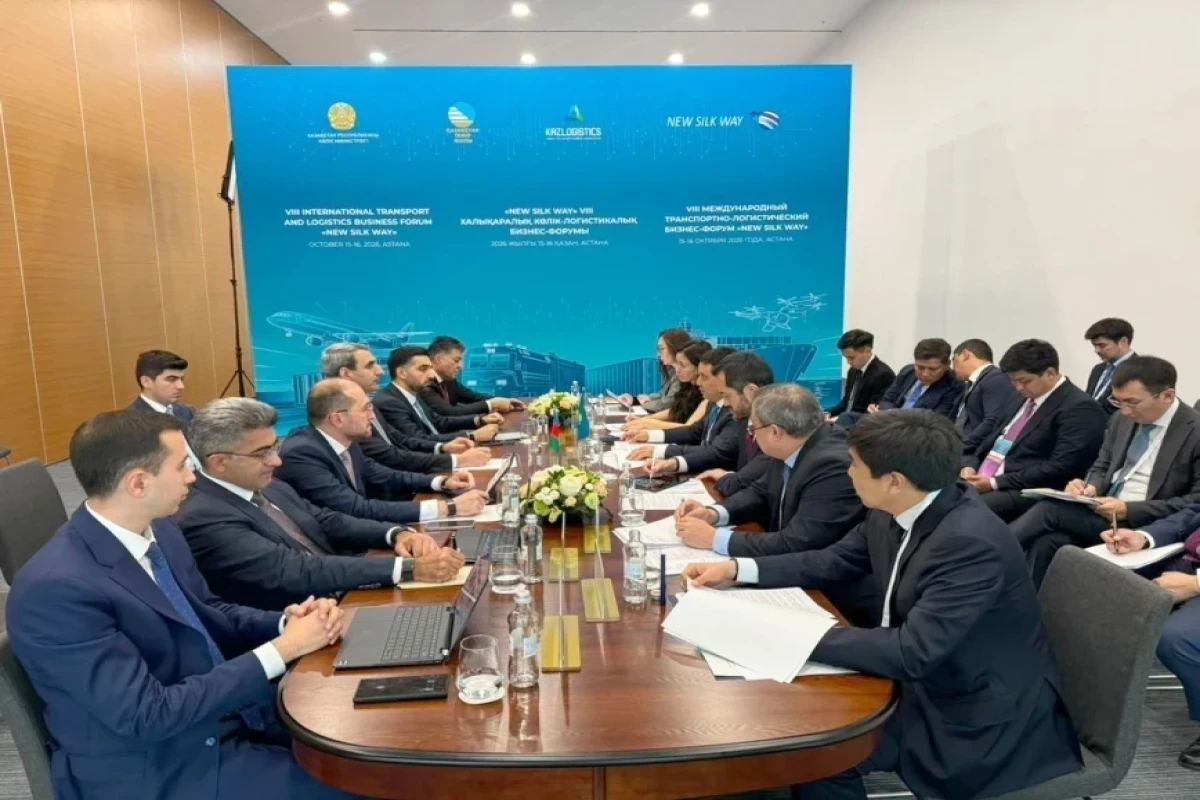
ADY chairman attends New Silk Way Business Forum in Kazakhstan
12:57
16 October 2026

Azerbaijani delegation familiarizes itself with operations of Kazakhstan’s leading ports and terminals
18:22
14 October 2026
Work on developing urban transport in Lachin nearing completion - Special Representative
12:51
14 October 2026

NEWS FEED
Chief of General Staff of Azerbaijan Army meets with NATO delegation
15:40
16 October 2026
Prospects for further development of Azerbaijan-Sri Lanka relations discussed
15:38
16 October 2026
Novak announced the actual solution to the issues of diesel supplies to the United States
15:36
16 October 2026
Armenia PM, Iran president meet in Yerevan, discuss bilateral agenda
15:12
16 October 2026
Criminal case opened over calls to seize power in Azerbaijan, Turkish citizen declared wanted
15:05
16 October 2026
Heydar Aliyev International Airport to switch to autumn-winter flight schedule
14:39
16 October 2026
Foreign Minister Jeyhun Bayramov meets with CICA Secretary General Kairat Sarybay
14:11
16 October 2026
Azerbaijan prevents smuggling of 35 kg of drugs from Iran
14:10
16 October 2026
FM Mirzoyan: Armenia-Türkiye border could open at any moment
14:05
16 October 2026
Media representatives familiarize themselves with demining operation carried out by MES in Aghdam - PHOTO
14:01
16 October 2026
Peskov accuses Zelenskyy of refusing to assume responsibility
14:00
16 October 2026
Lukashenko orders expansion of volunteer defense units in Belarus
13:50
16 October 2026
Death toll from Istanbul floods reaches 4, three people missing
13:39
16 October 2026
Araghchi: Iran concerned about US presence in region, but trusts Armenia
13:37
16 October 2026
Prospects for LNG supplies to Vietnam discussed in Baku
13:16
16 October 2026
9th Congress of Azerbaijani journalists held - PHOTO - UPDATED - 1
13:02
16 October 2026
SOCAR announces intention to purchase gas from Gazprom
12:59
16 October 2026
ADY chairman attends New Silk Way Business Forum in Kazakhstan
12:57
16 October 2026
President Ilham Aliyev awards group of individuals for contributions to development of Paralympic movement
12:55
16 October 2026
President Ilham Aliyev received newly appointed Georgian ambassador to Azerbaijan
12:54
16 October 2026
President Ilham Aliyev received newly appointed Indian ambassador to Azerbaijan
12:50
16 October 2026
Press Council will continue its activities to develop journalism - Chairman
12:37
16 October 2026
Azerbaijan detains six foreigners over attempted illegal border crossings
12:33
16 October 2026
Chemical production indicators in Azerbaijan announced - TABLE
12:30
16 October 2026
High demand could help Azerbaijan increase export potential of halal products - Deputy Chairman
12:25
16 October 2026
New board of Directors of Azerbaijan’s Press Council formed
12:15
16 October 2026
Fuel oil production sharply increases in Azerbaijan - TABLE
12:09
16 October 2026
Azerbaijan Press Council elects new Chairman
12:03
16 October 2026
Parliament committee chairman: Artificial intelligence cannot replace civil servants
12:02
16 October 2026
28 state standards reviewed in Azerbaijan
11:57
16 October 2026
Nearly 30 bcm of gas transported through Azerbaijan’s main pipelines this year
11:57
16 October 2026
State standards to become more accessible to businesses - Deputy Chairman
11:53
16 October 2026
AZSTAND: Nearly 4,000 new regulatory documents to be developed in Azerbaijan
11:50
16 October 2026
Russia’s Ryazan Oil Refinery hit by drone attack again
11:48
16 October 2026
Key indicators of Azerbaijan's oil and gas sector - TABLE
11:48
16 October 2026
Number of state standards adopted in Azerbaijan nearly triples
11:44
16 October 2026
Volume of oil transported via BTC this year announced
11:44
16 October 2026
Speaker: Ilham Aliyev’s election as President in 2003 holds special place in country’s history
11:42
16 October 2026
Azerbaijan drafts new Civil Service Code, plans to repeal 6 laws
11:41
16 October 2026
Nasar Hayat: FAO remains committed to continuing cooperation with Azerbaijani government
11:39
16 October 2026
Natiq Mammadli: Media and Broadcasting Council works intensively to counter disinformation against Azerbaijan
11:38
16 October 2026
Israeli President traveled to Baku on commercial flight – uproar in Türkiye has no basis
11:35
16 October 2026
Azerbaijan to set retirement age based on maximum service age for each rank
11:30
16 October 2026
Azerbaijan changes calculation of insurance part of labor pensions, social insurance reserve to increase
11:30
16 October 2026
Azerbaijan to increase salaries of military personnel
11:26
16 October 2026
Person accused of fraud extradited from Russia to Azerbaijan
11:26
16 October 2026
Azerbaijan to adopt new standards in artificial intelligence and digitalization
11:24
16 October 2026
Azerbaijan to bar clergy and persons with foreign citizenship from civil service positions
11:23
16 October 2026
Azerbaijan's population reaches 10.28 million
11:18
16 October 2026
FAO: Innovation can help address challenges faced by farmers in Azerbaijan
11:16
16 October 2026


