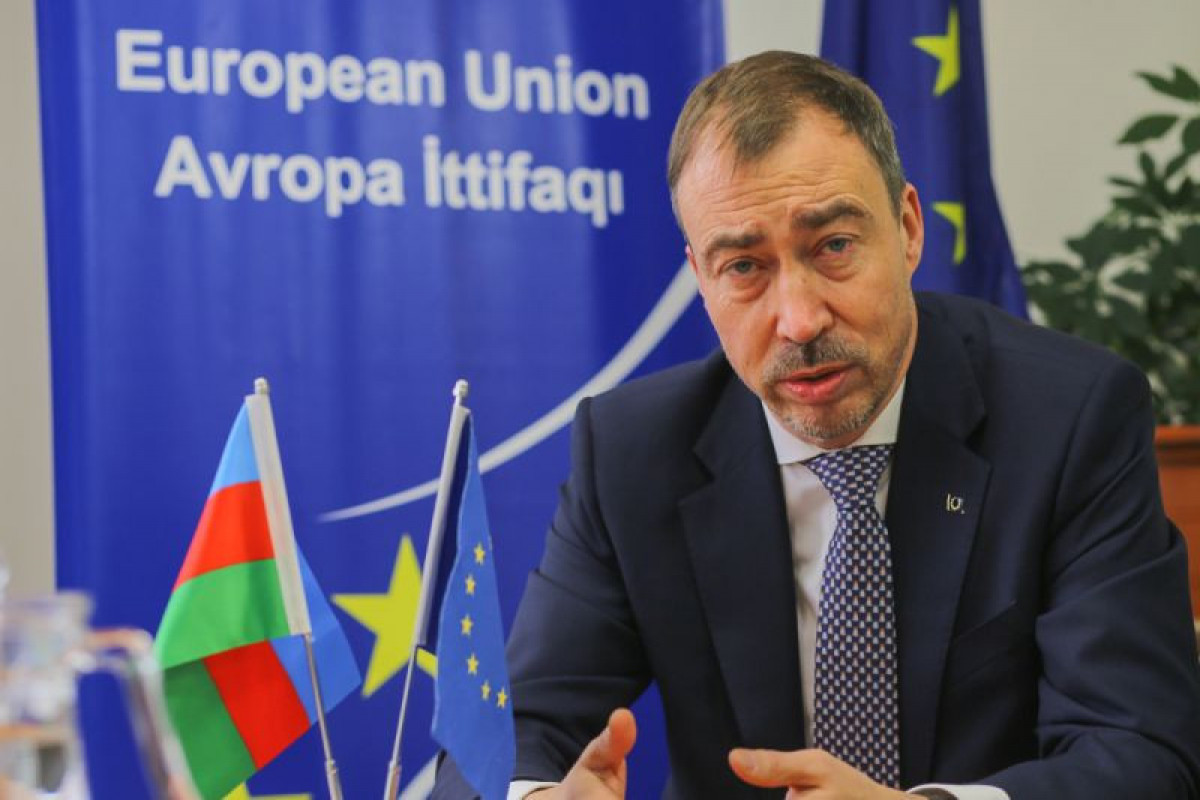

Interview of European Union Special Representatives (EUSR) for the South Caucasus and the crisis in Georgia Toivo Klaar with Azerbaijani news agency APA
– The European Union has already expressed its willingness to provide technical support to the process of delimitation and demarcation of borders between Armenia and Azerbaijan. Mr. Klaar, could you elaborate on that, which concrete support the European Union suggests?
–Yes, you’re right. This particular issue has been on the agenda of EU mediation efforts over the past year, in particular also through the personal involvement of the President of the European Council Charles Michel with the Armenian and Azerbaijani leaders.
In this context, I’m glad to indicate that I yesterday facilitated a meeting in Brussels between Secretary of Armenia's Security Council Armen Gregorian and Foreign Policy Advisor to the President of Azerbaijan Hikmet Hajiyev. This event was aimed at continuing and advancing joint efforts to find solutions to outstanding issues between both countries.
The participants reviewed the political and security situation in the region and the full spectrum of issues between Armenia and Azerbaijan as a follow-up to the understandings reached during the meeting of leaders of both countries and the EU that was held in Brussels in December 2021. I am pleased that the participants agreed to meet again over the coming weeks. Yesterday’s discussions also focused on preparations for the next meeting between President of the European Council Charles Michel, President of the Republic of Azerbaijan Ilham Aliyev, and Prime Minister of the Republic of Armenia Nikol Pashinyan, which will be held in Brussels on 6 April 2022.
– As a Special Representative, you often visit the region, hold high-level meetings in Baku and Yerevan. What are your personal impressions from these meetings?
–Indeed, I very often visit Baku and Yerevan for high-level consultations with the leadership of both countries. These privileged conversations and exchanges allow us to better understand the situation and also to have a better sense of where the EU can provide assistance and, in turn, take action in line with the leaderships’ willingness to engage in closer cooperation with the EU. My impressions from these meetings are largely positive. I have the honor to be always welcomed at the highest level, which is very much appreciated in Brussels as a sign of serious engagement from the sides. I hope that our engagement will contribute to more steps to find compromise solutions to all outstanding issues between both countries, and the EU will certainly continue efforts in this direction.
– The Ministry of Foreign Affairs of Azerbaijan has recently announced that Baku submitted a five-point proposal to Yerevan to normalize relations. Are you familiar with this proposal, if you are, what is your opinion?
–Yes, this proposal was made publicly available on 14 March. As I said already in previous comments with other media outlets in the region, the European Union, like many in the international community, has been emphasizing the need for a comprehensive settlement to conflict-related issues. In this regard, any moves in that direction are welcome.
Certainly, the Azerbaijani proposal is important, likewise, the Armenian response to the Azerbaijani proposal was made on the very same day. Again, what the European Union believes is important, is that these moves contribute to an environment conducive to discussions for a comprehensive settlement.
– Armenian armed groups are located in the Karabakh region of Azerbaijan, which contradicts paragraph 4 of the trilateral statement signed by the leaders of Armenia, Azerbaijan, and Russia. How will peace be possible if the militarization of Karabakh continues?
–Let me reiterate our great concern about the recent incidents near the Line of Contact. The ceasefire must be respected. The EU remains engaged at the highest level to facilitate direct discussions and a lowering of tensions with a view to ensuring a stable and peaceful environment.
However, while we call on all sides to respect their commitments under the trilateral statement of November 2020, I also wish to stress that the EU is not a signatory to that statement and is not in a position to review its implementation.
– How does the war in Ukraine affect the discussions between the EU and Russia on Karabakh? Do you think that the European Union should intensify its efforts to achieve peace in the South Caucasus?
–As EUSR for the South Caucasus and the crisis in Georgia, I have in the past had regular consultations with Moscow, in particular with Deputy Foreign Minister Andrey Rudenko and the Russian Co-Chair of the OSCE Minsk Group. These contacts are heavily impacted by the current war.
As I said already, the EU has been engaged at the highest level with Armenia and Azerbaijan over the past year, in particular through the personal involvement of the President of the European Council Charles Michel, but also through high-level meetings by European Commissioners, my visits and the daily work done by our Delegations in both countries.
The sides perceive the EU as an honest broker with a positive agenda for the region, which is something we value. I can assure you that our efforts to achieve sustainable peace in the South Caucasus will remain at a very high level


 Follow us on Telegram
 t.me/apanewsaz
 Follow us on Instagram
 Follow us on TikTok
 Follow us on Facebook
 Follow us on X