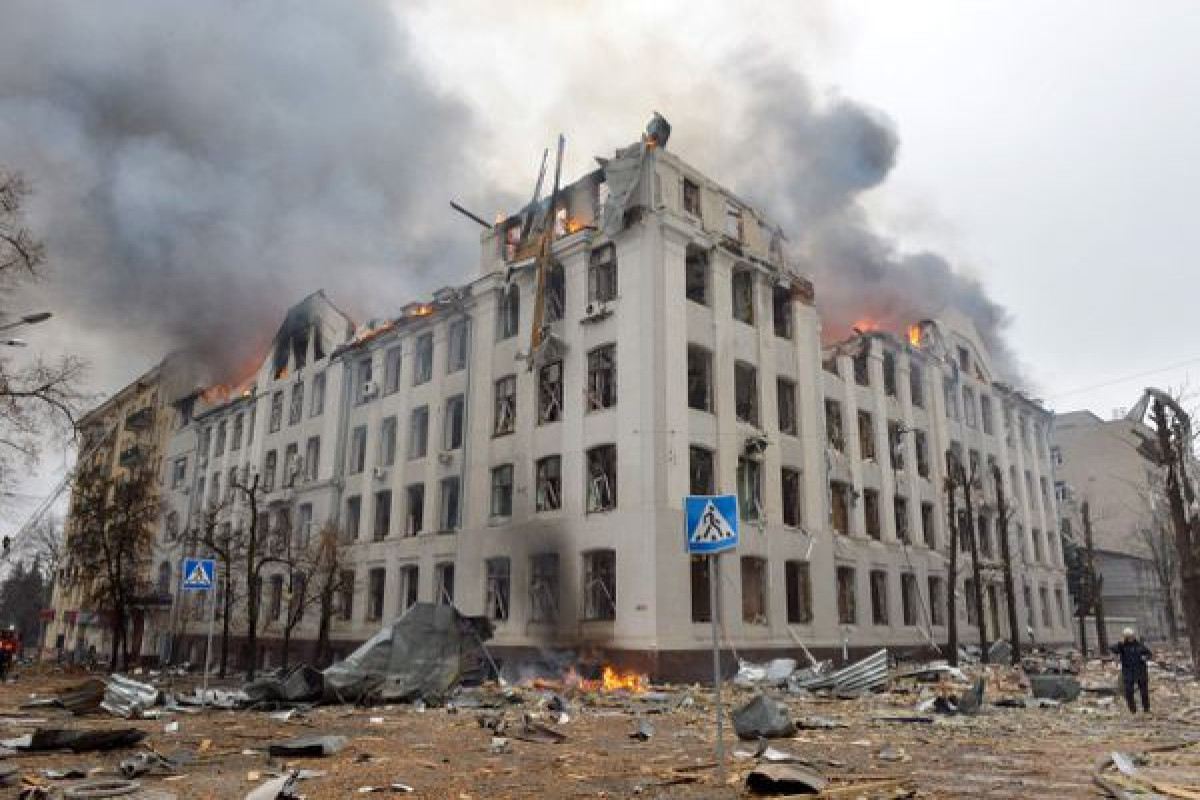

The world was shaken on the morning of February 24, 2022, when Russia launched military operations in Ukraine. Although Russia called the attack that launched from several directions a special operation, it was nothing but war in terms of international law and scale. Thus, Moscow and Kyiv, which have demonstrated harsh rhetoric against each other in recent years, have entered the most difficult period in their 30-year history of independence.
How did the two peoples, - the Russians and the Ukrainians- the Eastern Slavs, who have close genetic, historical, cultural, and economic ties to each other – turn on against each other and come to the point of war?
On December 8, 1991, the leaders of Russia, Ukraine, and Belarus signed the Belovezhskaya Pact, ending the agony of the perishing Soviet Union, sending the Red Empire into the archives of history. Fifteen allied republics, including Russia and Ukraine, gained independence. The tensions in Russian-Ukrainian relations have been observed from the very beginning, which was related to the fate of the Black Sea Fleet. The Black Sea Fleet, with 100,000 ships, including 6 cruisers, about 800 ships, 14 K-25 helicopters, and 28 submarines, was a very serious force. The division of the fleet, and the issue of whether the navy succeeded by Russia would change its permanent dislocation in the Ukrainian port of Crimea, the port of Sevastopol, has become a matter for discussion. Finally, in 1997, Presidents Leonid Kuchma and Boris Yeltsin agreed to split the fleet between the two sides and to keep Russia's Black Sea Fleet in Crimea until 2017. Russia recognizes the territorial integrity of Ukraine, including Crimea in the so-called "Great Treaty.”
Earlier, on December 5, 1994, Ukraine, which at that time possessed the largest number of nuclear warheads in the world after the United States and Russia, surrendered its nuclear warheads to Russia in exchange for security guarantees and voluntarily gave up these weapons. The document, called the Budapest Memorandum, the United States, Russia, and the United Kingdom assumed commitments to the threat of force against Ukraine's territorial integrity and political independence and its application.
After that, Russian-Ukrainian relations continued as normal until 2003.
In September 2003, there was another slight tension. Russia started to build a dam from the Taman Peninsula of the Krasnodar region towards the Ukrainian island of Tuzla, which was met with strong opposition from Ukraine. Even President Leonid Kuchma arrived in Tuzla to follow Russia's position. Intensive talks in October resulted in Russia halting dam construction.
The 2004 presidential election was one of the turning points in Ukrainian-Russian relations. While the Kremlin-backed Viktor Yanukovych was declared the new president of Ukraine in the second round with 49.46% of the vote, the results were annulled amid popular protests called the "Orange Revolution" and pro-Western candidate Viktor Yushchenko won the election held on December 26.
Russia openly states that these events were organized by the West and that the scenario of the "Orange Revolution" was prepared by Western countries, especially the United States. Thus, tensions in Russian-Ukrainian relations are growing.
The new government, which pursues a distance policy from the Russian vector, had serious problems with gas imports from Russia in 2006 and 2009, which also had a negative impact on Europe's gas supply. Under the new agreement, official Kyiv will have to buy Russian gas at twice the previous price. Amid the strained Ukrainian-Russian relations, the West was building close political, military, and economic cooperation with Ukraine. As a result, the two countries experienced a more serious breakdown between the sides in 2008. Although at the NATO Bucharest Summit, President George W. Bush proposed Georgia and Ukraine approve a plan to prepare for membership in the military alliance, Germany and France objected to the proposal, citing that Kyiv and Tbilisi were not ready for membership. The Kremlin, which believed its historical sphere of influence was intervened, also strongly opposed membership plans, which resulted in war between Russia and Georgia on August 8, 2008. Ukraine was the only CIS country that openly supported Georgia, which led to a deeper crisis in Russian-Ukrainian relations. Against this background, the election of pro-Russian Viktor Yanukovych as President of Ukraine in 2010 gave the impression that a new era would begin in Moscow-Kyiv relations.
Indeed, at first, Russian-Ukrainian relations were developing in a positive direction. Thus, in April 2010, Russian President Dmitry Medvedev reached an agreement with Ukrainian President Yanukovych which would allow Russian warships to remain in Crimea until 2042.
Instead, Kyiv started to buy Russian gas at a much lower price. However, soon the events turned out to be undesirable for Moscow.
Thus, like his predecessor Yushchenko, Yanukovych, who considered integration with the West a top priority for his country, started an active dialogue with the European Union.
As a result of this dialogue, the EU and Ukraine announced that they would sign an associative membership on November 28, 2013, within the framework of the Eastern Partnership summit.
However, on November 21, Yanukovych said he would not sign the agreement. The Ukrainian leader openly admitted that he was taking such a step under political and economic pressure from Moscow.
Then on November 21, protests started in Kyiv's Independence Square (Nezalejnost), where demonstrators demanded g the signing of an association agreement with the European Union, despite pressure from the Russian side.
Members of the so-called "Euromaidan" movement had already set up tents and held regular rallies in Independence Square.
The incident that seemed insignificant at first glance then turned the protest into a revolutionary course.
On the night of November 30, 2013, Berkut police attacked a protest camp and brutally dispersed the protest.
The video footage of the incident, spread on the Internet and television, provoked public outrage and serious dissatisfaction with the actions of law enforcement agencies and the political leadership.
As a result, more than 1 million protesters marched on Independence Square on December 1.
Starting that moment, the “Euromaidan” movement intensified its calls against the government and demand its immediate resignation.
The revolution culminated on February 21, 2014, with street fighting in central Kyiv and the flight of President Viktor Yanukovych.
Although mass protests have resulted in the overthrow of the current government, they had not brought the expected stability and happiness to Ukraine.
Because the overthrow of Yanukovych brought a final breaking point in Russian-Ukrainian relations.
One day before Yanukovych's overthrow, Russia began a covert military intervention in the Crimean peninsula, which was ceded to Ukraine in 1953 by the decision of the Soviet leader Nikita Khrushchev.
Russian troops, which took control of key political facilities, including the Crimean parliament, disarmed Ukrainian troops on the peninsula.
Moscow, which held a referendum in the region on March 16, 2014, announced that the people of Crimea want to unite with Russia. Thus, Crimea is annexed unilaterally by Russia.
However, it was not the last chord of the escalation of Russian-Ukrainian relations, and the two sides. Along with Crimea, protests started in eastern Ukraine, in the Donbas region (Donetsk and Luhansk oblasts), where traditional Russophile tendencies prevail.
The cities of Donetsk, Luhansk, Kharkiv, Dnipro, Melitopol, Mariupol, Odesa, Mykolaiv, and Kherson are experiencing a series of political events called the "Russian Spring". Not only local activists, but also volunteers from Russia, imperialists, nationalists, special services, and others also attended the protests.
During April, “People's Republics” were consecutively declared in Lugansk, Donetsk, and Kharkiv by supporters of secession from Ukraine and deep integration with Russia.
Although the seizure of administrative and military facilities in Luhansk and Donetsk was successful, attempts to seize the regional administration building in Kharkiv failed.
On April 13, 2014, Acting President of Ukraine Alexei Turchinov announced the launch of an anti-terrorist operation in the Donbas with the involvement of the Ukrainian Army.
A day earlier, an armed group led by former Russian Federal Security Service Colonel Igor Girkin (Strelkov) entered the Ukrainian city of Sloviansk and took control of the city. Most cities in Donetsk and Luhansk Oblast are under separatist control.
With the victory of Petro Poroshenko in the May presidential election in Ukraine, official Kyiv is launching active combat operations against separatists in the east.
On June 13, the city of Mariupol was liberated from separatists. During July, Sloviansk, Kramatorsk, Lysychansk, Severodonetsk, Rubizhne, and other large settlements were also cleared of separatists.
On August 12, 2014, the Ukrainian Army, which was already approaching the border with Russia, was besieged near the town of Ilovaysk. Ukraine blamed Russia for the failure of the operation, in which hundreds of servicemen were killed and wounded.
Kyiv said Moscow, which provided military and financial support to the separatists, was secretly using its troops in the direction of Ilovaisk, thus saving the separatists from complete defeat.
A ceasefire agreement (First Minsk Agreement) was signed between the sides in Minsk on September 5. The agreement had to move the settlement of the Donbas conflict from the military to the political level.
But the ceasefire agreement was soon violated In December 2014, military operations resumed, and this time battles waged for Donetsk Airport and the city of Debaltseve.
The military operation, which ended with the local success of pro-Russian separatists, ends on February 12, 2015, with the signing of the second ceasefire agreement (Minsk-2) in Minsk with the participation of the leaders of the "Quartet of Normandy" (Russia, Ukraine, France, Germany) and Belarusian leader Alexander Lukashenko.
The agreement provided for the pardon of members of illegal military units, the transfer of control of the border with Russia to Ukraine, the holding of elections in Luhansk and Donetsk under Ukrainian law, and the granting of special status to some parts of these two regions.
During seven years since the agreement was signed, the Minsk agreements have not been fully implemented. Over the years, the Donbas region turned into an unstable region, a "frozen conflict" with often violations of the ceasefire and periodic sabotage acts. In recent months, Ukraine's anti-Russian actions, messages of integration into the West, the European Union, and NATO have further irritated Moscow. The process was already moving in a direction that would be very difficult for Russian-Ukrainian relations to return back. The statements made by Russia, Ukraine, and Western countries and organizations were threatening and uncompromising. Although Russia has called on the United States and NATO not to expand eastward (Ukraine) and to provide security guarantees amid strained relations with Ukraine, proposals between the parties have failed in this regard. The reluctant offers of Ukrainian President Vladimir Zelensky to meet with Russian President Vladimir Putin several times also went unanswered.
The failure of the West and Russia to make concessions and persistently insist on their positions carried a can on Ukraine, and all the ways opened for the Russia-Ukraine warş
On February 21, 2022, Russian President Vladimir Putin signed decrees recognizing the “Donetsk People's Republic” and the” Luhansk People's Republic.” On February 24, Russia launched an open and direct military intervention in Ukraine to ensure the security of these "republics".
Thus, the growing tension between the two Slavic peoples and states, which gained independence in 1991, led to its peak in 2022 - the war.
Thousands of people have already fallen victim to this war, while millions of Ukrainian become refugees. Today, Ukrainian cities look like ruins. Russia-Ukraine which has been held several times failed to yield any results. It seems that the war will continue for some time. Without giving any political or other reasons, it can unequivocally be assumed that the relations between the two brotherly peoples have been severely damaged. It will take many years for Russian-Ukrainian relations, and relations between the two neighboring and fraternal peoples to return to the previous state. But even if relations are normalized between the two countries, the Ukrainian people, as well as the whole world, will never forget this war. February 24, 2022, will forever remain a black page in Russian-Ukrainian relations and history.


 Follow us on Telegram
 t.me/apanewsaz
 Follow us on Instagram
 Follow us on TikTok
 Follow us on Facebook
 Follow us on X