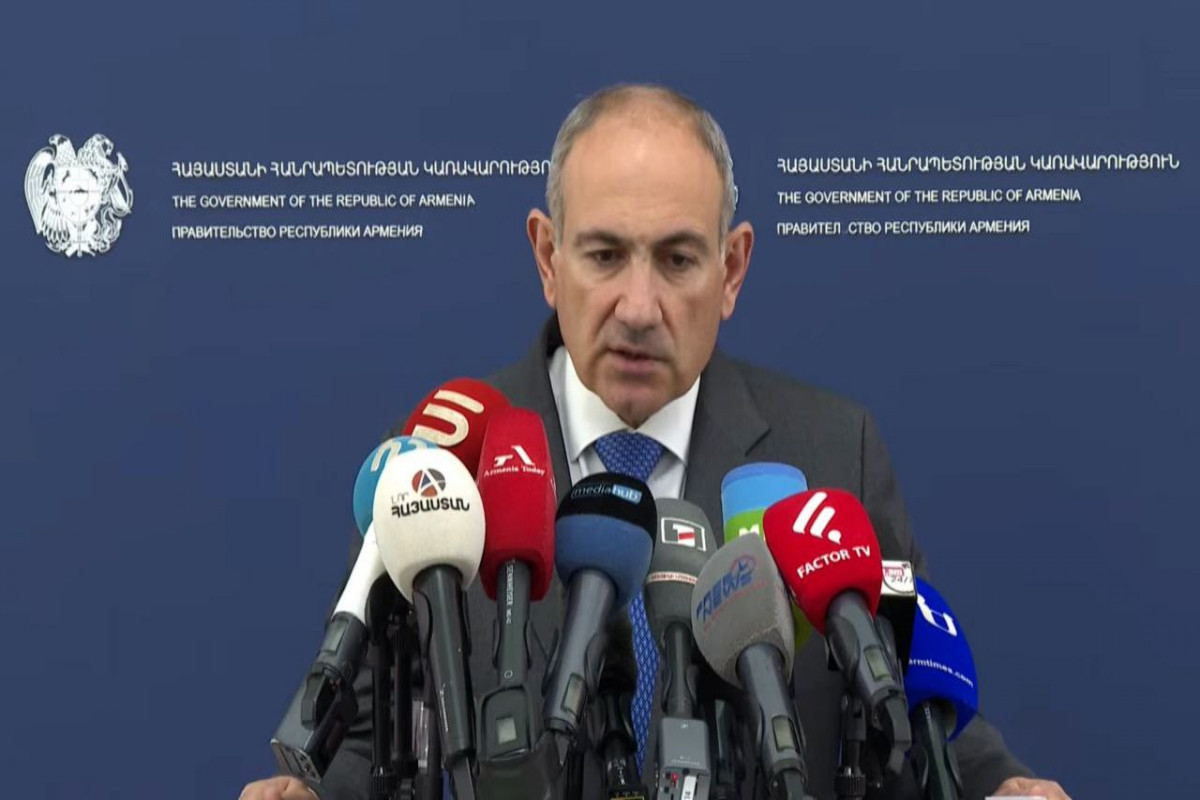

A train loaded with oil products produced in Azerbaijan has departed and is heading toward Armenia, Armenian Prime Minister Nikol Pashinyan told journalists, APA reports, citing Armenian media.
The Prime Minister noted that he welcomes this development.
“Trade is carried out between private companies, but it is precisely the peace established between the Republic of Armenia and the Republic of Azerbaijan that has created the political conditions for this,” he emphasized.
Note that for the first time, SOCAR has begun supplying domestically produced petroleum products to Armenia today. 1,220 tons of AI-95 gasoline loaded into 22 railcars have been dispatched from the Baku Freight Station toward the Boyuk Kesik station by an Azerbaijan Railways freight train. From there, the cargo will be delivered to Armenia via Georgia.
Recall that, according to information obtained by APA, based on an agreement reached during a meeting on November 28 in Gabala between Azerbaijan’s Deputy Prime Minister Shahin Mustafayev and Armenia’s Deputy Prime Minister Mher Grigoryan, 22 railcars of AI-95 gasoline produced by SOCAR are being sent. Azerbaijan’s export of petroleum products to Armenia is purely commercial in nature, and the gasoline will be sold at international market prices.
On December 8, Georgia’s Ministry of Economy and Sustainable Development announced that on December 5, it had received a request from partners to carry out a one-time fuel transit from Azerbaijan to Armenia through Georgian territory. “By decision of Georgian Prime Minister Irakli Kobakhidze, Georgian Railways was instructed to immediately ensure the transportation of the cargo by rail on a one-time basis, completely free of charge,” the statement said.
This development clearly demonstrates that the peace agenda is not merely declarative in nature but is also being implemented in practical terms.
The export of Azerbaijani petroleum products to Armenia reflects the concept of economic dividends of the peace process and represents an important step toward establishing economic and trade relations between the two countries. It is also expected to contribute to the development of economic and trade ties in the region and to the expansion of cooperation among regional countries in the future.


 Follow us on Telegram
 t.me/apanewsaz
 Follow us on Instagram
 Follow us on TikTok
 Follow us on Facebook
 Follow us on X