

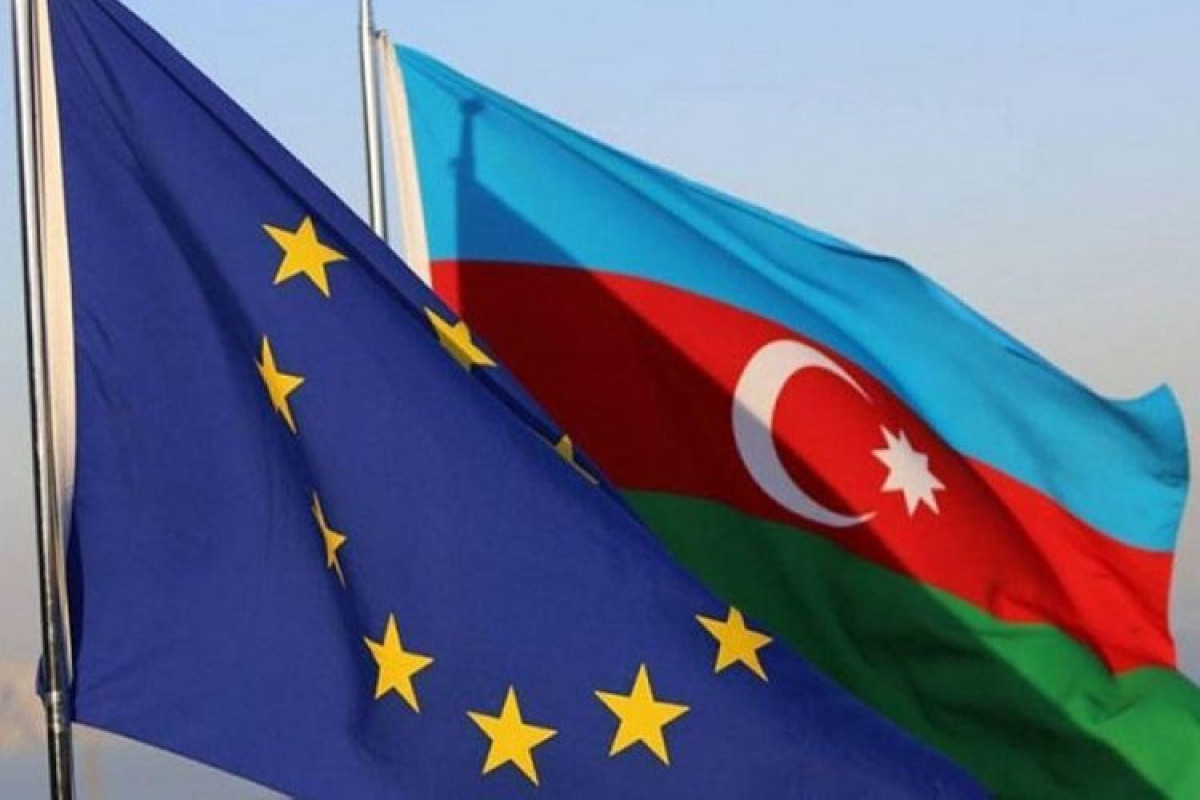

Those in the European Union must understand that the geopolitical reality created by Azerbaijan opens even greater prospects for them as well, said MP Sahib Aliyev, a member of the Azerbaijan–European Union Parliamentary Cooperation Committee, in his comment to APA.
The main reason for the defeat of revanchists in Armenia
Sahib Aliyev said that after the representatives of Azerbaijan and Armenia participating in the OSCE Parliamentary Assembly’s autumn session in Istanbul met there, the fact that civil society representatives of both countries met in Baku today — and that a similar meeting was held in Yerevan exactly one month ago — should be regarded not only as a contribution to peace, but also as a sign that peace is truly coming to the region and will be further strengthened:
“The fact that the head of a certain radio station — which is marketed as Russia’s most liberal and free media outlet, though I prefer not to mention its name — appeared in Yerevan this week and ranted there like the ravenous propagandists of his own country, saying things such as ‘if the Karabakh Armenians have not returned and Vardanyan is imprisoned in Baku, how can we talk about peace between Azerbaijan and Armenia?’, once again confirms whose interests the current situation in our region does not serve. Despite this reality, the fact that the European Union—though it claims to support the peace agenda—has not taken any practical steps to demonstrate this is both surprising and, in my view, reveals that the policymakers in Brussels do not possess a broad strategic vision; more precisely, it exposes their geopolitical short-sightedness.
If they believe that the main reason why the pro-Russian forces—whom they regard as rivals or even enemies—lost last Sunday’s election in Vagharshapat, the seat of Garegin, who is even more closely aligned with Moscow than other revanchists, was that the heads of their diplomatic missions in Armenia met with Pashinyan before the election and created an impression of upcoming visa-free travel, then they are mistaken.
The greatest impact on the revanchists losing the election in Vagharshapat was the geopolitical reality created by Azerbaijan and the peace parade it held on November 8. The fact that some EU member states’ ambassadors did not attend the parade, which clearly demonstrated that revanchists had no chance, no offence, but simply shows that those they acting according to the instructions of are not necessarily people of great wisdom. The parade, which nullified all the revanchists’ arguments, was actually fully in line with the interests of Armenia, whose sovereignty it helped to strengthen.
The reality that those in the European Union must understand
“I would also like to touch upon another surprising fact. Look, on the one hand, those in the European Union do not hide their strong interest in Central Asia—they held their first summit this April with the leaders of the five Central Asian countries. On the other hand, they fail to recognize how crucial the South Caucasus is for ensuring those very interests. They overlook the fact that if this region turns once again into an arena of confrontation—as desired by two large neighboring states—the EU’s ability to realize its known objectives will not disappear completely, but it will at least be severely limited.
I would like to hope that the Islamophobic circles within the European Union will finally assess the events correctly and will be able to see the dividends that Azerbaijan’s overall policy—bringing peace to the region—offers to the West. This is about Azerbaijan becoming part of the Central Asian Union. Once, Stalin planned to deport us to Central Asia just as he did with certain Muslim peoples of the Caucasus. Today, Azerbaijan is already in Central Asia—but Central Asia is, in fact, also in our region. This means that the era of ‘divide and rule’ in the Caspian basin has ended—more precisely, it was ended by Azerbaijan—and that our country has become, as described in Brzezinski’s The Grand Chessboard, a gateway, a breathing space, a connector, and a hub for our brothers on the other side of the sea.
Those in the European Union must understand that the geopolitical reality created by Azerbaijan, the peace it has brought to the region, and the steps it is taking today are a continuation of the policy of National Leader Heydar Aliyev—who attracted transnational companies to the Caspian, created an alternative route for transporting hydrocarbon resources, and in short, contributed undeniably to the energy security of many EU member states—now offering them even greater prospects,” Sahib Aliyev stated.


 Follow us on Telegram
 t.me/apanewsaz
 Follow us on Instagram
 Follow us on TikTok
 Follow us on Facebook
 Follow us on X