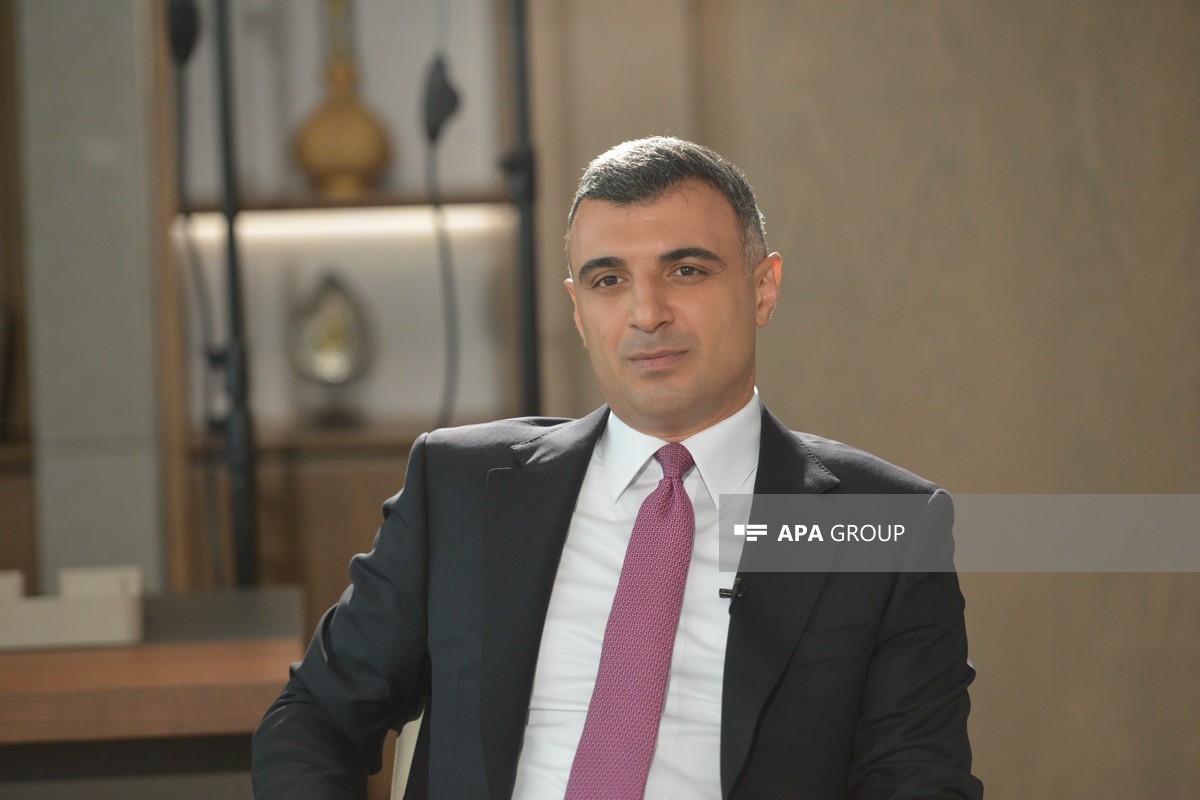
Baku – APA-Economics. BSTDB President Andrey Kondakov gave an exclusive interview to Ekonomist magazine (APA Holding).
- Mr. President, please tell us about the main tasks and objectives of BSTDB. How is your Bank different to commercial banks?
The Black Sea Trade and Development Bank (BSTDB) has received a dual mandate from its eleven shareholding countries: to assist in the economic development of its member states and to promote regional cooperation. The Bank’s strategic objective is to support the Governments of the Member States in the implementation of their economic and investment policy priorities. In establishing BSTDB, the shareholders aimed to create a viable regional development institution, which, by way of good performance and healthy credit ratings could help advance their regional goals and aspirations, not least through the mobilization of more affordable and diversified sources of financing. I am happy to tell you that this objective has been achieved. Currently, the Bank is the best rated financial institution in the Black Sea area and one of the top rated institutions in the Eastern and Central Europe.
Although BSTDB offers financing on market terms, it does not seek profit maximization in the same way that commercial banks do so. In the evaluation of any business proposal, BSTDB gives priority to the project’s development impact and to the extent to which it will contribute to the attainment of national development goals and to the promotion of regional cooperation.
- Does the Bank have any priority areas or limitations in its activities?
BSTDB focuses its activities on supporting key sectors generating economic growth and jobs in the member countries, including such sectors as energy, manufacturing, transportation, agribusiness, municipal infrastructure, and the financial sector. Over recent years, the Bank has significantly increased its financing to support the recovery of the Black Sea region, by facilitating access to affordable capital for the private sector, and in particular to small and medium-sized enterprises (SMEs). The Bank seeks to work with dynamic firms and financial institutions to help them modernize and expand, both nationally and regionally, thus creating wealth, new jobs and regional cooperation opportunities for the benefit of the Region’s economies.
On the subject of limitations on the Bank’s activities, BSTDB follows the practice of peer multilateral development banks in that it does not provide financing to projects that are environmentally harmful or linked to the production of arms, drugs, tobacco, hard alcohol, and other products included in its so-called “negative list”.
BSTDB provides financing only for operations in its eleven member countries. Given the considerable costs involved in project preparation, BSTDB does not generally provide direct financing to very small projects (with total cost of below 3 million euro). In this respect I should add that other international development banks would not normally finance projects of less than 5 million euro. For such projects, the Bank offers financing through its partner commercial banks in member countries which receive credit lines from BSTDB specifically for SME support. Many Azerbaijani banks have received such credit lines from BSTDB. Finally, an additional factor is that, due to the size of the Bank’s capital and risk management considerations, the Bank must impose a maximum limit of financing available to any single client. This limit is currently 44 million euro. There is no such limit for public sector operations.
- What are the structure and the total size of the Bank’s portfolio in the region?
The overall amount of financing which BSTDB has provided since its inception in 1999 exceeds 2.2 billion euro for 243 signed operations in all eleven member countries. The active portfolio of projects under implementation includes 120 signed operations with a total aggregate value of 1.2 billion euro as at the end 2012. Those projects cover a wide spectrum of sectors, with the most substantial exposure – around 45% - to the financial sector (including SME financing facilities, trade finance, leasing, and mortgage financing, and equity funds). BSTDB’s overall exposure to the transport and public utilities sector is 18% of its financing, to the energy sector -13% and to the manufacturing sector-11%.
Currently, about 85% of the Bank’s financing is provided to the private sector. In line with its strategy and business plan for 2011-2014, the Bank is gradually increasing its exposure to the public sector and to projects developed as public-private partnerships.
Importantly, the Bank seeks to prioritize supporting economic development in the group of so-called “small shareholders”, which includes Azerbaijan and four other member countries having a total share of 9% of the Bank’s capital. For this group, BSTDB has committed to provide around 20% of its financing. In fact, the Bank has exceeded this target, having extended to this group of countries 23.5% of its total outstanding financing in 2012.
- How do you assess the BSTDB activities in Azerbaijan?
In general, I may say that BSTDB has established and consistently maintained a robust and successful presence in Azerbaijan. The Bank has an integrated mechanism for independent evaluation of its operations, according to which the implementation of its last completed country strategy for 2007-2010 was assessed as “excellent”, on the basis that all of its targets were exceeded at a level of over 130%. While the current country strategy for the period of 2011-2014 is still under implementation, the mid-term results show that over the past 2.5 years the Bank has approved 10 operations in Azerbaijan with a total value of over 67 million euro, while the Strategy target for the whole 4-year period is 8 operations to a total amount of up to 88 million euro. This significant progress strongly suggests that the Strategy targets will be again exceeded. These results place Azerbaijan among the top five BSTDB member countries in terms of investment volumes, number of operations and ultimately in terms of overall portfolio performance.
- How big is the BSTDB portfolio in Azerbaijan and what are the Bank’s immediate tasks and plans for the country?
Azerbaijan is a dynamic economy and an active member of the Bank. In 2008, the Government of Azerbaijan increased its share in BSTDB’s capital from 2% to 5%. Meantime, the country’s share in the Bank’s outstanding portfolio has reached nearly 10% as of the end of 2012 and continues to grow. During 2012, the Bank signed five operations in Azerbaijan; more than in any other member country, which accounted for over 17% of the Bank’s total signed operations by value. This rapid expansion continues in 2013, and we are expecting several new loan agreements to be signed with Azerbaijani clients shortly.
The Bank’s Country Strategy for Azerbaijan for 2011-2014, sets a target of focusing on small and medium scale projects in the non-oil & gas sector with development and cooperation impact. In particular, the Bank intends to assist Azerbaijan’s economic diversification efforts with an emphasis on transportation, agriculture and agribusiness, manufacturing and development of micro, small and medium-sized enterprises.
In recent years, BSTDB has enjoyed great success in finding operations with financial intermediaries in order to support small and medium enterprises which account for the bulk of employment in the private sector in Azerbaijan, and which represent key target areas for further growth of the non-energy related sectors of the economy.
As I have mentioned, we expect to exceed the Strategy targets for Azerbaijan, which is indicative of robust activity in the market and fits well with our philosophy to respond to prevailing demand trends. In view of the fact that diversification is a key element of Azerbaijan’s development strategy, the Bank seeks to diversify its portfolio in Azerbaijan by dealing directly with so-called ‘real sector’ of the economy. We would especially welcome more operations with “up- and- coming” firms in areas such as manufacturing and agribusiness, which assist employment creation and support economic growth.
We would also like to become involved in certain infrastructure sectors, such as energy, and especially “green” or renewable energy. Furthermore, we are keen to become active in municipal and urban infrastructure development, such as supporting more efficient waste management and the rehabilitation of water sewage and supply networks. The Bank is prepared to consider projects in transportation, particularly in the context of cross-border cooperation with other member countries, which focus on additional road and rail transportation, as well as the improvement of port facilities.
- What are the main objectives of the BSTDB Annual Meeting and Business Forum, and why Baku is chosen as the venue of the Bank’s events?
The Annual Meeting of the BSTDB Board of Governors in Baku, to be held on June 23, 2013, wil, amongst other things, consider the Bank’s Annual Report and financial statements for 2012, decide on the allocation of net income and will evaluate Bank’s operations, as well as review policy documents. The Board will also elect a new Chairman and Deputy Chairmen.
I should point out that 2012 was a successful year for BSTDB, during which the Bank’s outstanding portfolio increased by over 9%. The Bank also posted a positive net income for the eighth consecutive year. In light of this, I expect a positive and constructive discussion with the Governors of the Member States at the meeting.
The Board of Governors Meeting in Baku will be chaired by Mr. Samir Sharifov, Governor for Azerbaijan, Minister of Finance of the Republic of Azerbaijan. He was elected Chairman of the Board at the Bank’s Annual Meeting in June last year. Normally, the venues of BSTDB Annual Meetings follow the annual rotation of the Chairmanship of the Board of Governors, with each Chairman hosting the Meeting in his country. This allows all eleven BSTDB Member countries to host the Bank’s Annual Meetings on an equal basis.
On the occasion of the Annual Meeting, the Bank will hold an Azerbaijan Business Forum at the Four Seasons hotel on June 21, 2013. The Forum is organized in close cooperation with the Azerbaijani Government and Azpromo, the national investment and export promotion agency, and regional business associations. At this international Forum, economic policy makers and representatives of development financial institutions will exchange views on economic diversification. This topic stands high on the development agenda of Azerbaijan and other countries in the region and is being actively discussed by the international development community.
The Forum will also gather many businessmen from the countries of the Black Sea region and beyond, who will discuss business, trade and investment opportunities in Azerbaijan and in the region. I would like to use this opportunity to invite all interested Azerbaijani and foreign businessmen to join us at the event.
- What is your opinion of Baku’s potential as a regional financial centre, and what has to be done in this respect?
In my opinion, the development and promotion of Baku as a regional financial center is an ambitious, but realistic and legitimate objective in the long term. Given the accumulation of energy wealth in the country, improving financial intermediation is an eminently sensible way to manage this wealth prudently, and, more importantly, to realize its transformative potential to develop the economy and help other sectors to grow.
Nevertheless, such an objective must be put in perspective. At present, the level of domestic credit to
This means that the level of financial intermediation in the Azerbaijani economy is insufficient, and the ample resources that are accumulating as a result of the energy wealth are yet to be transformed efficiently into capital that can support growth in other sectors of the economy.
On the plus side, Azerbaijan has a strong and stable macroeconomic position, and many key indicators are quite healthy. I note in particular the decline in inflation observed in 2012, since other key figures for external balance, debt, and currency stability have been achieved for a while now. Such a benign economic environment greatly facilitates planning and can be very attractive for the development of the financial sector. Azerbaijan has many active financial institutions and could maintain a healthy competitive balance even if the number of banks would be substantially reduced. A smaller financial sector could be better capitalized enjoying greater economies of scale and sophistication, while ensuring sufficient competition.
Azerbaijan will also need to market itself more dynamically. Beyond energy related activity, foreign direct investment (FDI) into Azerbaijan remains quite low in other sectors. FDI often brings added financial sector activity. In this respect, Azerbaijan has made good progress in recent years. According to the World Bank’s annual Doing Business report Azerbaijan has been one of the better reformers, helping to improve the domestic business environment. If this trend is sustained, it will greatly increase the attractiveness of Azerbaijan as an investment destination, and this will further contribute to the expansion and deepening of the financial sector.


 Follow us on Telegram
 t.me/apanewsaz
 Follow us on Instagram
 Follow us on TikTok
 Follow us on Facebook
 Follow us on X