












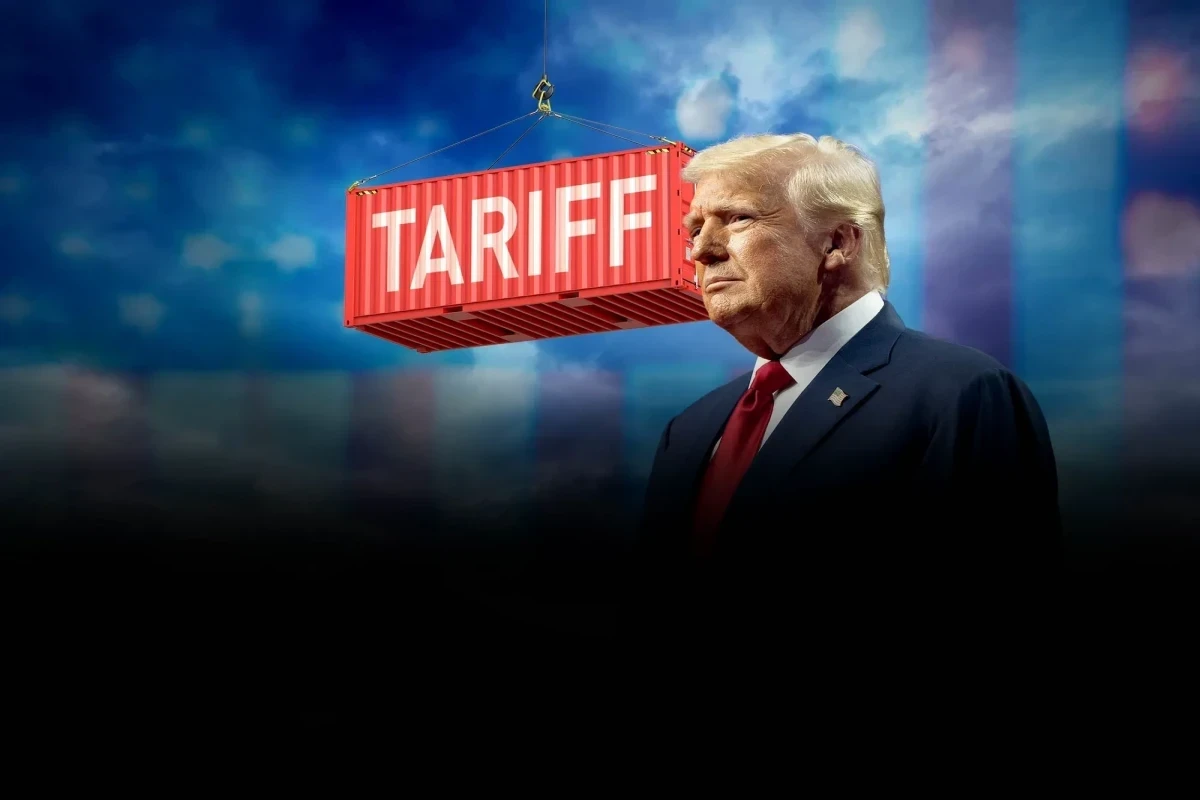


U.S. President Donald Trump has signed an Executive Order imposing reciprocal tariffs on countries around the world.
Recent changes in global trade show that countries are increasingly focusing on protecting the independence of their economies and strengthening their national industries. In this context, the U.S. government's decision to impose tariffs on all imported goods will significantly affect global trade dynamics. This could be seen as the beginning of a new era in the world markets.

Key reasons behind the decision
This shift in U.S. trade policy is a continuation of the "Made in America" initiatives from previous years. The policy aims to support domestic production and reduce reliance on foreign products. Specifically, it seeks to weaken China’s economic power, create new jobs, and ensure that U.S. manufacturers remain more competitive in the global market. The imposition of tariffs is primarily seen as a measure to block the influx of low-cost imported goods. The cheaper foreign products were preventing domestic producers from gaining an edge in the market. The tariffs are regarded as a step taken to stimulate local production and reduce unemployment.
Among the countries affected by the tariffs is Azerbaijan, with a minimum customs duty of 10% set. The tariffs will come into effect on April 3, 2025.

Economist Eldeniz Amirov said in a statement to APA that U.S. President Donald Trump’s tariff policy will have a significant impact on many countries around the world, including on the U.S. itself: “The U.S. tariff policy will affect many countries, increase product prices, and lead to higher inflation.”
Possible impact of tariff policy on Azerbaijan’s economy
Eldeniz Amirov also commented on the potential effects of Trump’s tariff decision on Azerbaijan.
“Azerbaijan is an import-dependent country, so the first impact will be felt in this regard. The share of the U.S. in Azerbaijan’s total exports is very small. In 2024, Azerbaijan exported goods worth 26.538 billion dollars, with 134.663 million dollars attributed to the U.S. This represents just 0.6 percent. This means that for every 100 dollars of products exported by Azerbaijan, only 60 cents are for the U.S. On the other hand, when a 10 percent tariff is imposed, 4-5 cents of that 6 cents will be transferred to the price of the product. Therefore, the loss in exports directed towards the U.S. will not exceed 30,000 dollars, which is not a significant amount. It cannot be considered a major loss. The problem will be in imports.”
Tariff decision – An unprofessional step

American political scientist Peter Tase, in a statement to APA, said that President Trump's decision to impose tariffs on Azerbaijani products is a highly unprofessional move: "Azerbaijan is the top strategic ally of the United States of America. President Trump has taken a very immature decision to impose tariffs towards all Azerbaijani products. However General Motors and GMC will be negatively affected by the Trump White House because their sales of vehicles in Baku will be less and less, as the tariffs will fracture the economic partnership between Baku and Washington DC. As President Trump has taken these international trade measures, President Ilham Aliyev must be welcomed and received at the White House by President Trump in order to find a common ground on these pressing issues."
Member of the Milli Majlis Committee for Economic Policy, Industries, and Entrepreneurship, Vugar Bayramov, also commented to APA, saying that Azerbaijan imports more from the U.S. than it exports to it.

"In 2024, Azerbaijan imported goods worth 1 billion 617 million dollars from the United States, while our exports to the United States amounted to only 135 million 30 thousand dollars. This means we have a $1.482 billion trade deficit with the United States in foreign trade. However, compared to the previous year, our imports from the U.S. increased 1.8 times, while our exports to the U.S. grew by 8.4 times. Although the export volume remains low, the growth rate is very high. This indicates that the U.S. is becoming a new export destination for our businesses."
Impact of the decision on non-oil/gas export products
Vugar Bayramov noted that the new tariffs primarily affect non-oil/gas export products.
"In 2024, our non-oil and gas exports to the United States amounted to 134 million 663 thousand dollars. For non-oil and gas products of Azerbaijani origin, exports were recorded at 55 million 949 thousand dollars. Considering that our total non-oil and gas exports in 2024 were 3 billion 356 million dollars, and total exports of non-oil and gas products of Azerbaijani origin were 2 billion 883 million dollars, our cooperation with the United States in this field does not hold a significant share."
Regarding non-oil and gas exports to the U.S., the economist noted that in 2024, Azerbaijan exported $6 million 508 thousand worth of other primary forms of substances resulting from polymerization, $593 thousand worth of animal intestines, bladders, and stomachs, fresh, chilled, and frozen product, $410 thousand worth of juices from tropical and other fruits, $279 thousand worth of sturgeon caviar, $242 thousand worth of unrefined, first-press extra virgin olive oil, and $177 thousand worth of fruit jams, jellies, marmalades, fruit purees, and pastes, as well as other products to the United Stated.
The beginning of a new phase in the world economy
Vugar Bayramov noted that while tariffs may not severely impact Azerbaijan’s exports to the U.S., they could still influence overall growth dynamics: “In all cases, new tariffs mean new costs. That is, a decline in the growth rate of our total exports to the United States cannot be ruled out. At the same time, since the products we export to the U.S. are mostly niche-specific, a 10% tariff might not significantly affect their market position. However, in any scenario, the introduction of new tariffs will mark the beginning of a new phase in the global economy.”
The tariff measures imposed by the U.S. on imported goods will alter global trade dynamics and have long-term effects on the world economy. This decision aims to strengthen domestic production and enhance economic independence. However, at the same time, this policy could increase tensions in global trade and create market instability. While it may pose challenges for consumers and exporters, the long-term impact of this decision on the U.S. economy will become clearer over time.



 Follow us on Telegram
 t.me/apanewsaz
 Follow us on Instagram
 Follow us on TikTok
 Follow us on Facebook
 Follow us on X


