












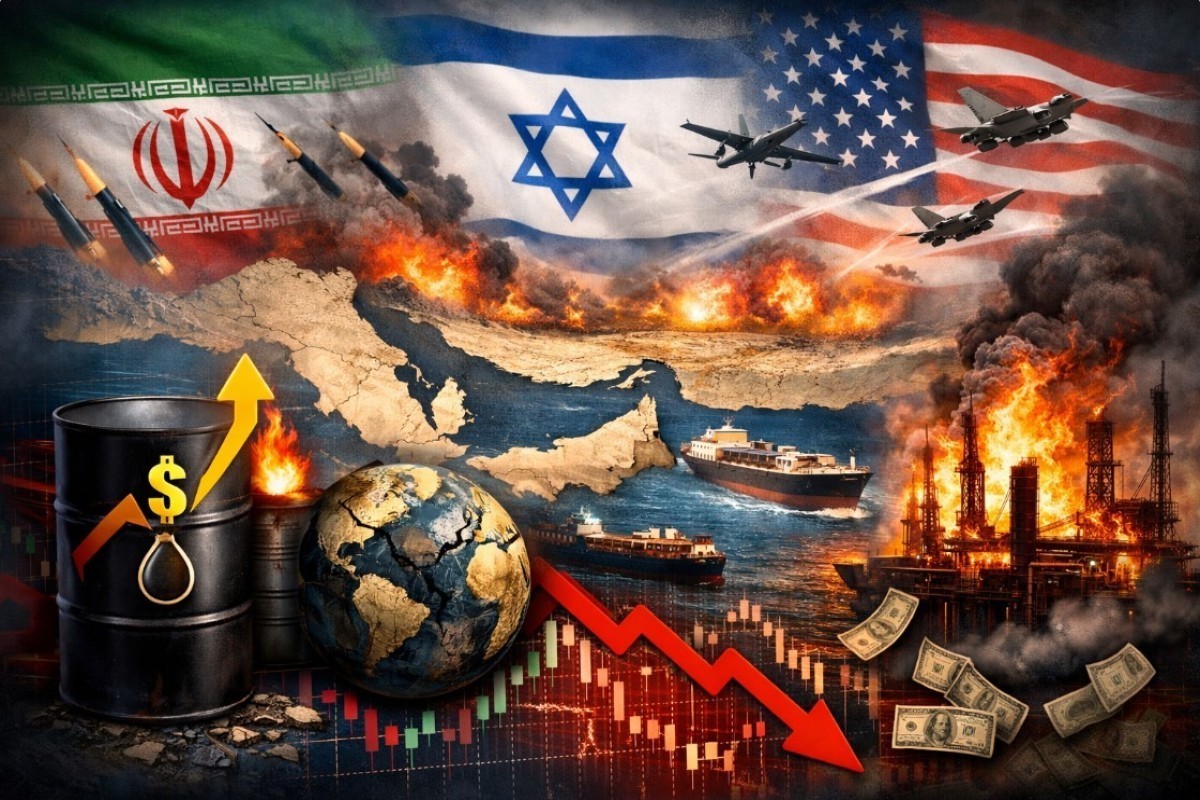


Rising geopolitical tensions in the Middle East have significantly increased the level of uncertainty in global energy markets. The region holds a strategic position in the international energy system. According to the International Energy Agency, Middle Eastern countries account for about 30 percent of global oil production, and a large share of proven reserves is concentrated there. Therefore, military and political developments in the region directly affect price dynamics in energy markets.
One of the most sensitive points in terms of energy supply is the Strait of Hormuz. Any risk along this transit route, through which about 20 million barrels of oil pass daily, could lead to rising prices in global markets. Currently, the price of Brent crude oil is forming in the range of approximately 80–90 US dollars.
According to some market scenarios, if regional escalation deepens, prices could rise to as much as 140 US dollars in the short term. However, the real scale of the price increase will depend on the level of geopolitical risks and the stability of global supply chains. Therefore, expert opinions are particularly important in assessing the economic prospects of the current situation.
Tension in energy markets
Bridget Payne, Head of Energy Forecasting at Oxford Economics, told APA that the current global oil market has a sufficiently high level of supply, and Iran’s potential to cause serious and long-term disruptions to global supply is considered low.

According to her, for this reason, the likelihood of a full-scale oil crisis is also considered relatively low: “This has also been reflected in the market reaction. Following the initial geopolitical shock, the price of Brent crude rose to around 80 dollars per barrel, but later stabilized again at about 78 dollars. This indicates that although markets have priced in certain short-term disruption risks, they do not expect a long-term and serious supply shortage.”
The expert noted that Oxford Economics’ baseline scenario currently assumes a moderate disruption in the Strait of Hormuz: “The strait may technically remain open, but due to rising security risks and higher insurance costs, transit could effectively be significantly restricted.”
According to Bridget Payne, around one-fifth of global oil and liquefied natural gas shipments pass through the Strait of Hormuz every day, and the total value of these shipments — including Iran’s own exports — exceeds 1.3 billion dollars per day.
She added that, based on current estimates, disruptions in global oil supply could average about 4 million barrels per day over the next quarter: “In this case, the average price of Brent crude is expected to reach about 79 dollars per barrel in the second quarter, which is roughly 15 dollars higher than the baseline forecast released in February. However, supply is expected to gradually recover toward the end of the quarter, which would lead to prices declining again.”
Price increase in the energy market will be short-term
Marijan Duriš, a Brussels-based expert on foreign policy and international relations, believes that amid rising geopolitical tensions, various market scenarios suggest that benchmark oil prices could temporarily approach 100–120 US dollars per barrel.

In a statement to APA, he noted that the risk of supply disruptions, particularly along key export routes such as the Strait of Hormuz, could further accelerate this price increase: “According to forecasts by the International Monetary Fund and the World Bank, such price spikes are usually driven not by actual supply shortages but rather by an increase in the geopolitical risk premium. Assessments by the U.S. Energy Information Administration show that for oil prices to remain above 110 dollars for a prolonged period, either long-term production disruptions or coordinated supply restrictions by OPEC would be required.”
Touching upon how long the upward price trend may continue, Duriš believes the increase will be temporary and that partial stabilization in the market can be expected within 6–12 months, provided that no structural disruption occurs in the global energy supply chain: “However, even short-term price spikes can increase inflation expectations in economies that depend on energy imports and may lead to tighter monetary conditions.”
Rising energy prices put pressure on inflation and industrial production in the Eurozone
The recent increase in energy prices poses significant macroeconomic challenges for the European economy. Since most countries on the continent import a large share of their energy resources, price fluctuations in global markets directly affect economic indicators. Rising energy costs increase inflationary pressure and raise the cost of industrial production. This may lead to reduced output, weakened competitiveness, and slower economic growth. At the same time, the issue of energy security is once again coming to the forefront. In this context, the key question concerns the potential macroeconomic effects of rising energy prices on the European economy.
Foreign policy expert Marijan Duriš said that the recent rise in energy prices could create a number of negative consequences for the European economy.
According to the expert, first and foremost, the increase in energy costs puts serious pressure on inflation: “In 2026, energy accounts for approximately 9 percent of the Harmonised Index of Consumer Prices (HICP) basket in the Eurozone. Therefore, even a moderate price shock in the energy market can lead to a rapid increase in overall inflation. As production and transportation costs rise, this effect is also indirectly transmitted to core inflation.”
He noted that recent statistics show how sensitive inflation dynamics are: “In February 2026, inflation in the Eurozone was estimated at 1.9 percent, which is 0.2 percentage points higher than in January. At the same time, core inflation remains around 2.4 percent, which increases the risk that the energy price shock could have longer-term effects through services and non-energy goods.”
Marijan Duriš added that market scenarios also demonstrate the sensitivity of inflation to energy prices: “According to analysts’ calculations, a 10 percent increase in oil prices could raise overall inflation by an average of 0.2 percentage points. The scale of this effect depends on how long the price increase lasts and how strongly costs are transmitted to the broader economy. Rising energy and raw material costs also have a significant impact on the manufacturing sector. In particular, the chemical industry, metallurgy, and energy-intensive manufacturing sectors are more sensitive to such price changes. According to economic forecasts by the European Commission, GDP growth in the Eurozone is expected to be around 1.4 percent in 2026. However, if energy prices remain high for a prolonged period, this could reduce profit margins, delay investments, and slow the growth of industrial production.”
The Hormuz crisis could alter global trade routes and logistics costs
The Strait of Hormuz is considered one of the most critical strategic points in global energy logistics. A significant share of the world’s exported oil and liquefied natural gas reaches international markets through this route. Therefore, any restriction or blockade affecting the strait could have a serious impact on the global energy supply chain. Such a scenario would not be limited to rising energy prices but could also lead to changes in global trade routes, increased transportation costs, and greater instability in financial markets. In this context, the potential closure of the strait by Iran has become one of the key topics of discussion regarding its possible impact on the global economy.
According to foreign policy expert Marijan Duriš, the closure of the Strait of Hormuz could cause significant shocks to the global economy: “Approximately 20 percent of the world’s daily oil supply and around 25 percent of global liquefied natural gas exports pass through this route. For this reason, a blockade of the strait could trigger a sharp increase in prices in global energy markets. Rising energy prices would directly affect global inflation by increasing production, transportation, and logistics costs. According to assessments by international financial institutions, a 10 percent increase in oil prices could raise global inflation by about 0.2–0.3 percentage points.”
He also noted that shipping companies may redirect vessels to alternative and longer routes, which could increase transportation costs by 15–20 percent and significantly extend delivery times:
“In a long-term scenario, weakening industrial production, declining consumer demand, and tightening monetary policy could significantly slow the pace of global economic growth.”
Diplomatic dynamics between China and Iran could reshape the situation
The Middle East is not only one of the main centers of global energy supply but also plays an important role in the energy security strategies of major consumer countries. In this regard, China is in a particularly sensitive position due to its dependence on energy resources imported from the region. A significant share of Beijing’s liquefied natural gas imports is supplied by Qatar, and a large portion of this supply passes through routes that cross the Strait of Hormuz. The possibility of the closure of this route raises new geopolitical and economic questions regarding the stability of energy supplies. Under such circumstances, the potential diplomatic dynamics between Iran and China in the context of energy security and economic interests are drawing particular attention.
Foreign policy expert Marijan Duriš believes that a possible escalation around the Strait of Hormuz could influence the diplomatic dynamics between China and Iran and bring the rebalancing of interests in the context of energy security onto the agenda: “The Middle East plays a crucial role in ensuring China’s energy supply, and a significant portion of the country’s liquefied natural gas imports comes from Qatar, while a large share of crude oil shipments is transported through this strategic route.”
The expert notes that the closure of the Strait of Hormuz or restrictions on transportation along this route could pose a serious energy security risk for Beijing.
According to Duriš, in such circumstances China may use diplomatic channels to call for the preservation of stability in the region and for keeping sea routes that are critical for international energy trade open: “However, under conditions of high military and political tension, the effectiveness of such diplomatic initiatives may be limited and may not directly influence the strategic decisions of the parties involved. Such a situation could further complicate the geopolitical balance in the region, create new political discussions within the framework of the strategic partnership between China and Iran, and force Beijing to engage in more delicate diplomatic maneuvering between its economic interests and regional security realities.”
Rising geopolitical tensions in the Middle East remain one of the key risk factors for the stability of global energy markets. Expert assessments suggest that short-term price increases and market fluctuations are possible, but at the current stage the likelihood of a long-term and large-scale energy crisis appears relatively limited. Nevertheless, any serious disruption along strategic routes such as the Strait of Hormuz could have significant consequences for global energy supply, inflation dynamics, and international trade routes. Under current conditions, the future trajectory of energy markets will largely depend on the regional security situation, the policies of major consumer and producer countries, and the resilience of global supply chains.



 Follow us on Telegram
 t.me/apanewsaz
 Follow us on Instagram
 Follow us on TikTok
 Follow us on Facebook
 Follow us on X


