













Recently, there have been reports that there will be another devaluation in Azerbaijan.
This issue not only confuses people but also leads to certain concerns. Some claim that these reports are false, while others claim that the process is slowly moving towards it. But, what exactly is the forecast?
APA-Economics has investigated the current economic situation of the country and sought an answer to the "Is devaluation expected?" question, which makes everyone think, about the reasons affecting the depreciation of the manat in 2015 and the economic indicators that can directly affect the exchange rate of the manat today were analyzed.
Let’s say that, the devaluation is the depreciation of the national currency against the foreign currency. This term started to become more popular in Azerbaijan in 2015. Thus, on the morning of February 21, 2015, the Central Bank of Azerbaijan (CBA) implemented the devaluation of the national currency and announced that the official exchange rate of 1 US dollar increased from 0.78 manat to 1.05 Azerbaijani manat. In December 2015, the manat depreciated against the dollar again, and the Central Bank of Azerbaijan (CBA) announced the transition to a floating exchange rate. This decision caused confusion and some anxiety in the country. The devaluation of the manat had a very serious impact on economic subjects. Thus, the basic products consumed by the population - food, medicine and medical supplies, household appliances, electronics, automobiles and automobile spare parts, and other products became more expensive.
After the depreciation of the manat against the dollar, citizens who took loans in US dollars faced serious difficulties. Because until then, loans were usually formalized in dollars, and given to the population in manats. As a result of devaluation, an additional liability for debts in foreign currency was created. Thus, after the appreciation of the dollar, the amount of hopeless debts suddenly increased as the population faced difficulties in repaying loans.
Now let's look at the factors that made the dollar more expensive in 2015.
Of course, the first indicator we will look at here is the drop in oil prices in the world commodity markets since the end of 2014. Thus, as a result of the decrease in the price of oil, the volume of currency entering the country decreased. As a result of this decline, the CBA sold its foreign exchange reserves to meet the demand for dollars. This, in turn, resulted in a serious melting of the CBA's foreign exchange reserves. In the graph below, we can see the change in the CBA's foreign exchange reserves.
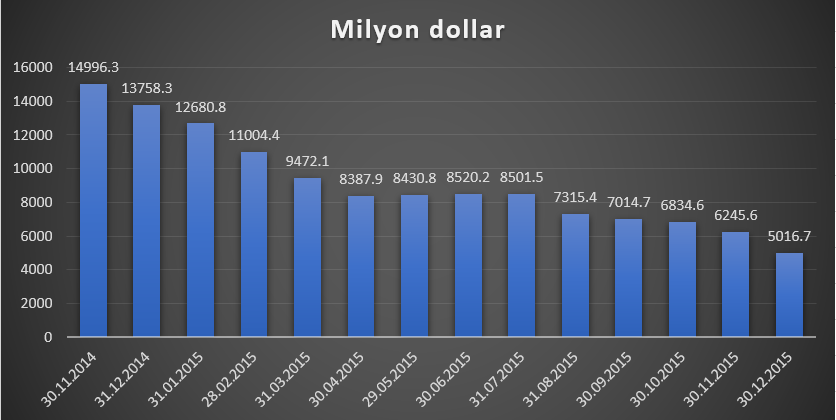
As can be seen from the graph, the foreign exchange reserves, which reached 15 billion USD at the end of November 2014, decreased to 4 billion USD within 3 months. By the time of the second devaluation, these reserves were decreased again by about 6 billion dollars. In that period, the main indicator affecting the exchange rate of the manat was the rapid fall in the CBA's reserves. CBA protected its reserves by depreciating the manat. At the end of 2015, the reserves fell to 5 billion US dollars, which was a sign that the situation had worsened.
The sharp drop in oil prices also reduced Azerbaijan's strategic currency reserves. Thus, the reserves, which reached 50.9 billion US dollars at the end of 2014, decreased to 38.6 billion US dollars by the end of 2015.
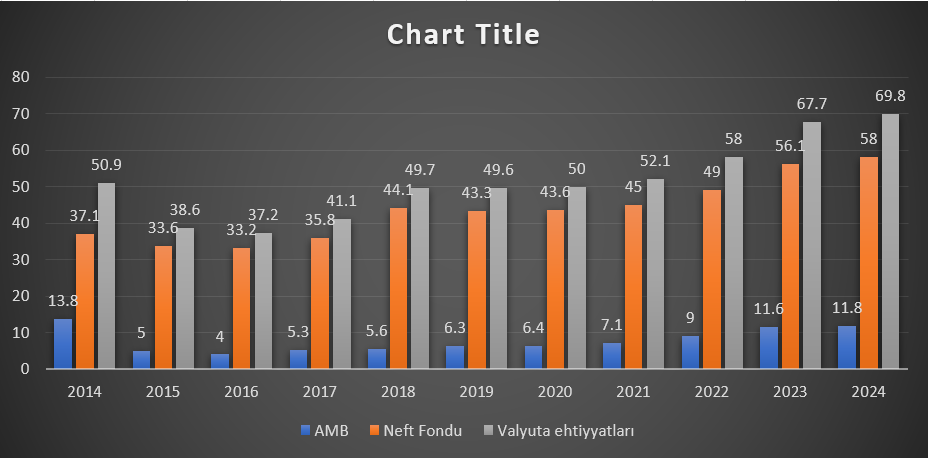
The country's strategic currency reserves consist of the sum of reserves of the State Oil Fund of the Republic of Azerbaijan (SOFAZ). As can be seen from the graph, the CBA's reserves reached 11.8 billion US dollars in the current year while it decreased to 4 billion US dollars in 2016, while the reserves of SOFAZ increased to 58 billion US dollars in the first half of the current year while it decreased to 33.2 billion US dollars.
It should be noted that Azerbaijan's strategic currency reserves play the role of a security cushion against external shocks.
Regulation of monetary market
In 2015, the depreciation of the manat accelerated the sharp increase in the demand for cash foreign currency. In the year of devaluation, there was a serious agitation in the cash currency market, so that the dollar sales of banks in that year exceeded 12 billion.
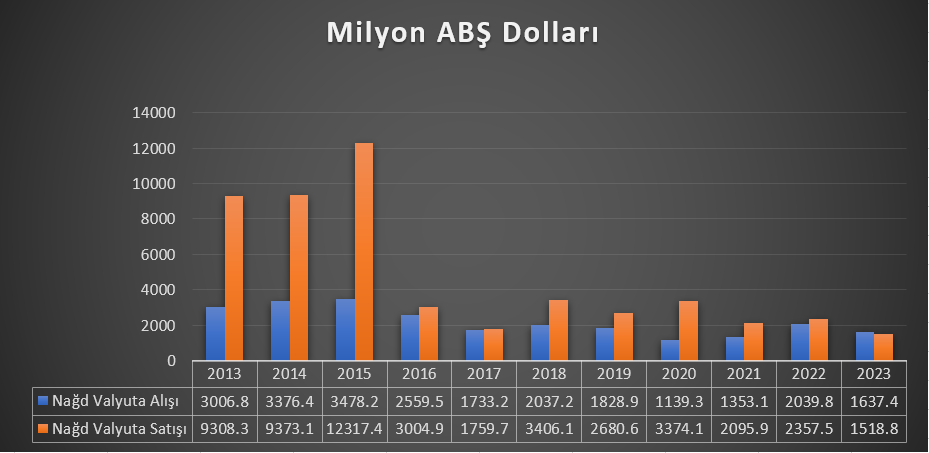
As can be seen from the graph, starting from 2016, cash currency sale of the banks started to going down. For the first time in a long time, in 2023, banks' dollar purchases exceeded their sales. Last year the banks sold USD 1 billion 518.8 million, and purchased USD 1 billion 637.4 million.
The main reason why cash currency sales decreased sharply in 2016 to USD 3 billion is the executive measures taken by the Azerbaijani government in order to mitigate the pressures on the exchange rate of the national currency.
Thus, the requirements on the identification of the foreign currency sales operations of the banks have been tightened, "Rules for transactions of residents and non-residents of the Republic of Azerbaijan in foreign currency" was approved in a new edition by the decision of the Central Bank of the Republic of Azerbaijan dated November 28, 2016 in order to strengthen financial order of the currency operations of the legal entities and the physical persons operating in the country, as well as increasing transparency in the import-export operations.
According to the regulations, the requirement to import goods or provide services to the country within 180 days in return for advance payments related to import and to submit supporting documents to the bank has been established. Additionally, limits on foreign currency transfers of natural persons through a bank account and without opening an account (up to USD 10,000 per month for close relatives, USD 1,000 per transaction day in other cases, up to USD 10,000 per month in total) have been introduced. Transaction limits are also defined for transfers to close relatives.
Noted that since 2017, the demand for dollars in the country has been met through currency auctions organized by CBA and SOFAZ. That is, revenues from the sale of crude oil and gas enter the Fund in US dollars. The fund, in turn, converts those funds into manats in currency auctions to cover transfers to the state budget and other expenses. In 2021-2023, SOFAZ sold USD 14.5 billion in currency auctions. At the same time, the Central Bank purchased USD 245 million from the foreign exchange market in 2021, USD 2 billion 48 million in 2022, and USD 2.1 billion in 2023. This means that in those years the supply exceeded the demand, and since there was no demand for these funds in the market, they were bought by the Central Bank. The increase in the reserves of the Central Bank has increased the possibilities of intervention in the foreign exchange market. That is, if the demand for the US dollar increases, a sell-oriented intervention in the market can be made at the expense of reserves to meet this demand.
Dedollarization of savings and deposits
The depreciation of the manat in 2015 naturally caused concerns among the population. People turned to banks to quickly get rid of their deposits in manat. A sharp rise in dollarization had a negative impact on the position of the national currency. Thus, in that year, the specific weight of foreign currency deposits in total deposits increased to 81.9%. It should be noted that in 2014, the level of dollarization of total deposits was 49.9%. This indicator, which began to decrease from 2016 (75%), decreased to 39.8% in 2023. In addition to the psychological factor, the high deposit rates were also important in the high dollarization. Thus, as of January 1, 2014, the average interest rate of deposits and savings in foreign currency was 9.66%.
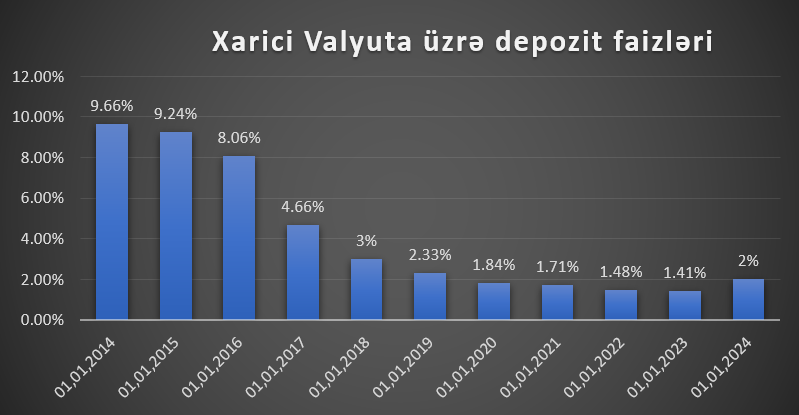
Since the average interest rate of deposits in foreign currency is higher than that of manat deposits, it had an effect on the increase of dollarization. However, as can be seen from the graph, from the end of 2016, the average interest rates of deposits in foreign currency began to decline sharply and fell to 1.41% by the beginning of 2023.
The main reason for the sharp decrease in the average interest rates of foreign currency deposits is the administrative steps taken by the government. Thus, since March 2, 2016, the annual interest rate of deposits protected by the Deposit Insurance Fund has been set at 3% in foreign currency and 12% in national currency. As can be seen from the graph, this decision gradually led to a decrease in interest rates.
The factor of external debt
Another factor creating demand for foreign currency is the country's external debt. As of July 1, 2024, the external state debt stood at $5 billion 361.3 million.
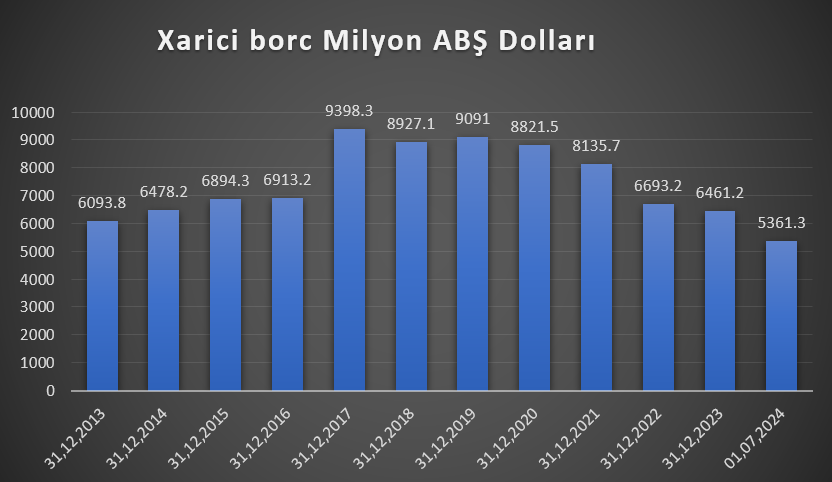
As seen from the graph, the country's external debt has dropped to its lowest level in recent years, Azerbaijan's external debt has decreased by $1 billion 99.9 million within just the first six months of the current year. The fact that the external debt is at 7.5% of GDP has reduced pressure on the manat, as demand for foreign currency rises when debt is repaid. At the beginning of the year, the demand for dollars in currency auctions increased sharply compared to the same period last year. In January-April of this year, $2.3 billion were sold in the auctions, The main part of this amount consisted of Azerbaijan's repayment of its external debt.
Balance of payments
The balance of payments is the value of a country's international economic relations expressed in foreign currency in the form of inflows and outflows.
A surplus in the balance of payments means that the country is exporting more goods, services, and capital than it is importing. A deficit in the balance of payments means the country is importing more goods, services, and capital than it is exporting. The most important component of the balance of payments is the current account balance (CAB). Simply put, the current account balance is the difference between the currency coming into the country and the currency leaving it. If the CAB is in surplus, it means that more currency is entering the country than leaving.
A deficit in the current account balance does not necessarily mean that a devaluation will occur, a condition for devaluation is created if the deficit cannot be covered by reserves. For example, in 2020, despite a deficit of AZN 227.6 million in the current account balance and AZN 1 billion 987.7 million in reserve assets, the manat did not depreciate.
In the first quarter of 2024, the current account balance in the country had a surplus of AZN 1 billion 729.8 million, which equaled 10.1% of GDP.
International rating agencies' forecasts
According to the forecast by Fitch Solutions (FS) company under the Fitch Group, Azerbaijan's current account balance (CAB) will remain in surplus over the next 10 years. FS projected that the CAB's share of GDP will be 23.7% in 2024, 21% in 2025, and 17.7% in 2026. Fitch Solutions also estimates that the CAB surplus will be above 10% until 2030. FS analysts believe that the CAB surplus will be 7.3% in 2031, 4.9% in 2032, and 2.7% in 2033.
As for the FS forecast for the Azerbaijani manat exchange rate, the manat will remain stable until 2027. However, the company predicts the manat’s exchange rate will drop to 1.75 in 2027 and further to 1.80 starting in 2028. According to the forecast, the USD/AZN exchange rate will stay at 1.80 until 2033.
It should be noted that the Netherlands-based international banking and financial services corporation ING has also forecasted that the manat's exchange rate will remain stable until 2026.
In conclusion, let us emphasize that there is currently no economic situation in the country that would lead to a depreciation of the manat. Strategic currency reserves reaching $70 billion, the low level of dollarization in savings and deposits, the regulation of the currency market, restrictions on the outflow of foreign currency, the low level of external debt, oil prices being above forecasts, and the surplus in the current account balance all provide grounds to say that no change in the manat's exchange rate will occur.
Note: The tables used in the article were prepared by APA-Economics.


 Follow us on Telegram
 t.me/apanewsaz
 Follow us on Instagram
 Follow us on TikTok
 Follow us on Facebook
 Follow us on X


