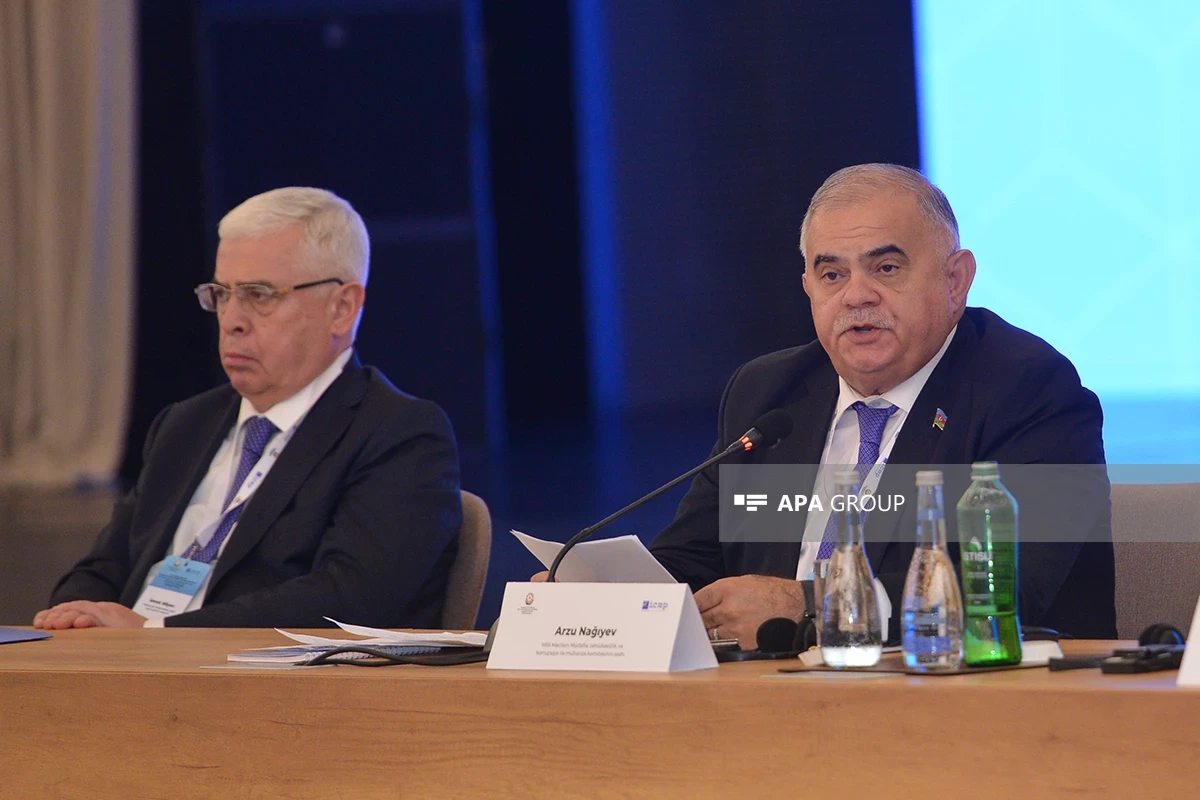


"The status of the State Commission's Working Group, as well as issues related to strengthening its material and technical base, human resources, employees' social protection, and safeguarding their health, should be reviewed," MP Arzu Naghiyev said at the international conference titled "Modern Approaches and Strengthening Cooperation in Resolving the Issue of Missing Persons," held within the framework of cooperation with the International Commission on Missing Persons (ICMP), APA reports.
He said that the State Commission's Working Group successfully fulfilled its tasks during the First Karabakh War, the ceasefire period following May 1994, and the Second Karabakh War, which began in September 2020 and lasted 44 days.
Naghiyev noted that following the victory in the Patriotic War, the Working Group was entrusted with the more important task of determining the fate of missing persons, conducting search and excavation operations in the liberated territories, exhuming remains, identifying them, and returning them to families who had waited for years. He described this as a new and more challenging stage in the Commission's work, requiring significant time, human and financial resources, a sustainable material and technical base, patience, and responsibility.
"As an MP closely following the Commission's activities, I can say that the measures implemented in recent years, particularly the identification and burial of missing martyrs, have created great hope among all Azerbaijani citizens, especially the families of the missing," he said.
However, he stressed that alongside responsibility and conscientious work, these activities require substantial financial resources, a strong material and technical base, modern technological equipment, and a clear division of responsibilities. He also underlined the importance of protecting the health of team members conducting search and excavation operations in areas heavily contaminated with mines and unexploded ordnance, in difficult terrain and harsh weather conditions, while working in direct contact with human remains.
Naghiyev noted that working groups are generally established to address specific issues over a short period and that their status is regulated accordingly.
Considering that more than 4,000 Azerbaijani citizens went missing as a result of Armenia's military aggression and that the fate of only 226 of them has been established in recent years, he said the State Commission's Working Group will need to continue its activities for a long time.
He recalled that President Ilham Aliyev has repeatedly stated that determining the fate of all missing Azerbaijani citizens is an important and urgent task for the relevant state institutions.
The MP added that the study of mass graves discovered in the liberated territories, DNA analysis for identification, and the application of modern forensic methods constitute an important part of this work. He also noted that the state provides social and psychological support to the families of missing persons.
Naghiyev said that all these factors should be taken into account and that the status of the State Commission's Working Group, its material and technical base, staffing capacity, employees' social protection, and health safeguards should be reviewed.
He also emphasized the importance of strengthening the legal framework for the unified registration and database of prisoners of war and missing persons, ensuring family members' right to information more effectively, improving coordination among state institutions, more clearly reflecting psychological, social, and legal support measures in legislation, and expanding legal mechanisms for cooperation with international organizations.
The MP said the issue of missing persons should be discussed at a joint meeting of the relevant parliamentary committees and the State Commission. He also proposed exempting goods and materials purchased by the State Commission, particularly specialized excavation equipment, from customs duties and taxes.
"In my opinion, it is necessary for the state institutions represented in the State Commission and the Commission's members to take the appropriate steps to review and resolve these issues," he said.


 Follow us on Telegram
 t.me/apanewsaz
 Follow us on Instagram
 Follow us on TikTok
 Follow us on Facebook
 Follow us on X