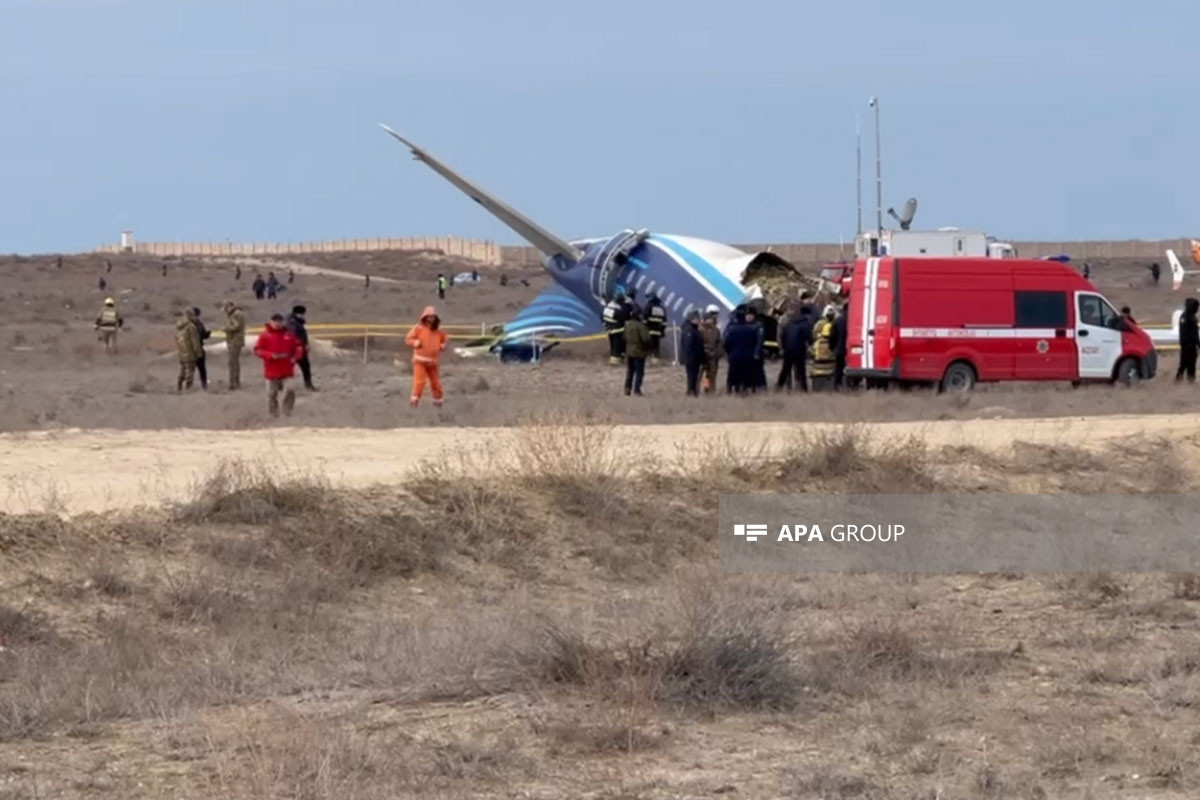


Damage to the AZAL passenger aircraft occurred as a result of destructive elements of a warhead, but their origin could not be determined, this is stated in the interim report of the commission investigating the crash of the Embraer 190 aircraft (registration 4K-AZ65) belonging to AZAL, conducted by the Ministry of Transport of Kazakhstan, APA reports.
The report also notes that damage to the aircraft’s No. 2 hydraulic system pipe may have occurred as a result of contact with hard objects, and that the holes formed could have been caused by external objects made of a metal alloy (steel-based).
Within the framework of the investigation of the aviation incident, the following studies were carried out:
• A comprehensive examination (isotopic, ballistic, explosive, and fire-related) was conducted on the detected external metal objects (foreign bodies). As a result of the examination, no traces of explosive substances were found. In the study conducted on three oxygen cylinders, no signs of explosion were identified. The aircraft’s damage is believed to have occurred due to destructive elements of a warhead, but their origin could not be determined.
• An isotopic examination of the No. 2 hydraulic system pipe was carried out. The investigation revealed damage to the pipe. The mechanism of the damage is fragmentation of the metal as a result of contact with hard objects. The holes could have been caused by external objects made of a metal alloy (steel-based).
• A study was conducted on the cartridge of the Central Maintenance Computer extracted from the Avionics Modular Block. Due to thermal impact, it was not possible to retrieve data from the cartridge. To extract the data, Honeywell International Inc recommended contacting the memory card manufacturer Delkin Devices Inc. The Commission is currently in discussions with a U.S. representative about conducting research at the Delkin Devices Inc factory.
• The cartridges of the Global Positioning System (GPS1 and GPS2) extracted from Avionics Modular Blocks No. 1 and No. 3 were examined. The work has been completed and analysis is underway.
Thus, the Investigation Commission is currently awaiting completion of the study of the Central Maintenance Computer cartridge and the preparation of a report by the working group assessing flight risks over or near conflict zones. It is noted that the Investigation Commission maintains a balanced position and that all conclusions will be presented objectively, based solely on facts. The final report on the aviation incident investigation will be published on the website of the Ministry of Transport of the Republic of Kazakhstan.


 Follow us on Telegram
 t.me/apanewsaz
 Follow us on Instagram
 Follow us on TikTok
 Follow us on Facebook
 Follow us on X