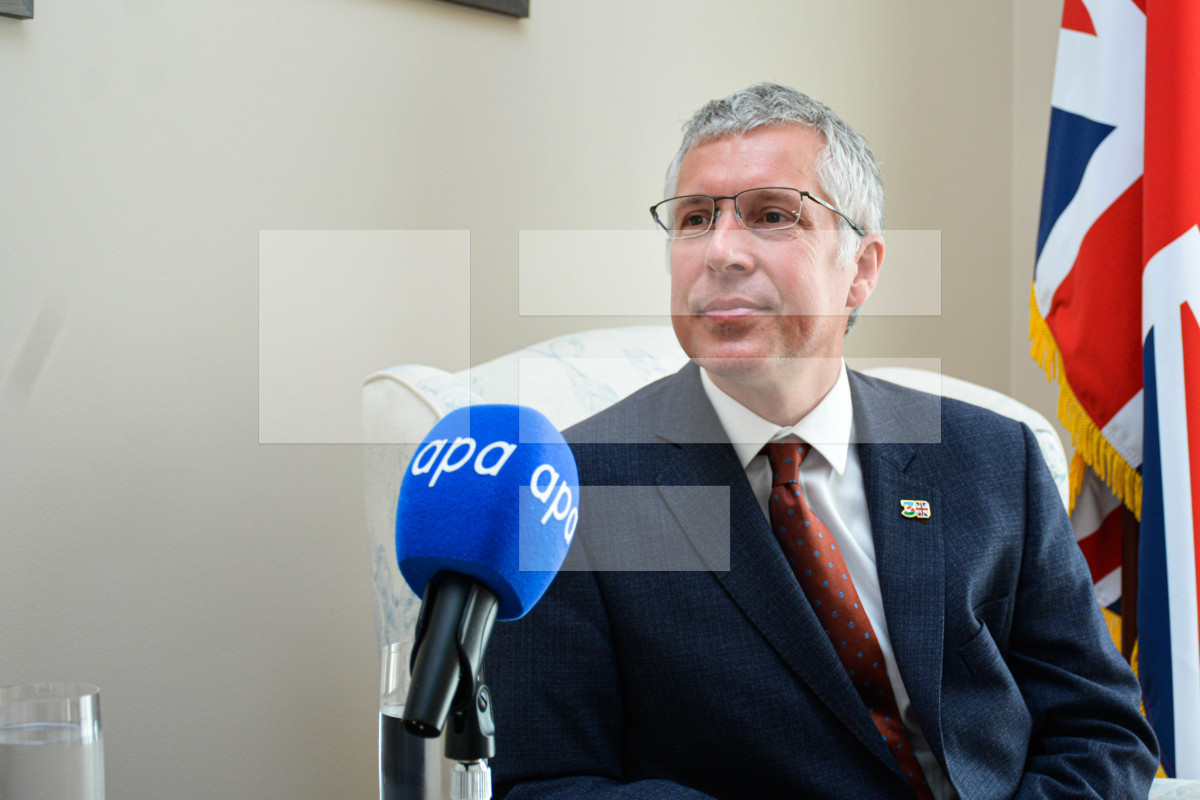

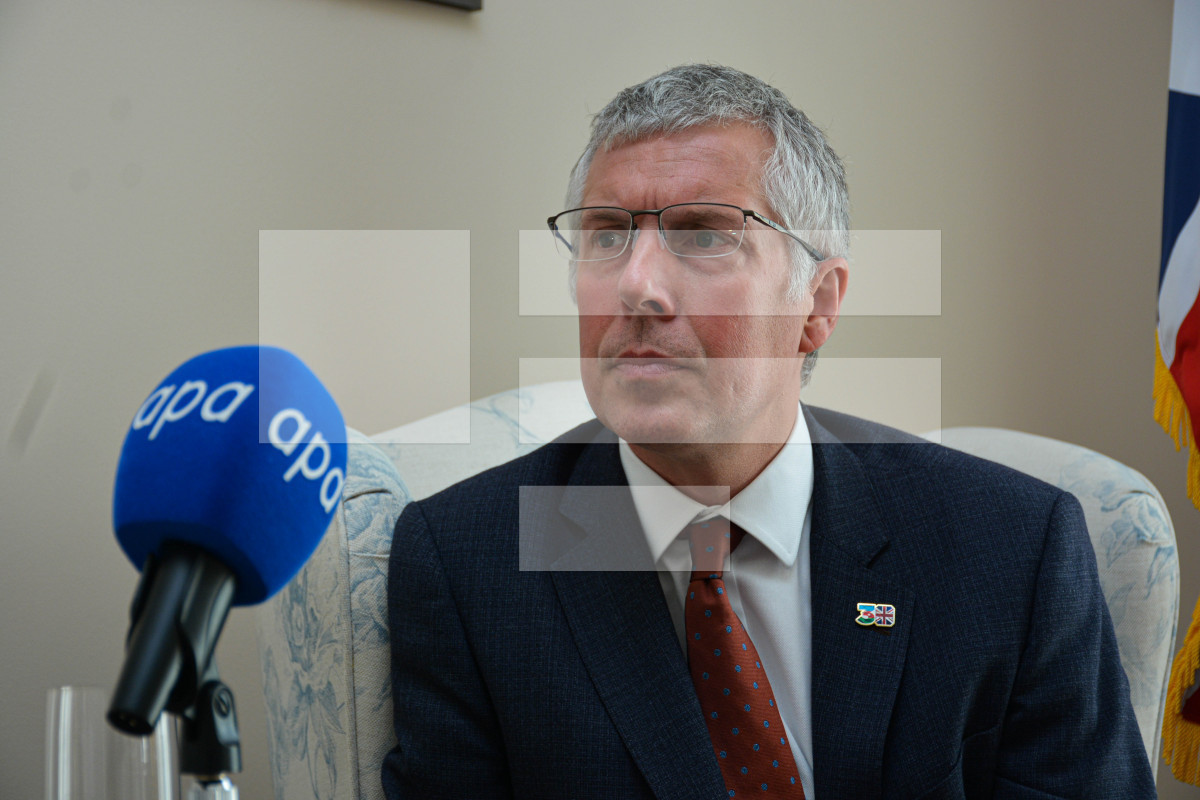
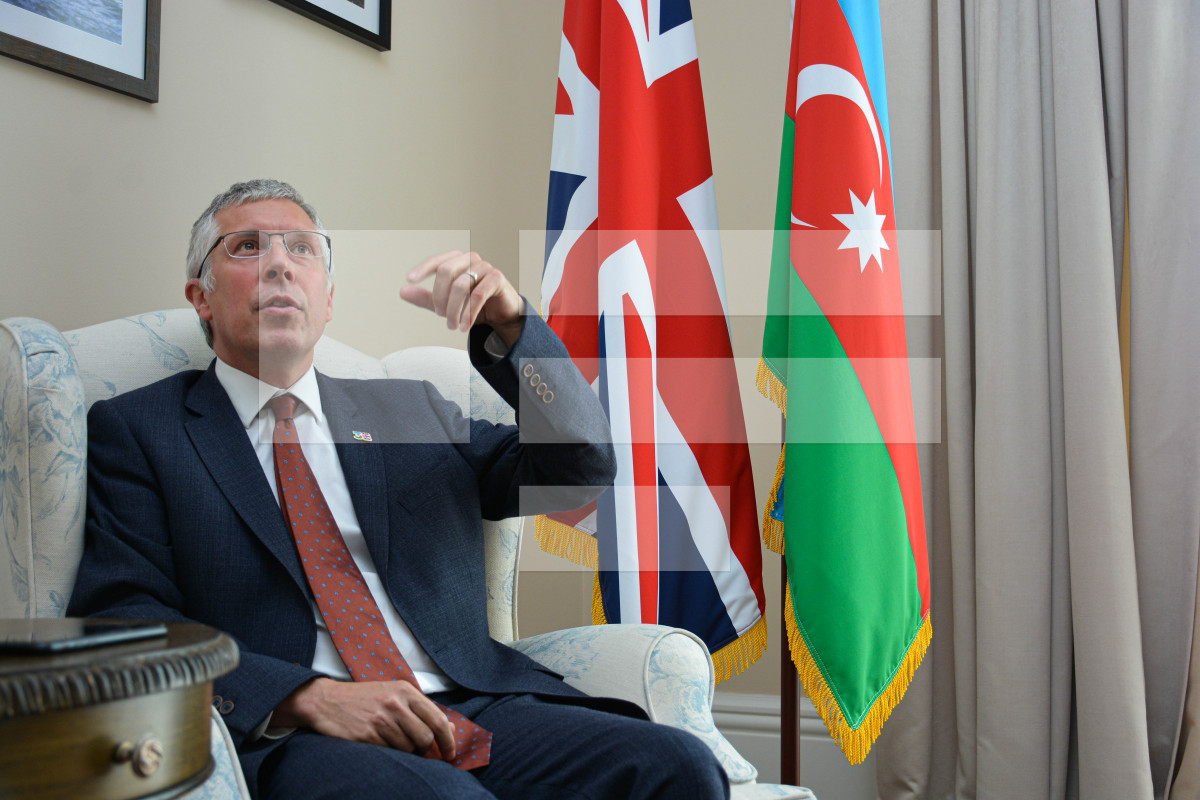
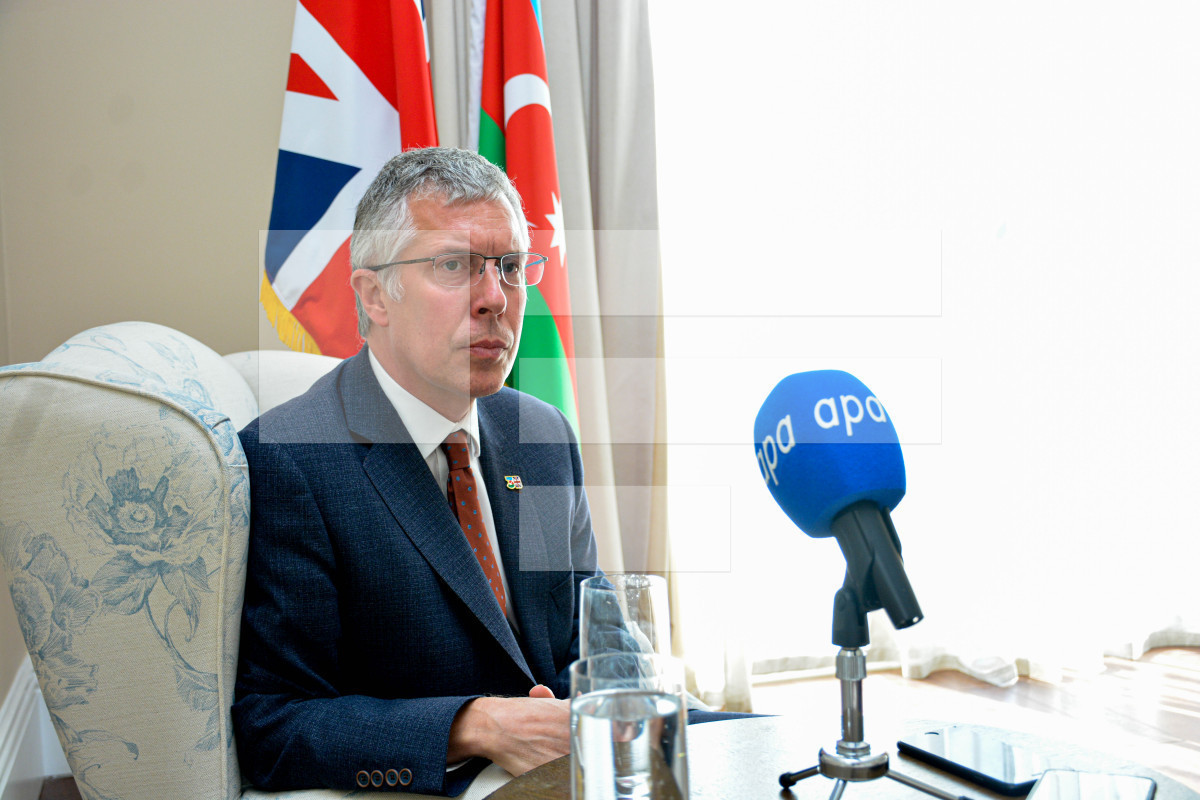
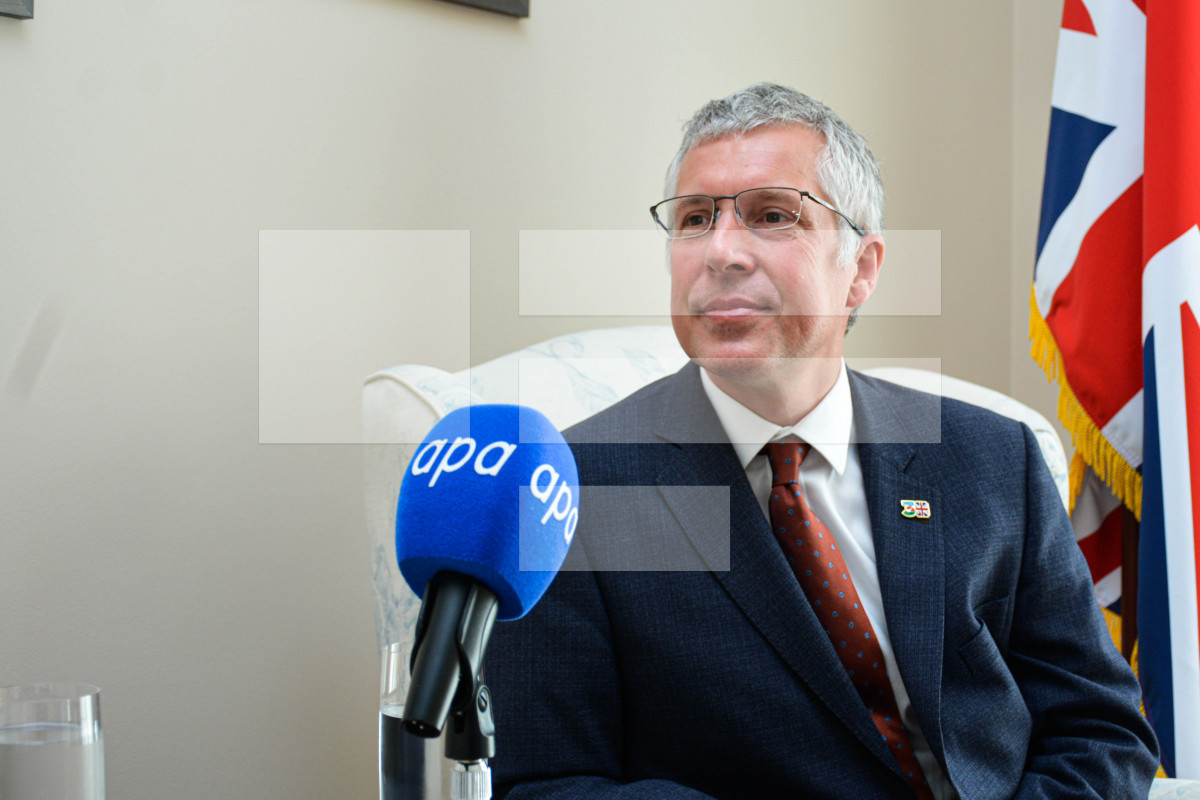
Newly appointed Ambassador Extraordinary and Plenipotentiary of the United Kingdom of Great Britain and Northern Ireland to Azerbaijan Fergus Auld was interviewed by APA
– You are new in Azerbaijan, I mean your appointment as a diplomat to this country. What will be your priorities as a diplomat in the coming years in Azerbaijan?
– That is great for the first question. I will start if I may by telling you a little bit about my arrival here. So, first I came to Azerbaijan in January, I spent six weeks in Ganja learning Azerbaijani I stayed with a stay-home family there. I ate local food, I spoke Azerbaijani as much as I could all day, and I had four-hour of lessons each day. So, that was an amazing experience to first come as a student, to first come to a country outside of the bubble that the capital city sometimes can be, to travel a bit to Tovuz, to Mingachevir, to Goygol, to Shaki, to Zagatala, so to see a bit more of the country.

I think it is particularly poignant to be speaking to you about Ganja today. Of course, it is two years since the first rocket attack on Ganja during the 44-day war. When I was in Ganja I saw the sides of some of that destruction. So, I think one thing is to say, to pass my condolences to people who lost someone during those attacks and to remember that on this particular day.
So I then came back to Baku, Azerbaijan at the very beginning of September, I have been here for five weeks. I feel as if I have been very warmly welcomed by people here, I have very much enjoyed my first few weeks. It is amazing to me to meet people every day who make people-to-people connections between Azerbaijan and the United Kingdom. So on Friday, I met a British chef, actually a Scottish chef, someone who has worked in "Michelin Star" restaurants both in Scotland and in England and he is here working with the Culinary Association of the School of Azerbaijan. And he is training young Azerbaijani chefs in internationally recognized UK qualification. He is training them to take part in the world chefs competition in Switzerland this month. It is like the Olympics for chefs. And it is just one of the so many examples of the connections between Azerbaijan and the UK people-to-people level which for an Ambassador are like "gold dust".
These are the things that are really special that goes beyond and I will get on to my kind of priorities, of course, but as an Ambassador part of what you are doing is passing messages and building understanding between governments but actually, as an Ambassador it is much more enjoyable, it is much richer where you have these wider links. And so I see part of my role as helping to explain a country that still is an undiscovered treasure for lots of British people, - "keşif edilmemiş xezine" between our countries. And actually, there is a wonderful new documentary which has been produced by British historian Bettany Hughes which I think is gonna be shown both in Azerbaijan and in the UK quite soon. It is an hour-long documentary about Azerbaijan.
So helping people understand a little bit more about Azerbaijan is important for me, helping Azerbaijani people know a bit more about the UK is important for me, and building those links wherever we can. Probably the greatest honor I have had in my first five weeks here in the country was when His Excellency President Ilham Aliyev came to the British embassy to sign the condolence book for her late Majesty Queen Elizabeth II.
 It was a great honor for the first time in 20 years as the President visited the Embassy. We talked about two times that he had met her Majesty in 1998 and 2009. We talked about the broad smile on Her Majesty's face when she received the gift of a "Karabakh horse" at the Windsor Horse Show during her platinum jubilee celebrations this summer. Obviously, sadly now one of the final public appearances she made. But there is a beautiful picture of her receiving that horse with joy on her face. So, to be able to share that with the President even before I have presented my credentials to him and to see that is just one of the other person-to-person, high-level person-to-person links, but a person-to-person link nonetheless is very special.
In terms of my priorities here and priorities for the Embassy, there are five priorities that I would highlight. Because I am a simple person, in order to remember those better I have an alphabetical order. So, "A" is for Azerbaijan. "B" is for business. Of course, the trade and investment links between our countries are very important. The UK over the thirty years of our bilateral relations has been the single largest foreign direct investor in Azerbaijan. BP alone in that time has invested 84 billion dollars and of course, it is particularly in the energy sector. Since that trade and investment links have been developed. We know just as Azerbaijan's government knows that it needs to diversify its economy beyond oil and gas, still a very large proportion of the economy here. And so we have identified through our joint intergovernmental commission six sectors of the economy that we want to help grow and we think that there are particular interests for British business for mutual benefit in. Those are health, security, agriculture, clean energy, and two more which I will remember at some stage. So, we see beyond oil and gas is very important. I thought it was very striking at the ceremony in Bulgaria a couple of days ago where president Aliyev spoke at, he was speaking about the 167 GW potential of offshore wind here. As well as, oil and gas which is a much bigger story of today's energy exports. The UK was very pleased to support the World Bank IFC survey that identifies that potential and as I understand the two windiest places on Earth are the North Sea and the Caspian Sea, there is a natural partnership that we can have in that area. So, Business is "B".

The "C" is climate change and energy security. For the next few weeks as the UK is still the president of COP2026, the international climate negotiations. This is a year in which in the UK we have seen the highest temperature ever recorded over 40 C degrees in England. We have seen the worst European drought in five hundred years, we have seen the terrible floods that have put a third of our mutual friend and partner Pakistan under water. So the impacts of climate change are all around us. And we, therefore, think that working together and what is one of the world's great crises is very important. We were very pleased that Azerbaijan came to COP26 and signed up to 11 of the key pledges for we were helping to negotiate there. We would like to see Azerbaijan do a little more, we believe that the thirty percent target on renewables by 2030 is a serious one, and we think that Azerbaijan to help build international momentum, a new more ambitious nationally determined contribution and it would be wonderful if it was possible to do that before COP 27 starts in Egypt next month. One of the important pledges that Azerbaijan signed up to with its own methane probably the most damaging of all greenhouse gases and one that given Azerbaijan's oil and gas industry one that can certainly make a contribution.
But as said the "C" was climate change and energy security, they are just as I mentioned, with the signature of the new IGB, the opening of that on the 1st of October is once again an indication of the very important role that Azerbaijan plays for European energy security that has been more important than ever. In a year in which Russia is looking to weaponize energy supplies and to have stable, reliable friends supplying energy is tremendously important for Europe. I think your Energy Minister who is the Azerbaijani co-chair of our joint intergovernmental commission has spoken very powerfully about looking beyond oil and gas to Azerbaijan as a source of renewable energy for Europe not just for Azerbaijan and that is an ambition I really welcome.

The "D", there are three "D"s, actually: the first is de-mining. As you may know, the UK was the first international partner supporting ANAMAs work, clearing land mines in recovered territories we see that as a tremendously important program, probably the single most important program that we are supporting Azerbaijan at the moment. As well as the funding that we are giving through UNDP to clear mines because the UK has a significant amount of expertise both in our civil society organizations and our business, we are very pleased that there is a very strong UK history in terms of mine action here in Azerbaijan and we look forward to doing more on that.
"D" is also for drugs where in recent years we have been stepping up our cooperation with the State Border Service of Azerbaijan looking to identify and interdict drugs coming across Azerbaijan's southern border, particularly heroin coming from Afghanistan but also increasingly metan-phetamins as something that clearly is gaining very much our mutual interests to tackle.
And "D" is also for defense. So, we have so many years helped to develop Azerbaijani officers in terms of a number of areas that can help them to be effective, not least as one of NATO"s partnerships for peace and international deployments, some of those have included in also in mine actions, in English language training where of course, it is a key capability in order to be able to do more internationally. And I hope that is an area that we will be able to continue to develop in my time.
"E" is for education. That is partly about English teaching in Azerbaijan, and partly about training English teachers in Azerbaijan through the British Council we have been doing both direct teaching and teaching the teachers for a number of years. We also through the British Council run a number of exams both in the English language but also a number of other professional skills and we see both English language, and professional skills key for the aspirations of the next generation of Azerbaijani talent. We want to help develop that, that is clearly Azerbaijan's interest. We also are delighted with the number of Azerbaijanis choosing to study in the UK. We support through the Chevening scholarship scheme that for the last decades has supported almost two hundred Azerbaijani students to do master's degrees in the UK. The first event I held in this residence in my second weekend in the country with them, farewell and say good luck to nine Chevening scholars who are studying right now in the UK. And we are very excited that I think we do not have exact numbers but I think it is going to be dozens of tens of Azerbaijani students under the new state scholarship scheme are also studying across the UK. I think that is a tremendous thing that such a high proportion of scholars going internationally are going just to the UK. We think that shows both the world-class universities we have in the UK but also the recognition the UK is a diverse welcoming country for Azerbaijanis to come and study in. So I look forward to carrying that on.

The final of the five areas is "G". That is "G" for gender. And we have a particular focus on women peace and security. I was in an event the other day supporting 8 different Azerbaijani civil society organizations working under the women in peace and security umbrella. I am delighted that with our support there are the first all-female land-mine clearance teams working in the recovered territories. We are also supporting women's economic empowerment in various ways. So that "G" for gender is also something that we feel we are able to work hand in hand with the Azerbaijani government on, there is a very strong gender element to the government zone reform program, and there are a number of bilateral and multilateral partners that we have, they are also working in this area. That is also an area that I am really glad to be able to champion in my time here.
So, I think that are five areas: "B" for business; "C" for climate change and energy security; "D" for de-mining, drugs, and defense; "E" for education; "G" for gender.
There was a statement recently saying what I know is a very typical official language that the level of relationship between Azerbaijan and the UK was already at a satisfactory level. For me, satisfactory is like saying maybe three out of five, I want to see our relations at a level that is beyond satisfactory. I really believe that right now we have a very good relationship, I am really pleased to come as the Ambassador to a country where there are so many different aspects to the relationship including our very strong relations at the highest level. I believe there is the potential for more, I believe there is the potential for growth in the relationship that can be wider, can be deeper. For four years I am going to be Ambassador here, I believe that we will be able to take the relationship to the next level.
 – In your answer about priorities you mentioned de-mining. Independent experts say to clean completely these territories from land mines will take several decades and will require a lot of finance. In the future will the UK help Azerbaijan to deal with this issue?
– The first thing I would say is I really recognize what I see is almost the national project of getting people back to their homes, getting people back to their farms, I am very conscious that there are seven hundred thousand IDPs waiting to get back home. An essential first step of that is for them to feel that they are able to return to the land that is safe. That is why we were delighted to be the first international partner for ANAMA. We have given a million pounds so far, funded through UNDP in order to clear those mines. As I say, as well as direct aid contribution, we also see that in order to clear those mines at the speed and the scale there is needed it is going to be an effort that requires not just UNDP but civil society organizations both domestic and international. It is gonna require commercial expertise so businesses working in this area because it is a simply massive project, a massive mission for the country and the international community. And we will continue to see how best we as the UK can support that effort.
– I would like to ask about the British position regarding the normalization and peace process in the South Caucasus. Given that Britain's allies, the United States and the EU, have recently been actively involved in the process.
– We welcome everywhere that is bringing Armenia and Azerbaijan together to have meaningful negotiations. We were very pleased to see the latest talks in Geneva between Foreign Minister Jeyhun Bayramov and his Armenian counterpart. We were pleased to see Hikmet muellim and his Armenian counterpart in Washington last week at the meeting chaired by Jake Sullivan in the White House. Most importantly, I think we're pleased to see the most recent discussions between President İlham Aliyev and Prime Minister Nikol Pashinyan in Brussels at the end of August. So, for us, the most important thing is to see that the future is through dialogue, the future is not through further violence. And where proactive, meaningful progress is made through those negotiations that is what we particularly want to see. The UK is not directly participating in talks but we stand ready to help anywhere we can bring those sides together. We have relations both with Azerbaijan and Armenia, and we will continue to encourage on both sides progress where we can. Clearly, there are a number of different strands to those negotiations and I think what people want to see is meaningful progress on all of the strands of those negotiations. So that the momentum is clearly toward a comprehensive peace agreement.

– A new government cabinet was formed in Britain. What can we expect from the foreign policy of the new government, in particular regarding the South Caucasus?
– That is a really good question. So, as you say it is a very new government, it is a government that has said its number one focus is on economic growth in the UK. This has been a difficult year in the UK just as has been in many countries around the world with high inflation, particularly in energy but also in food. And so the government, PM has said that her number one priority is dealing with the economic challenges in the UK. But the PM has also been very clear from the beginning. She spoke to President Zelensky last week for the first time, of course, she comes having been Foreign Secretary immediately before. So she knows very well the international agenda, but she has been very clear that the support that the UK has given to Ukraine's political, military, and humanitarian support will absolutely continue. If you put all of the different elements of support that we have given to Ukraine together it is almost 4 billion pounds this year alone. I actually have just come from an introductory meeting with the Ukrainian Ambassador. And I am very proud as a British diplomat of the support that we have been able to give but also humbled by the bravery and heroism of Ukraine's people given the brutal, barbaric invasion that they are currently facing.
In terms of the South Caucasus more broadly, we have a new Europe minister within a very few days of his appointment I was very pleased that he was able to speak to Foreign Minister Jeyhun Bayramov, we have between the UK and Azerbaijan strategic dialogue on foreign policy and security issues and we are hopeful that we will be able to host Foreign Minister Bayramov in the UK for next round of that dialogue in the next few months. Europe minister Leo Docherty is also very keen to visit the region as soon as he can. In order he really gets to understand the situation here first hand. So we are hopeful we will also be able to welcome him here within the next few months

– After the Russian war in Ukraine opinions about the mediation of Russia between Azerbaijan and Armenia, and the peacekeeping forces of Moscow in the region changed, I would say a lot of negative views on that. I would like to ask your opinion.
– Well, I think it is certainly true that terrible strategic mistake that Russia has made invading Ukraine. You have to remember that a year ago we were seeing the sign of invasion was imminent, we were warned that it would be a strategic mistake to invade and I am sad to say that, that is exactly the way that we are seeing things on the ground. So I think that has called into question Russia's actions not just in Ukraine but in countries across the region and internationally whether it is able to operate as an honest broker, as a peacemaker in other parts of the world as well. I was shocked to see within my first two weeks in the country the scale of causalities on both the Armenian and Azerbaijani sides deeply saddened by that and my meeting both with the President and with the Speaker of Parliament when she went to London for Her Majesty state funeral, Mr. Docherty's phone call with Foreign Minister Bayramov, we have all wanted to express our condolences towards families and people who knew people who died, a terrible new loss of, a needless loss of lives. I think the key thing is for everyone as you said, this region the instability in this region has not helped anyone over the last few decades, it is a region with tremendous potential, it is a region of great strategic and economic importance, and it is a crossroads between East and West, between North and South and the only way in which region"s potential will be found is if there is lasting peace and stability that is what is in everyone's interests, it is in the interest of people in the region itself even more than it is in the interest of the UK. But we as a friend of Azerbaijan very much want to see that.
– Western officials say that Europe also suffered in this war. Recently, I read the interview of NATO Secretary General where Stoltenberg said that the Europeans are also paying a price in this war: inflation, rising energy prices, food crisis, etc. while Ukrainians are paying for it with their lives. I would like to ask what British society thinks about this, until when they are ready for paying this "price"...
– It is a really good question. It speaks to what I said before. My last foreign posting before coming to Baku is Moscow. I was in Moscow from 2011 to 2014, which means I was there the year that Russia illegally annexed Crimea and invaded the Eastern part of Ukraine to speak plainly.
 The UK from 2015 onwards has been supporting directly the development of the Ukrainian armed forces. So that seven years of support we think is evident in what the incredibly brave armed forces of Ukraine have been able to achieve. Of course, in 2022, the nature of our support has accelerated and developed and we can only play a supporting role. It is not just the armed forces of Ukraine but men, women, and children of Ukraine who are paying the price for Russian aggression and we are supporting in the ways we can. We are also, I have to say, very supportive, and again having just spoken to Ukrainian Ambassador this morning, we really welcome the humanitarian support Azerbaijan has been able to provide to Ukraine. That is not one of the things, that is something that continues now, we thought the statement that your President gave on the National Day of Ukraine highlighting the importance of Ukraine's territorial integrity and sovereignty was a very important one. We think it is very important to be calling out Russia on the international stage, there is discussion in UN General Assembly and we think for all of those countries who want to reject Russian aggression it is important to make their voices heard. We, of course, understand Azerbaijan's own history and the importance of territorial integrity and sovereignty and the times fighting in order to defend that. Your question is a good one. It has been a very difficult year in the UK, the economic indicators at the national level how British people are experiencing, the global energy crisis, the food crisis, the inflation at levels that we have not seen in 40 years in the UK. So, it has been a hard year, people are nervous about the hard winter ahead of them. I think that is undeniable. But I think there is popular support for the people of Ukraine, the terrible things that are being done there and continue. As a small thing, we are very pleased that next year, of course, it was Ukraine won the Eurovision song contest this summer, narrowly beating the UK into second place, we will be able to host on Ukraine's behalf the Eurovision song contest next year. And I do not want to trivialize the situation there but I think that is one of again those people-to-people links that shows the real bond has been built between the British and Ukrainian people. We have issued 176000 visas to Ukrainians this year looking to escape the fighting. That is a huge number but the fact those people are being warmly welcomed in the UK just shows that we understand that this is not a war Ukraine is making.

– You touched upon the illegal annexation of Crimea and the war in Donbas in 2014, before that Russian "record" in Georgia in 2008, as well. There is a widespread view that both in 2008 and 2014 the West kept its calm, and we did not notice a serious reaction to Russia's actions such an approach by the global community has prepared the ground for 2022. What do you think?
– I would not say that we were silent. I think that as a diplomat it is always important to be humble, to recognize as we look back on history that if we had a time game we might do things differently. I would not say that we were silent in 2008 or in 2014. I remember in 2014 being part of the effort in Moscow looking to galvanize international action, in opposition to what was happening we did implement sanctions then. But you are right the level of sanctions that we have implemented in 2022 is unprecedented in the history of our sanctions regime they have gone further, they have been devastating for parts of Russia's economy, and with every new round of Russian actions most recently the ridiculous sham referendums that were held in the four regions of Ukraine last week, there was another wave of sanctions that the UK was part of. Of course, we recognize that sanctions are only effective when they are organized together with our international allies and partners. And I think what is really changed since 2008 and 2014 is not just that the UK has understood the situation and we were always, I think, one of the more skeptical about Russian intentions but the scales of fallen from people's eyes, there is recognition across Europe, across the Americas, across the world the Russian aggression and really dangerous destabilization, Russia has embarked on is more widely understood. And that is why we are seeing an international, global reaction on a different scale.

– President Putin announced partial mobilization in the country, "referendums" were held in territories of Ukraine controlled by Russia, Kremlin is using nuclear rhetoric. Considering all this will Ukraine's allies, including Britain, increase their military assistance to the country?
– I think the first thing is to say that the sham referendum, and mobilization, I would not add the "partial" to the beginning of that, I think that just as in the Russian narrative there is a "special military operation" rather than a war. I think what we are seeing in terms of hundreds of thousands of Russians looking to leave the country that is a sign that they understand the "partial" mobilization is something more worrying. The referendums, mobilization of people, and some of the rhetoric is a signs of weakness rather than strength. It is a sign that Putin is losing a war rather than winning it, we are seeing every day new evidence of the effectiveness of Ukrainian armed forces which we are pleased to support. So you know we take the threat Russia poses very seriously we absolutely refute the appropriateness of nuclear rhetoric but we take it seriously. The UK and all NATO allies have been absolutely clear about our commitments to support and defend every inch of NATO soil. But our support for Ukraine is for now and for the long term. We will continue to provide that support in all the ways we can.

– My final question, is about relations between the UK and Russia. Relations between Britain and Russia are currently at an all-time low. Russian society is also blamed for this war because they did not prevent it. I would like to ask about Russian-British relations and relations between societies in the future.
– I mean it takes an almost full circle of our conversation because those links between peoples are really important too. It is absolutely critical that this is understood as Putin's war, this is a war that he has prosecuted with the support of many people in the Russian elite but our fight is certainly not with Russian people, there are deep, longstanding connections between Russia and the UK, people-to-people level. When I was in Moscow in 2014, we had just begun a year of the UK - Russia language, and culture, before we had been even able to complete our first event of the year of activity, we had a seizure of Crimea that year was canceled. But I know all of the links exist between the UK and Russia. Russia is a great country, is a great civilization by grew up as a literature student, and a lover of Russian classic literature when I spent my three years in Moscow I loved going to the opera, and ballet, and I am a deep lover of Russian culture, I have many Russian friends. That is why so sad to see not just what is happening in Ukraine, but what is happening in Russia right now. The speed at which Russian people themselves are being oppressed and the speed in which that country is being made turn the worst, all this is very disappointing and is very sad for people who have left the country.
Note: The interview with the British ambassador took place on October 4.
Photo - Orkhan Karimov © APA Group


 Follow us on Telegram
 t.me/apanewsaz
 Follow us on Instagram
 Follow us on TikTok
 Follow us on Facebook
 Follow us on X