










Baku-APA. The most destructive wildfire in U. S. state of Colorado’s High Park has taken the back seat to the Waldo Canyon fire, terrifying residents 150 miles (241 km) to the south near the state’s second largest city, Colorado Springs, where firefighters are scrambling for cover and looking to the heavens for relief, APA reports quoting Xinhua.
"This one’s like a freight train and we can’t stop it ... we can only get out of its way," said Steve Segin, U.S. Forestry service spokesman.
Segin said the fire is only 5 percent contained and 65 mph (105 km) winds Tuesday doubled its size overnight to 15,786 acres, triggering evacuations of more than 32,000 people, including all non-essential personnel from the nearby United States Air Force Academy. On an aerial inspection, Colorado Governor John Hickenlooper called the scene "a war zone."
"We had a large scale evacuation last night to Fort Carson, more than 2,100 residents," said Harry Lundy, public affairs specialist for the Air Force Academy. "Smoke was everywhere and it was no time to hesitate," Lundy said, noting that no aircraft have yet been moved from the Air Force’s sprawling 18,000-acre campus north of Colorado Springs.
Nearby Denver has seen temperatures above 100 degrees Fahrenheit, (37.78 Celsius) for a record five straight days and 105 f (40.55c) on Tuesday. Combined with the driest spring on record, fires are seemingly erupting out of the ground. A total of 10 "large" fires are burning simultaneously across the state.
"It’s hard to keep track of them," Segin said.
With local headlines reading "Colorado’s On Fire" and Gov. Hickenlooper saying the ground looks like a scene from "the worst movie imaginable," more than 10 new fires are being reported daily, according to the U.S. Forestry Service.
The record-breaking, 19-day-old High Park fire west of Fort Collins has consumed local resources with more than 1,800 fire fighters and 30 firefighting aircraft. It has torched 257 homes and 87,285 acres, and cost 33 million dollars in losses thus far. As of Wednesday, it was 65 percent contained.
The "little" Colorado fires, not receiving national attention, are almost too many to count, with 10 new incidents being reported daily and causing officials’ heads to spin. Each is classified as having "extreme" growth potential.
In the past few days, 23 buildings were engulfed by flame in the two-day "Woodland Heights" fire near Estes Park. The " Flagstaff" fire has torched 300 acres, is burning out of control and is "zero" contained, located a little more than a mile from the affluent, 100,000 population city of Boulder. The six-day-old "Weber" fire, caused by a lightening strike, has taken 4,500 acres and is only 20 percent contained. The "Little Sand" fire is 11-day old, has claimed 22,000 acres and is only 30 percent contained. These are just a few.
Forest fires are bursting from the ground daily in America’s West almost like a scene from the 1998 blockbuster movie Armageddon, as blistering temperatures and record drought conditions have U.S. Forestry officials thinking the worst is yet to come. To Colorado’s immediate south in New Mexico, the record breaking Whitewater-Baldy fire has destroyed almost 300,000 acres and is still burning. It is 87 percent contained. Fire officials say the entire region is ripe for more "big" fires.
"It’s so dry out there ... it’s like a tinderbox," said Clay Templin, fire chief for Arizona’s massive 3-million-acre Tonto National Forest, who are currently fighting two active "big" fires, "Poco" and "Sunflower," totaling about 30,000 acres. Arizona fire officials still have vivid memories of last year’s nightmare 538,000-acre, record "Wallow" fire.
"We get fires every year, but this year has been extraordinary, " Templin said. "Our burning indices and our energy release components are at record highs. We’re one big fire away from breaking our worst season for the third year in a row."
Even with the summer monsoon season moving into America’s Southwest bringing cooler, more moist weather, fire officials are not convinced the weather will bring relief, due to the overall dryness of the region.
"We’re bracing ourselves now for ’dry lightening,’ coming soon, and under these conditions, very dangerous," Templin said. Origins of the fires vary greatly, from routine causes such as " human" and "lightening," to uncommon sources, such as flat tires, gunfire, downed power lines and chains dragging behind cars.
Next to Colorado, neighboring Utah is seeing the greatest active fire activity with "Wood Hollow," 40,000 acres and 15 percent contained; and the three-day-old "Church Camp" fire, consuming 4,000 acres so far and "zero" containment.
"We’re fighting these with all of our resources, but we had a record low snow pack this year, and that’s increased dryness incredibly," said Louis Haynes, public information officer for Utah’s 1.4-million-acre Ashley National Forest.
Everybody in America knows that "Four Corners" is the place in the West where the states of New Mexico, Colorado, Utah and Arizona come together in one perfect point, the only such four- state spot in the country. But until this year, all four states were not involved in a rash of simultaneous fires that are occurring today.
"It’s a strange coincidence," said Ed Delgado, of the National Predictive Services Subcommittee. "But the heat and drought conditions are similar in the ’Four Corners’ region, despite the different geographical locations."
New Colorado fire evacuates 32,000, U.S. Air Force Academy

 28 June 2012 04:16 (UTC +04:00)


 İDMAN XƏBƏR
 Follow us on Telegram
 t.me/apanewsaz
 Follow us on Instagram
 Follow us on TikTok
 Follow us on Facebook
 Follow us on X
Americas

33 people rescued, thousands still missing after Venezuela quakes
22:44
 28 June 2026

Venezuela quake death toll rises to 1,430
10:00
28 June 2026

Trump threatens more military action against Iran if strikes continue
03:52
28 June 2026
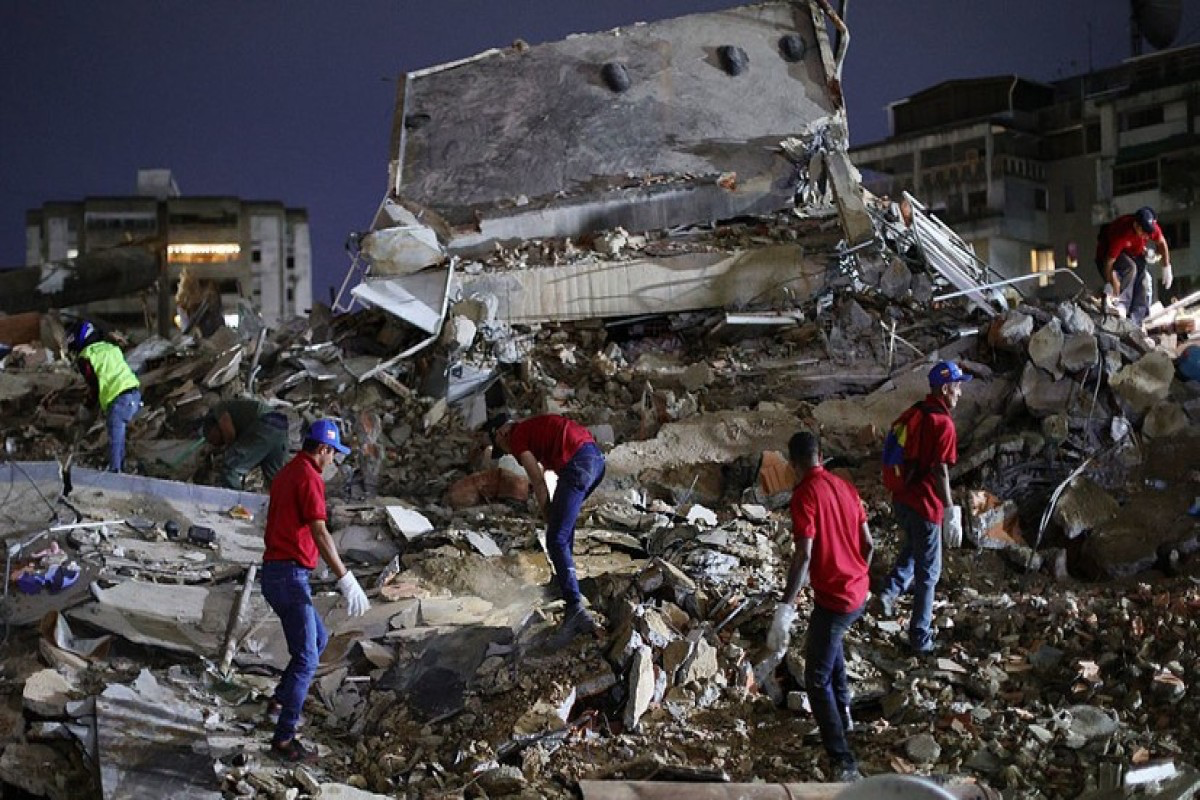
UN: Venezuela earthquake could affect more than 6.7 million people
02:44
28 June 2026

NEWS FEED
Türkiye says Israel using 1915 events decision to cover up crimes against Palestinians
23:20
28 June 2026
33 people rescued, thousands still missing after Venezuela quakes
22:44
28 June 2026
Qatari citizen died from shrapnel wounds on board ship
21:54
28 June 2026
Russian President held meeting on fuel supplies for domestic market
20:50
28 June 2026
Starmer could run for NATO Secretary General
20:33
28 June 2026
Azerbaijani MFA expresses condolences over helicopter crash in Saudi Arabia
19:03
28 June 2026
Mutual attacks between Iran and the US are increasing – LATEST SITUATION
17:13
28 June 2026
Israeli government unanimously votes to recognize the so-called "Armenian genocide," bill to be submitted to Knesset
15:06
28 June 2026
Another wheat shipment transits Azerbaijan from Russia to Armenia-PHOTO
13:06
28 June 2026
Venezuela quake death toll rises to 1,430
10:00
28 June 2026
IRGC says it struck U.S. military infrastructure in Kuwait and Bahrain
09:34
28 June 2026
Trump threatens more military action against Iran if strikes continue
03:52
Audio
28 June 2026
UN: Venezuela earthquake could affect more than 6.7 million people
02:44
28 June 2026
US launches more strikes against Iran
02:17
Audio
28 June 2026
Britain has zero active submarines at sea for now
02:00
28 June 2026
Israel will withdraw troops from two areas in southern Lebanon on June 28
01:48
28 June 2026
Netanyahu announces plans to form broad national government after elections
01:30
28 June 2026
Argentina cabinet chief resigns after corruption allegations
01:20
28 June 2026
Magnitude 5.4 earthquake struck Venezuela
00:56
28 June 2026
Netanyahu: Deal says Israel can keep security zone as long as needed
23:53
27 June 2026
UFC Baku: Rafael Fiziev defeats Manuel Torres in main event
23:14
Audio
27 June 2026
UFC: Abus Magomedov defeats Mikhal Oleksiychuk
21:22
27 June 2026
UFC: Farman Hasanov defeats his opponent from the United States
21:11
27 June 2026
Wheat to be shipped to Armenia via transit through Azerbaijan
19:53
27 June 2026
Jeyhun Bayramov and Hakan Fidan hold phone conversation
19:04
27 June 2026
"Caucasus Eagle 2026" exercise concludes-VIDEO
18:43
27 June 2026
Tremors jolt Delhi-NCR, Kashmir as magnitude 6.2 earthquake hits Afghanistan
18:37
27 June 2026
Tanker hit by unidentified projectile in Hormuz, British maritime agency says
16:54
27 June 2026
Russian Defense Ministry claims two Ukrainian MiG-29 fighter jets destroyed at Mykolaiv airfield
16:51
27 June 2026
Iran accuses U.S. of violating two clauses of memorandum
16:48
27 June 2026
Service chief: Lowering military conscription age limit has reduced state expenses
16:09
27 June 2026
Ukrainian MiG-29 crashes during combat mission, Air Force says, pilot ejects safely
15:25
27 June 2026
Russia and Ukraine exchange civilian detainees
14:40
27 June 2026
Baku–Nakhchivan flights cancelled due to thunderstorms
14:16
27 June 2026
One killed, 11 injured in Ukraine's attack on Volgograd
13:58
27 June 2026
Bahrain says Iranian drones targeted its territory early Saturday
13:55
27 June 2026
Zelenskyy confirms strike on military plant in Volgograd-VIDEO-UPDATED
13:42
27 June 2026
Kremlin: Putin and Lukashenko continue talks
13:38
27 June 2026
Small aircraft crash in Beijing kills one person, injures 13, local govt says
13:30
27 June 2026
Iran's Foreign Ministry reacts to U.S. airstrikes
11:31
27 June 2026
Leyla Aliyeva and Arzu Aliyeva visit "CandyFest" summer festival and watch "Magic Pearl" water circus show-PHOTO
11:24
27 June 2026
Leyla Aliyeva and Arzu Aliyeva participate in seasonal flower planting campaign on Baku Boulevard-PHOTO
11:21
27 June 2026
Leyla Aliyeva and Arzu Aliyeva attend opening and presentation ceremonies at the Seaside National Park-PHOTO
11:14
27 June 2026
Baltic states urge EU to speed up ban on Russian oil imports
11:07
27 June 2026
Seoul says Chinese, Russian military aircraft enter its air defense zone
10:51
27 June 2026
Gold and silver rise in commodity markets
10:24
27 June 2026
Natural gas falls on New York exchange
10:22
27 June 2026
Azerbaijani oil trades at $74
10:20
27 June 2026
Two police officers killed in armed attack on police checkpoint in Iran
10:15
27 June 2026
Brent oil falls by more than 4%
09:35
27 June 2026


