

The historical heritage of Caucasian Albania, particularly its monuments associated with Christian culture, has for many years been one of the issues at the center of scholarly attention. The question of which historical and cultural tradition the Christian churches, monasteries, and other examples of religious architecture located in Karabakh, Eastern Zangezur, and other regions of Azerbaijan belong to is being studied on the basis of various scholarly approaches.
Ramil Aghayev, Doctor of Historical Sciences and head of the “History of Atropatene–Albania (Caucasus)” Department at the Abbasgulu Agha Bakikhanov Institute of History and Ethnology of ANAS, told APA that information about the Christian heritage of Caucasian Albania is reflected in written sources dating from various periods.
Historical sources on Christian monuments in the territory of Caucasian Albania
According to Ramil Aghayev, information about Caucasian Albania and Christian monuments located within its territory can be found primarily in the Albanian historian Movses Kaghankatvatsi’s “History of Albania,” in the works of Mkhitar Gosh, as well as in Syriac, Armenian, and Arabic-language sources. The historian notes that these sources, including Armenian sources themselves, indicate that a number of monuments were located in the territory of Albania. In these sources, Albania is also referred to as “Aghvan” and “Aluank”:
“For example, the Armenian historian Tovma Artsruni states that the Ktishvank Monastery and Ktish Fortress in the Khojavend area were located in Aluank (Albania). Determining the ethno-cultural identity of any historical and architectural monument is not so simple, and there are no universally accepted criteria in this regard. Nevertheless, there are certain distinctive features, particularly architectural characteristics, that make it possible to distinguish monuments belonging to one people from those of others.”
What place does Caucasian Albania occupy in the history of Azerbaijan?
Ramil Aghayev notes that Caucasian Albania was one of the ancient states that existed on the historical lands of Azerbaijan:
“It managed to maintain its existence from the end of the 4th century BC until AD 705. Pre-Arab authors described in various ways the territory situated between the Caucasus Mountains in the north, the Araz River in the south, the Caspian Sea in the east, and Iberia in the west. In ancient sources it was called ‘Albania’; in Pahlavi sources, ‘Ardan’ and ‘Aran’; in Syriac sources, ‘Aran’; in Georgian sources, ‘Rani’; and in Armenian sources, ‘Aghvan’ and ‘Aluank.’ At certain times, Albania also encompassed a large part of the territory of the present-day Republic of Armenia. Ancient authors, Armenian sources, and Arab sources indicate that it was located in the territory of what is now the north, pointing to its direct connection with our political, cultural, and ethnic history. It should be particularly noted that Arab sources describe Albania (Arran) as a province within Azerbaijan and discuss its prosperous cities, trade routes, and culture.”
The heritage of Caucasian Albania and the question of the attribution of monuments
Ramil Aghayev stated that attempts to present examples of Albanian material and spiritual culture to the international community as “Armenian heritage” are closely linked to the territorial claims of the Republic of Armenia against the Republic of Azerbaijan:
“The territories claimed by Armenians are mainly the western frontiers of Albania. Following this claim, they also seek to appropriate the material and cultural heritage belonging to the region. This inevitably creates the need to discuss Azerbaijan’s western borders. According to Armenia’s claims regarding the Sasanian period, several written sources allegedly show that Azerbaijan presents ‘ethnic Armenian’ cultural heritage and places of worship as the heritage of Caucasian Albania. In its principal document setting out these claims, Armenia refers to monuments in the Karabakh and Nakhchivan regions. In fact, several monuments in the Karabakh and Nakhchivan regions of the Republic of Azerbaijan are presented by Armenians both to their own people and to the international community as ‘Armenian cultural heritage.’ In doing so, Armenians mislead the wider public by selectively presenting scattered facts from historical sources in whatever manner suits them. On the other hand, they refer to Armenian inscriptions on some monuments in the Nakhchivan and Karabakh regions. However, the Armenian language never served as a common means of communication either in the South Caucasus or, more generally, anywhere in the world, whether in the early Middle Ages or during the period of classical feudalism. The Armenian people have always been a people governed by the Church. The works they wrote are also nothing more than fabricated history written by individuals associated with the Church.”
_1789640453.jpg)
Inscriptions on monuments and the issue of ethnic affiliation
Ramil Aghayev stated that some Armenian inscriptions on the monuments were mainly related to religious matters and that it would not be appropriate to determine the ethnic and cultural affiliation of these monuments based on such inscriptions:
“As for some Armenian inscriptions on the monuments, this is purely related to religious matters. Thus, during the process of Islamization, the Muslim population of Albania abandoned the former alphabet and switched to the Arabic alphabet. This soon also affected the Christian population, which had become a minority. Thus, the Christian population of our country strengthened its ties, in one form or another, with the Armenian Church and Armenian clergy based on ‘religious unity’ and Christian solidarity. This, in turn, strengthened the tendency to use a Christian writing system rather than a Muslim writing system in place of the forgotten Albanian script. Therefore, the ethnic and cultural identity of some Christian Albanian monuments cannot be determined on the basis of the inscriptions on them. For example, the population of Azerbaijan used the Arabic alphabet and language for a long time in inscriptions on gravestones and religious monuments. Does this mean that Azerbaijani Turks are Arabs? Of course not. Consequently, the criteria of ‘Christian’ and ‘Muslim,’ which were the main criteria of the Middle Ages, could not serve as indicators for determining the ethnic identity of the population. Taking advantage of this, Armenian specialists speak of an ‘inseparable Armenian-Albanian’ connection in the Middle Ages, attempting to portray them as closely related peoples and subsequently to Armenianize everything. However, medieval sources clearly distinguish Albanians from Armenians and regard them as a separate people. For example, the Syriac author Zacharias Rhetor (6th century) writes: ‘On that northern side there are five believing peoples with 24 bishops... the land... of Aran, which has its own language and Christian people.’ Zacharias Rhetor adds that the language of Aran (Albanian) was distinct from the languages of the other peoples mentioned alongside it. Farida Mammadova writes that the country’s tribes and tribal groups speaking different languages communicated with one another through this language, namely Albanian. Arabic-language authors, meanwhile, repeatedly mention that Albania (Arran) had its own language and that its population spoke the ‘Arran’ language.”
Scholarly approaches to Christian monuments in Karabakh and Eastern Zangezur
Ramil Aghayev noted that the connection between the Christian monuments located in Karabakh, Eastern Zangezur, and other regions of Azerbaijan and the religious and cultural heritage of Caucasian Albania has been studied by both Azerbaijani and foreign historians.
According to the historians X. Hubschmann, J. Marquart, I.H. Aliyev, R. Raisnia, F.C. Mammadova, K.G. Aliyev, T.M. Mammadov, K.V. Trever, R. Goyushov, N. Alishov, G. Mammadova, and other researchers have put forward important views in this field.
Ramil Aghayev states that these studies refer to a number of facts to substantiate the attribution of the monuments to the Albanian-Azerbaijani cultural heritage.
Facts cited by historians
One of the main facts noted by the historian is that the geographical areas in which these monuments are located are presented in historical sources as territories of Caucasian Albania. According to him, the areas where the monuments are situated correspond to the historical geography of Albania, and this factor is of considerable importance in determining their affiliation.
Ramil Aghayev notes that identifying who commissioned the construction of the monuments is another important area of research. According to him, the names of rulers, governors, or catholicoi of Armenian origin are not found among those who commissioned these monuments.
The historian states that some inscriptions on the monuments likewise do not mention Armenian rulers or religious figures. On the contrary, the names of rulers and catholicoi of Albanian origin appear in some examples:
“The architectural and planning style of Albanian architecture differs significantly from that of Armenian monuments. It is known that Armenian architecture largely replicated Byzantine architecture. If one may put it this way, medieval Armenian architecture is a branch of Byzantine architecture. On the other hand, the typical Albanian church plan featuring four- and six-column, three-aisled basilicas is rarely encountered in Armenian architectural monuments. Albanian and Armenian crosses differ from one another. Therefore, as early as the Soviet period, Armenians began removing religious elements from monuments in Karabakh that indicated their affiliation with the Albanian cultural heritage. During the 30-year occupation, this ‘cleansing’ operation continued at full intensity. Gravestones erected in memory of the deceased and bearing images of crosses, namely cross-stones (khachkars), should not be overlooked either. Many inscriptions on the khachkars indicate that those buried there included people who had come from the ‘land of Aluanak,’ as well as from other places.”
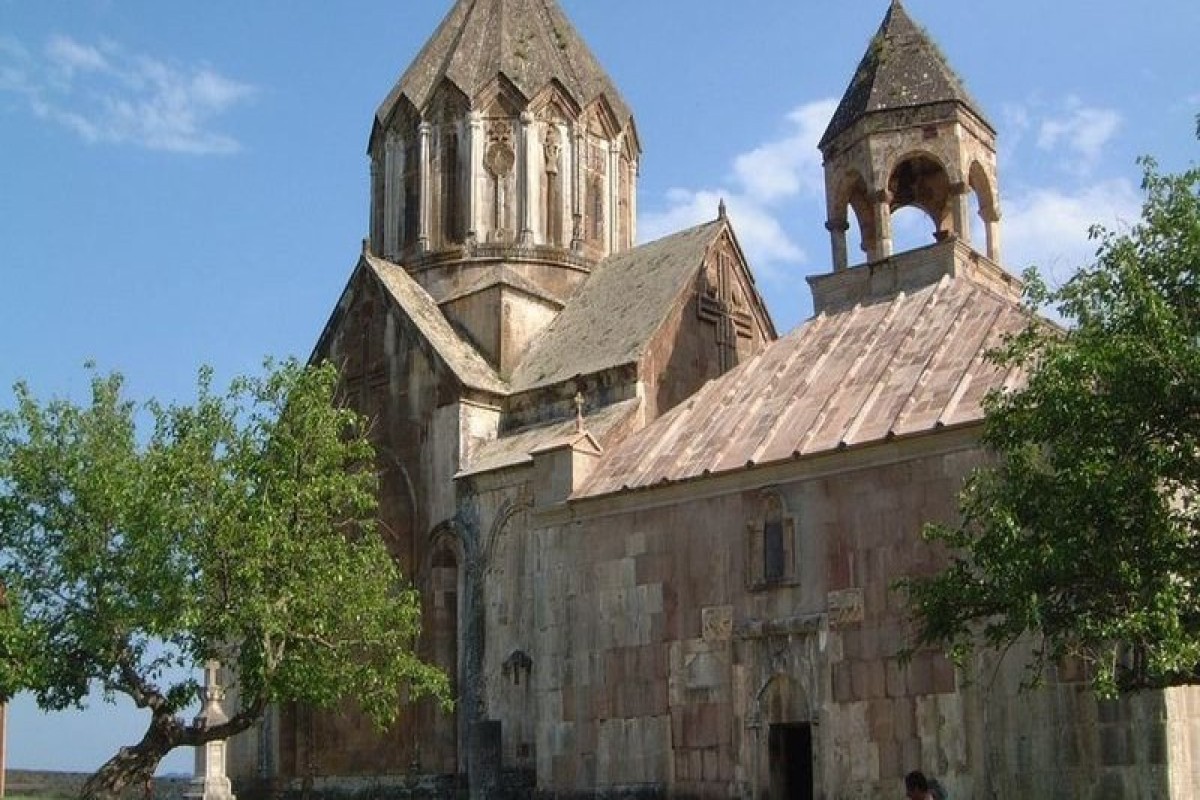
Hasan Jalal’s name is particularly associated with the Ganjasar Monastery
The historian also spoke about the Ganjasar Monastery. He stated that Ganjasar Monastery is one of the most important monuments associated with the Christian heritage of Caucasian Albania: “The monument is located near the village of Vangli in the Aghdara region of Karabakh. Built in the 13th century by Hasan Jalal, ruler of Khachen, the monastery was one of the religious and political centers of the Khachen principality. The monument is currently located within the territory of Azerbaijan and is presented as an example of historical and cultural heritage protected by the state. Following the collapse of the Albanian state, Islam and the political influence of Muslim states began to grow stronger in the region. During this period, some Christian communities, mainly settling in mountainous areas, sought to preserve their religious and political institutions. In the Middle Ages, various small principalities emerged among Christian communities living under the rule of Muslim states in the territory of Azerbaijan. One of these was the Khachen principality, which experienced a period of ascendancy in the 12th–13th centuries. The best-known representative of the Khachen principality was Hasan Jalal. He was the son of Vakhtang, ruler of Khachen, and played an important role in the region's political life in the 13th century. Although the exact date of Hasan Jalal’s accession to power has not been established, it is known that he headed the Khachen principality in the first half of the 13th century. He died around 1260. Hasan Jalal’s name is particularly associated with the Ganjasar Monastery. Built in the 13th century, this monument is regarded as one of the religious and political centers of the Khachen principality. The inscriptions at the Ganjasar Monastery mention Hasan Jalal by name and identify him as the ruler of Khachen. These inscriptions are said to indicate that he presented himself as a successor to the ancient Albanian political tradition. In this regard, the Khachen principality is regarded as one of the political and cultural centers in the region where Christian Albanian traditions continued after the collapse of Caucasian Albania. Ganjasar is one of the important monuments of the Christian heritage of Caucasian Albania. The Armenian side distorts the historical fact by presenting it as a monument of Armenian Apostolic heritage.”
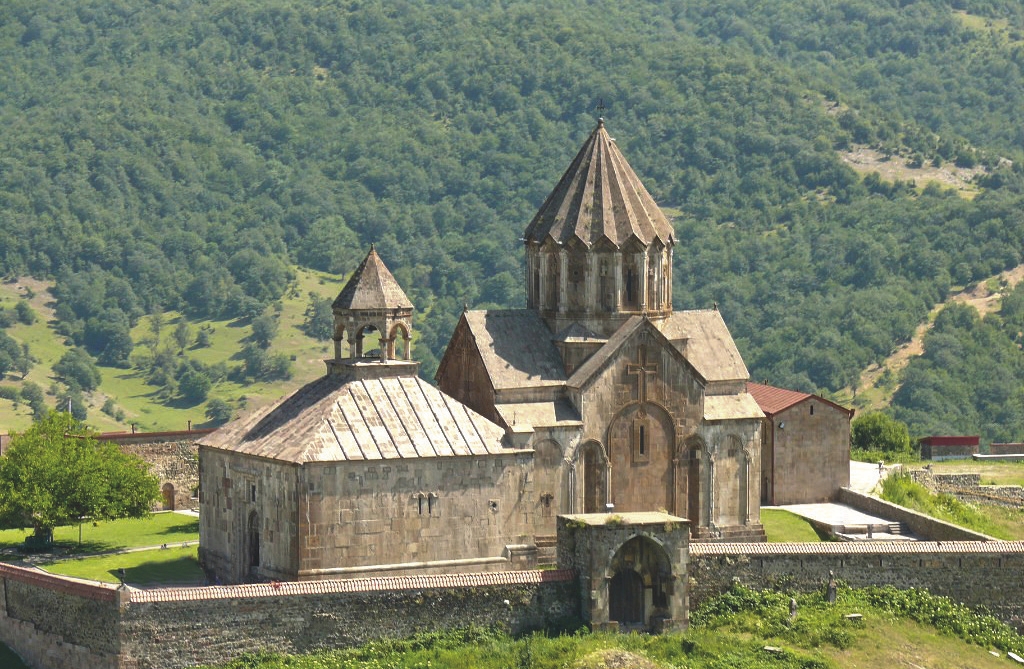
The place of Caucasian Albania’s Christian monuments in Azerbaijan’s historical and cultural heritage
Ramil Aghayev states that churches, monasteries, and other structures presented as examples of the Christian heritage of Caucasian Albania constitute an important part of Azerbaijan’s rich historical and cultural heritage: “Presenting these monuments as Albanian cultural heritage makes it possible to restore historical truths and the actual historical picture. This once again demonstrates that Azerbaijan possesses a rich material and cultural heritage. It shows that all of its ethnic groups, including the Christian community and the Muslim population, participated in creating this heritage. At the same time, this once again demonstrates Azerbaijan’s tradition of tolerance. Thus, the small Christian community that continued to live in a Muslim environment was allowed to preserve its beliefs and cultural values. Together with examples of Muslim material culture in our territory, these monuments demonstrate how rich Azerbaijan’s overall historical and cultural heritage is. These monuments also attest to mutual cultural ties between Azerbaijan’s predominantly Muslim population and its small Christian communities.”


 Follow us on Telegram
 t.me/apanewsaz
 Follow us on Instagram
 Follow us on TikTok
 Follow us on Facebook
 Follow us on X