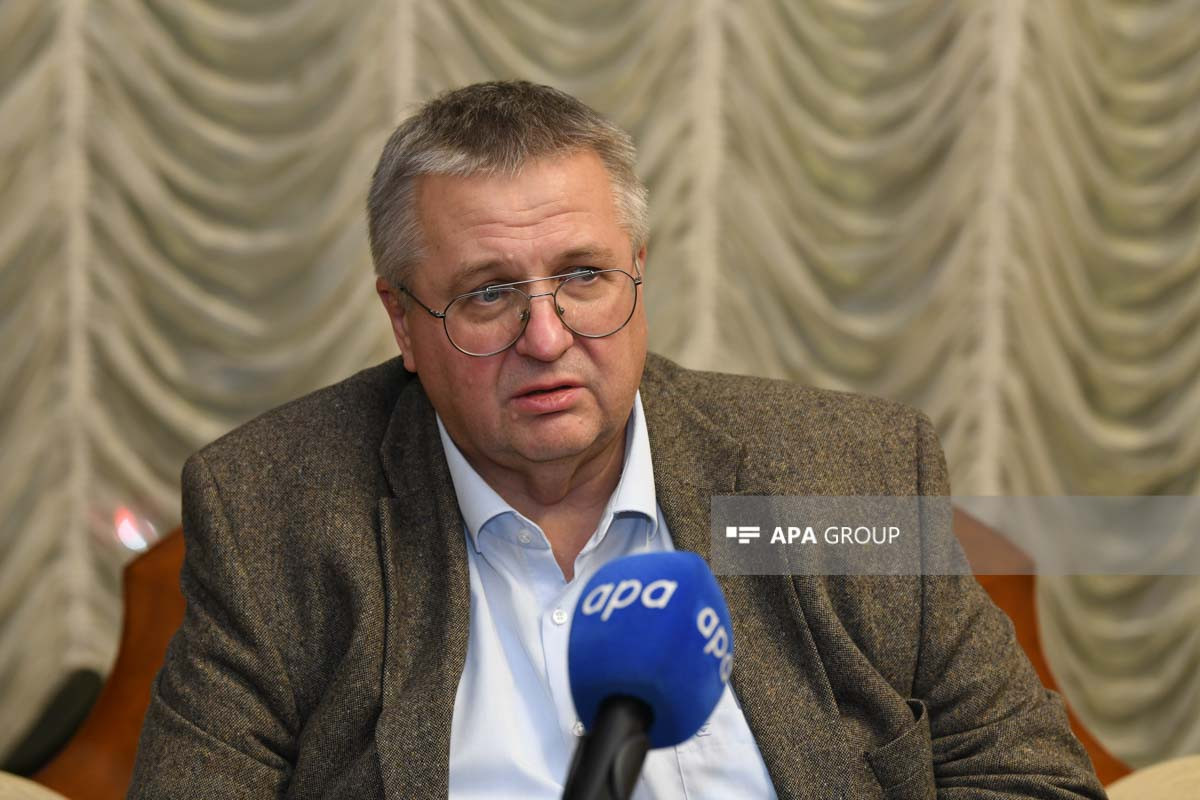

Russia, Azerbaijan, and Iran are interested in the formation of the new North-South International Transport Corridor and its Western route, Russian Deputy Prime Minister Aleksey Overchuk stated in an exclusive interview with APA.
Access to the markets of the Global South
Russian Deputy PM noted that the project covers both rail and road transport. All three countries are making efforts to implement this large-scale project within their territories: “This project is indeed of global importance. Because we are living in a changing world today, the economic center is shifting from the West to the East and South. Therefore, in Russia, we view the North-South International Transport Corridor as an opportunity for Russian exporters to access the rapidly developing markets of the Global South. Of course, we are also interested in importing goods from these countries. For this reason, we want Russian exporters to have a more favorable competitive environment when entering these markets. Azerbaijan and Iran are located in such a geography that it provides us with the shortest route to Asian and African countries, as well as to the Persian Gulf. In fact, we are engaged in the construction of this corridor, this transport route. We have been planning this meeting for quite a long time - approximately half a year, and finally, it has taken place.”

Azerbaijan is making great efforts to modernize its railway infrastructure
Aleksey Overchuk said that during the meeting held on October 13 in Baku between the delegations led by Azerbaijani Deputy Prime Minister Shahin Mustafayev, Iranian Minister of Roads and Urban Development Farzaneh Sadegh, and himself representing Russia, a very extensive exchange of information took place: “Each delegation head briefed the other partners on the initiatives being implemented in their respective countries. We also listened to our sectoral experts and the heads of institutions responsible for various segments of the North-South Transport Corridor. There are certain specific aspects that we recognize, and we understand that to achieve the goals set by the leadership of our countries, appropriate steps must be taken. In particular, we are striving to ensure the transportation of 15 million tons of cargo through the North-South Corridor by 2030. This is a very significant figure, which requires thorough preparation and coordinated action among the three countries. We must understand that the infrastructure along this route must be capable of handling such a volume of cargo. Therefore, we must achieve this common goal together. We can see what work is being done in Russia, Azerbaijan, and Iran. In Iran, together with our Iranian partners, we are working on the construction of a railway line between Astara and Rasht, which is slightly more than 160 kilometers long. At the same time, we know that some bottlenecks along this route in Iran need to be expanded. We are aware that Azerbaijan is making great efforts to modernize its railway infrastructure in order to achieve this major common goal. We agreed to establish working groups at the level of deputy heads of the relevant sectoral institutions to coordinate this work. It was also agreed that we will meet every six months to review what has been accomplished, identify existing challenges, and determine which issues need to be resolved at a higher level to move the project forward.”

Majority of trucks stuck in traffic in Iran had Russian license plates
The Russian Deputy Prime Minister drew attention to Azerbaijan’s efforts regarding the highway section of the North-South International Transport Corridor: “We see that Azerbaijan has made large investments in the highway to ensure the best possible conditions for freight transport from the Russian border to the Iranian border. We see modern roads and modern border checkpoints, all aimed at attracting customers. On the Russian side as well, modern checkpoints are being built, road infrastructure is being improved, and bypass roads are being constructed around cities to prevent freight traffic from entering urban areas. Of course, we are also very interested in ensuring good conditions for our freight carriers on the Iranian side. When we were in Iran today, we saw that the vast majority of the numerous trucks stuck in traffic there had Russian license plates. Naturally, we want these trucks to be able to cross the border more quickly, while observing all safety procedures and requirements. But we are striving to create the best possible conditions for our freight carriers.”

Trilateral mechanisms
Aleksey Overchuk said that during the meetings held in Baku, the sides decided to resolve existing issues in a trilateral format.
“For this purpose, regular meetings will be held, the problems will be identified, and solutions will be found. Therefore, we believe that as a result of the trilateral meetings held yesterday and today, we have managed to form mechanisms that will help transform the North-South International Transport Corridor into an efficient international route in the future. This will encourage carriers to make greater use of the corridor. Russia, Azerbaijan, and Iran are all interested in this. Therefore, we believe that this meeting was very productive,” he concluded.


 Follow us on Telegram
 t.me/apanewsaz
 Follow us on Instagram
 Follow us on TikTok
 Follow us on Facebook
 Follow us on X