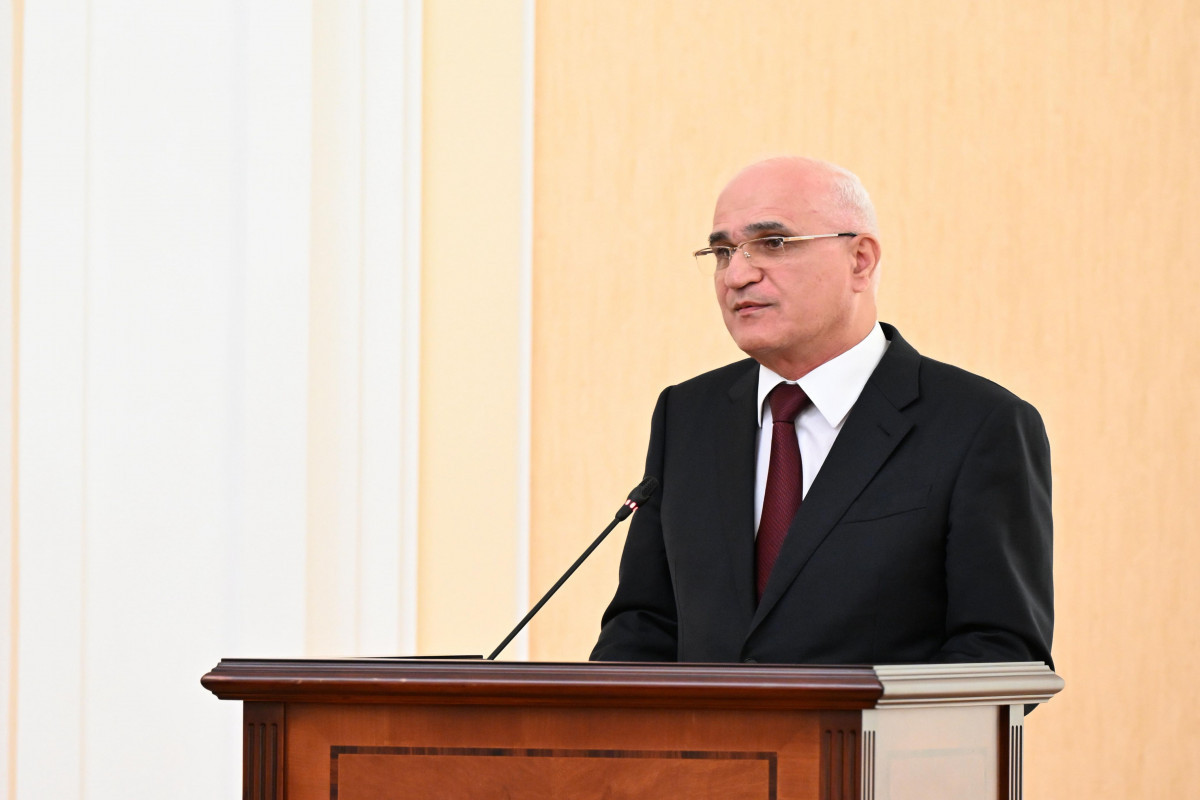

The implementation of the “Trump Route for International Peace and Prosperity” (TRIPP) connectivity project in the territory of Armenia has been agreed upon, said Deputy Prime Minister Shahin Mustafayev at a special meeting held at the Cabinet of Ministers dedicated to President Ilham Aliyev’s visit to Washington, APA reports.
The Deputy Prime Minister noted that this project is part of a plan initiated by President Ilham Aliyev to ensure the integration of regional transport communications that have been ongoing for many years: “Undoubtedly, one of the main strategic points of the project for our country is to ensure unobstructed movement from the main part of Azerbaijan to the Nakhchivan Autonomous Republic and in the opposite direction. The opening of the new corridor will serve the closer integration of Nakhchivan with other regions of our country. As is known, until the late 1980s, railway transportation was carried out along the specified route. At the same time, in the 1970s, at the personal initiative and support of the National Leader Heydar Aliyev, the implementation of the highway project along the Baku-Shirvan-Fuzuli-Jabrayil-Zangilan-Minjivan-Nuvadi-Meghri-Nakhchivan route was started for the first time. The 184 km section of this road located within Azerbaijan's territory has been rebuilt, reconstruction work has been carried out on a 200 km section of the existing road, construction work has been completed on the Minjivan-Nuvadi section, and it was put into use at the end of the 1980s. After the known events, at the end of the 1980s, railway operations and the construction of the highway in the territory of Armenia were halted. These works, which were initiated by the national leader Heydar Aliyev, are being successfully continued and realized by President Ilham Aliyev. The new transport corridor passing through Zangazur, which has great potential as an important trade route between Europe and Asia, will stimulate the development of transport connections in the region, as well as the expansion of trade and economic relations. With the implementation of the project, a new route will be opened that can play an important role in cargo transportation along the East-West international transport corridor through China, Central Asia, the Caspian Sea, Azerbaijan, Türkiye to Europe and in the opposite direction. At the same time, the new transport connection will promote the development of the North-South international transport corridor as one of its branches, especially serving to increase the efficiency of transportation between the Persian Gulf, the Black Sea, and the South Caucasus countries. The corridor is not just an infrastructure project but also a new economic artery connecting East with West, North with South. This corridor, as an alternative to existing routes, has a higher capacity."
Shahin Mustafayev noted that according to calculations, the opening of the corridor will increase the transit capacity of the Middle Corridor by 15 million tons per year. In addition, the corridor is a strategic bridge connecting the main territory of Azerbaijan with Türkiye and Eurasia, and at the same time will serve as a new artery linking Southeast Asia and the Persian Gulf with Northern European countries: “Azerbaijan has already implemented and is implementing a number of large infrastructure projects to realize its existing economic and transport potential. The Baku-Tbilisi-Kars railway and the Baku International Sea Trade Port are the main pillars of this strategy. The transport capacity of the Baku-Tbilisi-Kars railway has been increased up to 5 million tons per year, the annual cargo handling capacity of the Baku Port will be increased to 25 million tons by 2030, and the container capacity to 500 thousand containers. Additionally, the cargo terminal will strengthen multimodal transportation.”
The Deputy Prime Minister noted that the construction of the Horadiz–Aghbend railway began in 2021. Out of the total length of 110 kilometers, 76 kilometers have already been completed: “Alongside the railway, the construction of the Horadiz–Aghbend highway is also ongoing and 95 percent of it has been carried out. To accommodate the increasing volume of cargo, reconstruction works on the Nakhchivan railway and highways will be carried out in parallel. After the highways are opened, the Persian Gulf–Nakhchivan–Jabrayil–Fuzuli–Agdam–Yevlakh–Black Sea highway route will become a new route connecting the Persian Gulf to the Black Sea. Due to its climate and terrain, this route will operate year-round. One of the important infrastructure projects being implemented is the construction of automobile bridges over the Aras River. The new Aghbend–Kelala and Ordubad–Siyahrud automobile bridges will not only serve as additional connections linking Eastern Zangazur with Nakhchivan but will also enable large-scale international transportation between regional countries.”
Shahin Mustafayev stated that a few days ago, the construction of the Kars-Iğdır-Aralık-Dilucu railway line, which will connect Turkey with Nakhchivan, was also launched: “With a length of 224 km and providing access to European markets, this line will have an annual transport capacity of 15 million tons of cargo. Since it is located at the intersection of the East-West and North-South transport corridors and has significant infrastructure capabilities for the uninterrupted transportation of cargo, our country plays an important role in the transportation and transshipment of transit cargo in both directions. In this regard, our country has become a center for carrying, transshipping, and managing large volumes of cargo. Along with all this, the opening of communications will also reshape the energy map of the South Caucasus, especially increasing Azerbaijan’s role as an energy transit country to Europe and the world. The opening of communications is a historic opportunity for ensuring peace in the region. Azerbaijan, in turn, acts as a promoter of stability and cooperation in the region through this corridor. Thus, the implementation of the documents signed and agreements reached in Washington is not only about opening communications but also about ensuring stability and trust between states in our region.”


 Follow us on Telegram
 t.me/apanewsaz
 Follow us on Instagram
 Follow us on TikTok
 Follow us on Facebook
 Follow us on X